Argentina – Article: Front food labeling. A suture in the fragmented ordering of food security

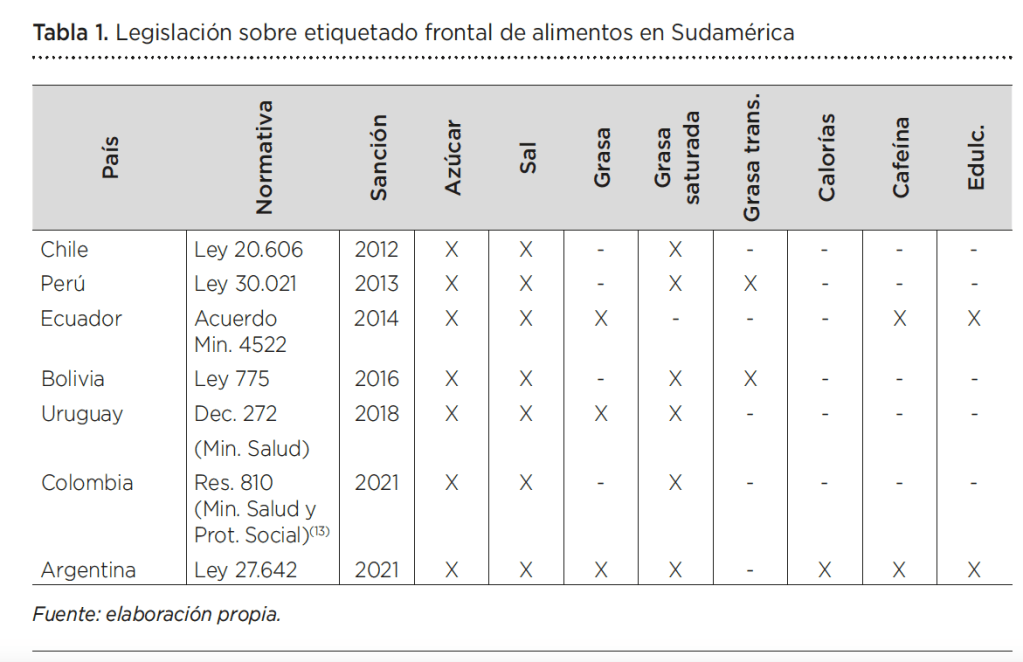
This work aims to reflect upon the debate over the Promotion of Healthy Nutrition legislation 27.642, better known as frontal labeling legislation. Through a critical reflexive methodology, the potential value of the legislation is presented, as a contribution to overcome the fragmentation of the food safety regulation. First, the notion of regulatory fragmentation is explained. This notion is taken as prior assumption and analysis key. Second, the main pillars of this legislation are presented, as well as their contribution to the advance in the human right to food. Legislation 27642 is located precisely in the intersection of the sub-sectors that the regulation is fragmented. It is a first attempt of a normative and inter-institutional dialogue. Then, two appreciations on the value of the law´s legislative debate are presented: the democratization of the food lawmaking process, and the advice on some critical points in the food law institutional design. Finally, some challenges that the legislation could face during the regulation process, are presented.
Chile – Article: National food and nutrition policy of Chile

The National Food and Nutrition Policy, was developed by the Ministry of Health of Chile in conjunction with other ministries, in 2017. This has an exempt resolution that is in force, which is No. 1864 of 2017. This Policy has two guiding principles: the human right to food and the social determination of food and nutrition. These concepts had not been explicitly considered in any public document until now. It is also oriented to the fulfillment of two Sustainable Development Goals, which are SDG 2 Zero Hunger and SDG 3 Health and Well-being.

Honduras – Article: Honduran Food and Nutritional Security Law

The Food and Nutritional Security Law of Honduras is being developed in a complex social and constitutional context. The same Law, in its recitals of creation in 2011, recognizes that food and nutritional insecurity affects a significant percentage of the population. Today in 2021, we have more than 70% of poor people in the country in conditions of no access, enjoyment, enjoyment and consumption of food in the quantity and quality necessary for the achievement of a dignified life and adequate development, which establishes this law in the year of its creation.

Jamaica: Standard Specification for Packaged natural coconut water

This document specifies the requirements for packaged natural coconut water offered for sale and consumption. This standard establishes the general, microbiological and labelling specifications for packaged natural coconut water offered for sale and consumption. This is specific to coconut water that has been packaged in its natural state without the use of additives.