Argentina – Article: Front food labeling. A suture in the fragmented ordering of food security

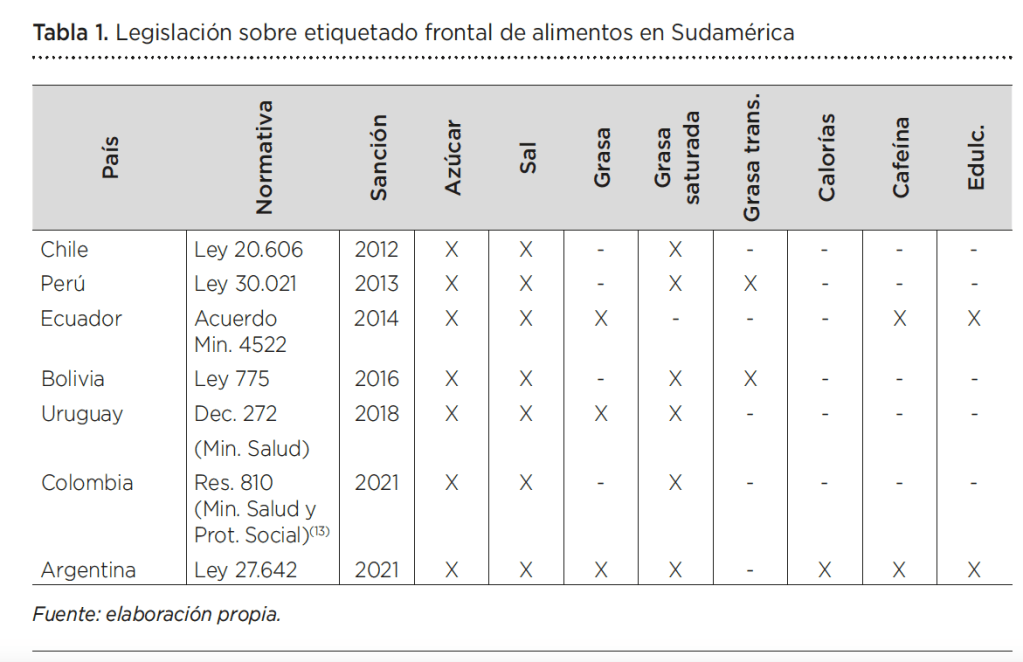
This work aims to reflect upon the debate over the Promotion of Healthy Nutrition legislation 27.642, better known as frontal labeling legislation. Through a critical reflexive methodology, the potential value of the legislation is presented, as a contribution to overcome the fragmentation of the food safety regulation. First, the notion of regulatory fragmentation is explained. This notion is taken as prior assumption and analysis key. Second, the main pillars of this legislation are presented, as well as their contribution to the advance in the human right to food. Legislation 27642 is located precisely in the intersection of the sub-sectors that the regulation is fragmented. It is a first attempt of a normative and inter-institutional dialogue. Then, two appreciations on the value of the law´s legislative debate are presented: the democratization of the food lawmaking process, and the advice on some critical points in the food law institutional design. Finally, some challenges that the legislation could face during the regulation process, are presented.
Chile – Article: National food and nutrition policy of Chile

The National Food and Nutrition Policy, was developed by the Ministry of Health of Chile in conjunction with other ministries, in 2017. This has an exempt resolution that is in force, which is No. 1864 of 2017. This Policy has two guiding principles: the human right to food and the social determination of food and nutrition. These concepts had not been explicitly considered in any public document until now. It is also oriented to the fulfillment of two Sustainable Development Goals, which are SDG 2 Zero Hunger and SDG 3 Health and Well-being.

Honduras – Article: Honduran Food and Nutritional Security Law

The Food and Nutritional Security Law of Honduras is being developed in a complex social and constitutional context. The same Law, in its recitals of creation in 2011, recognizes that food and nutritional insecurity affects a significant percentage of the population. Today in 2021, we have more than 70% of poor people in the country in conditions of no access, enjoyment, enjoyment and consumption of food in the quantity and quality necessary for the achievement of a dignified life and adequate development, which establishes this law in the year of its creation.

Article – Brazil: Incorporation of the NOVA classification into scientific production on food and nutrition in Latin America: a scientometric review

Introduction. In 2009, a food classification was proposed, called NOVA classification. Latin American countries have stood out in their use in nutritional recommendations and regulatory agenda. Objective. To evaluate how scientific production in food and nutrition in Latin America has incorporated the NOVA classification. Materials and methods. The analysis of scientific production was carried out from annals at the Latin American Congress of Nutrition (SLAN) in 2012, 2015 and 2018. The terms used for the search were: NOVA, ultra-processed, processed, processing and food guide, in Portuguese, English and Spanish. After the search, the exclusion and inclusion criteria were applied and the selected abstracts were described according to previously defined analytical variables. Results. A total of 153 were analyzed, 24 of which were published in 2012, 20 in 2015 and 109 in 2018. Most studies were carried out in Brazil (56,2%), followed by Mexico (12,4%) and involved adolescents (28,8%), adults (21,6%) and food (19,6%) as subject or unit of analysis. Most of the works were classified in the area of Public Health Nutrition (88,9%), were observational (82,3%) and used a quantitative method (76,5%). The sale and/or consumption of food (46,4%) and the food environment (24,2%) were the most common objects of study. Conclusion. The scientific production that considers the NOVA classification in Latin America increased in 2018, with Brazil and Mexico leading the development of studies. Studies that explore the relationship of NOVA classification to food price, culinary skills and public policy analysis are research opportunities. Arch Latinoam Nutr 2022; 72(2): 109-124.

Final paper – Brazil: Nutritional labeling in Brazil: history and perspective

The adoption of alternative labeling models to improve the effectiveness of information presented to food consumers has been occurring in Brazil and worldwide due to the increased prevalence of chronic non-communicable diseases, in addition to the existence of scientific evidence that the nutritional table is difficult to see, understand and use for most consumers. In this context, the objective of this narrative review is to present the history, motivations, objectives, and perspectives related to changes in nutrition labeling legislation planned for 2022 in Brazil. The sample consisted of 98 references searched in the Scielo, Capes and Google Academic databases, using the descriptors “labelling”, “nutrition labeling”, “front nutrition labeling” and “front labeling”, “Impacts of nutrition labeling”, ” new nutritional table”. The first regulation on the labelling of packaged foods emerged in 1969, but it was only in 1998 that nutritional labeling was regulated in Brazil. Since then, new legislations have been published and improved over the years, culminating in the publication in 2020 of Collegiate Resolution number 429 and Normative Instruction number 75, which bring greater rigor to the standard of the nutritional table and implement the nutritional frontal labeling in loupe format. After the implementation of these legislations, positive impacts are expected in the reformulation of products, in the understanding of the labeling and composition of foods by the population, consequent healthier food choices and improvement in the population’s epidemiological profile in the long term.