Articles – Chile: On the Design of Food Labeling Policies

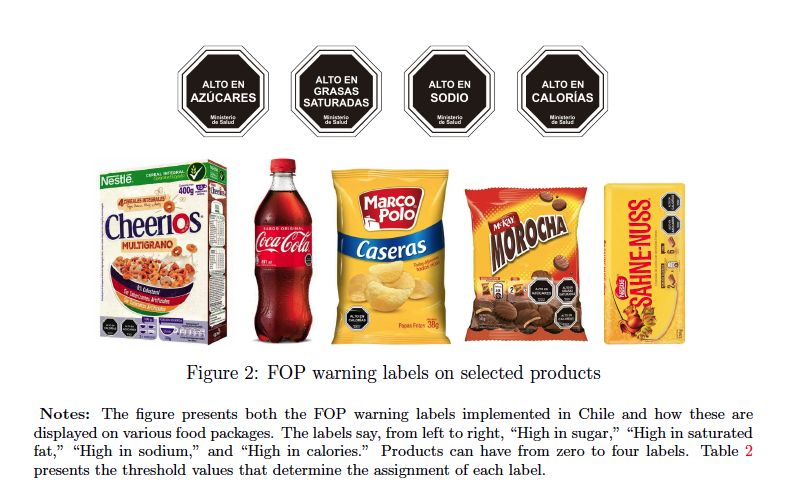
We study a regulation in Chile that mandates front-of-package warning labels on products whose sugar or caloric concentration exceeds certain thresholds. We document an overall decrease in sugar and caloric intake of 7-9%. To unpack the underlying mechanisms, we provide descriptive evidence of the impact of the policy on consumer choice, both across and within categories and firms’ behavior. We  find no noticeable substitution of products across food categories and show that most of the demand effect of the regulation comes from within-category substitution. We also find that a substantive portion of the overall effect comes from product o reformulation. We discuss how these  findings can inform the design of effective labeling policies.
The Americas – Brazil: Congressman introduces gluten amendment bill for food labeling regulation

Bill 907/22 has been introduced in Congress, which aims to modify the regulation on labeling of processed foods to include the following warning: “contains gluten – harmful to the health of consumers with celiac disease” or “does not contain gluten”.

Currently, the law defining the labeling of products containing gluten (Law 10.674/03), which establishes that industrialized foods must contain on their label and insert, mandatorily, only the inscriptions “contains gluten” or “does not contain gluten”.

The Americas – Brazil: Consultation project on regulation of the Beverage Law

The Ministry of Agriculture, Livestock and Supply (Mapa) published the Ordinance Nº 562 of July 1994 (Beverage Law) which provides for the standardization, classification, registration, control, production and inspection of beverages.

The proposed new regulation of the Beverage Law focuses on identity and quality requirements, which involve the composition and labeling of beverages; technological requirements, which involve the controls of the processes of the establishments to offer products with quality and safety; and administrative procedures, which involve the inspection and registration carried out by Mapa.

Article – Costa Rica: The superiority of front-of-package warning label in Costa Rica

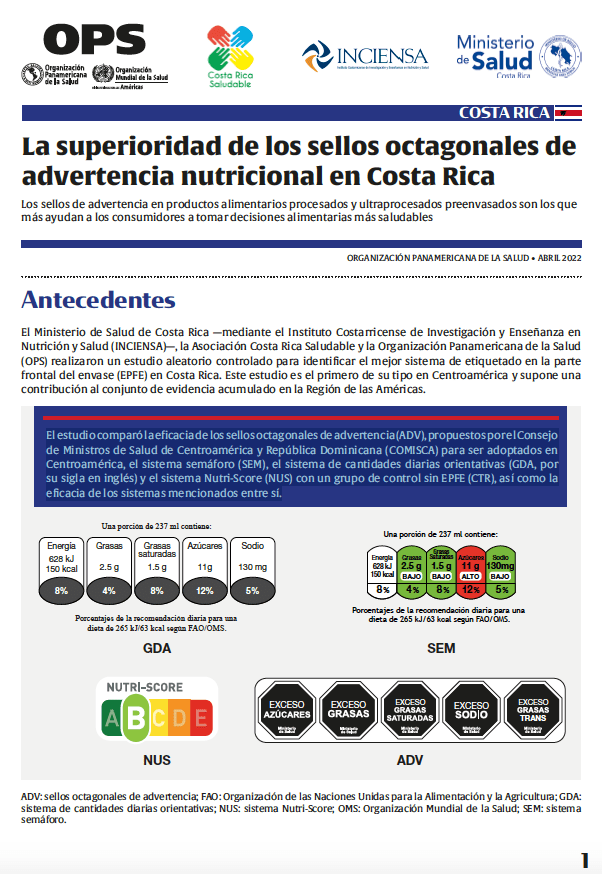
The study compared the efficacy of the octagonal warning stamps (ADV in Spanish), proposed by the Council of Ministers of Health of Central America and the Dominican Republic (COMISCA in Spanish) for adoption in Central America, the traffic light system (SEM in Spanish), the guideline daily amounts system (GDA) and the Nutri-Score system (NUS) with a control group without EPFE (CTR), as well as the efficacy of the aforementioned systems with each other.

Articles – Brazil: Changes brought about by the new nutrition labeling of packaged foods: a review

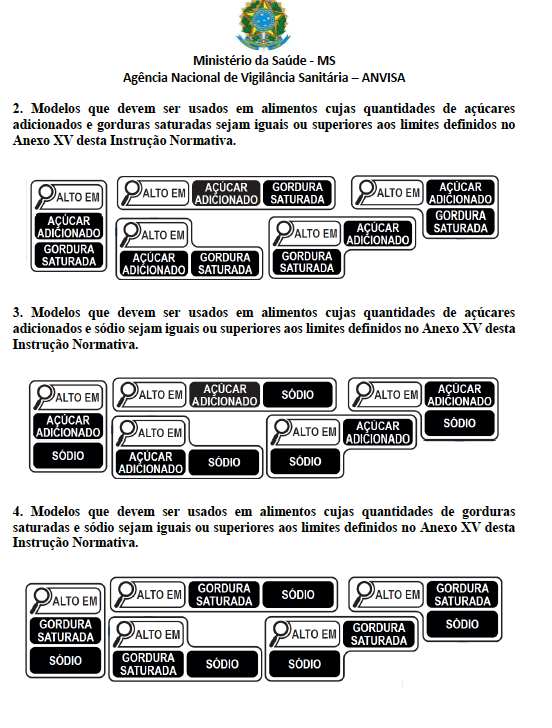
Nutrition labeling of packaged foods is essential to promote public health, proper and healthy eating, and to combat obesity and chronic non-communicable diseases. Despite this, the information used on food labels can be difficult for consumers to understand, raising doubts about their healthfulness. In this context, it is necessary to use information that is easy to understand for laymen, such as front-of-package nutrition labeling, used in more than 40 countries and approved in Brazil through Resolution RDC No. 429/2020 (nutrition labeling of packaged foods) and Normative Instruction No. 75/2020 (technical requirements for the declaration of nutrition labeling of packaged foods). In view of the above, the objective of the present review was to compare the new legislation for nutrition labeling of packaged foods and the repealed resolutions, focusing on changes in the table of nutrition information, nutrition claims and the introduction of front nutrition labeling on food labels.