Article – Is nutrition labeling associated with decreased obesity? A quantitative approach to nutritional health policy in Ecuador

Few studies assess consumer response to nutrition labeling, especially in less-developed countries. We analyzed the link between nutrition labeling and obesity in Ecuador using a representative cross-sectional sample of 29,770 individuals from the National Health and Nutrition Survey (ENSANUT) in 2018. Nutrition labeling reduced the probability of obesity in adolescent (12–18 years old) and adult (18–59 years old) people by 4% (CI: − 5.7, − 2.2) and 8.4% (CI: − 12.7, − 4.0), respectively. The magnitude of average treatment effect of using nutrition label on obesity ranged from 0.90 (CI: − 1.299, − 0.500) to 1 (CI: − 1.355, − 0.645) BMI points for adolescent, and from 1.16 (CI: − 1.554, − 0.766) to 1.80 (CI: − 2.791, − 0.811) BMI points for adult. The effect of nutrition labeling is greater among the less obese. We recommend that health policy makers and clinicians continue to promote nutrition labeling especially where obesity is not chronic, where nutrition labeling is most successful.

Brazil: Nutrition labeling: new rules to take effect in 75 days

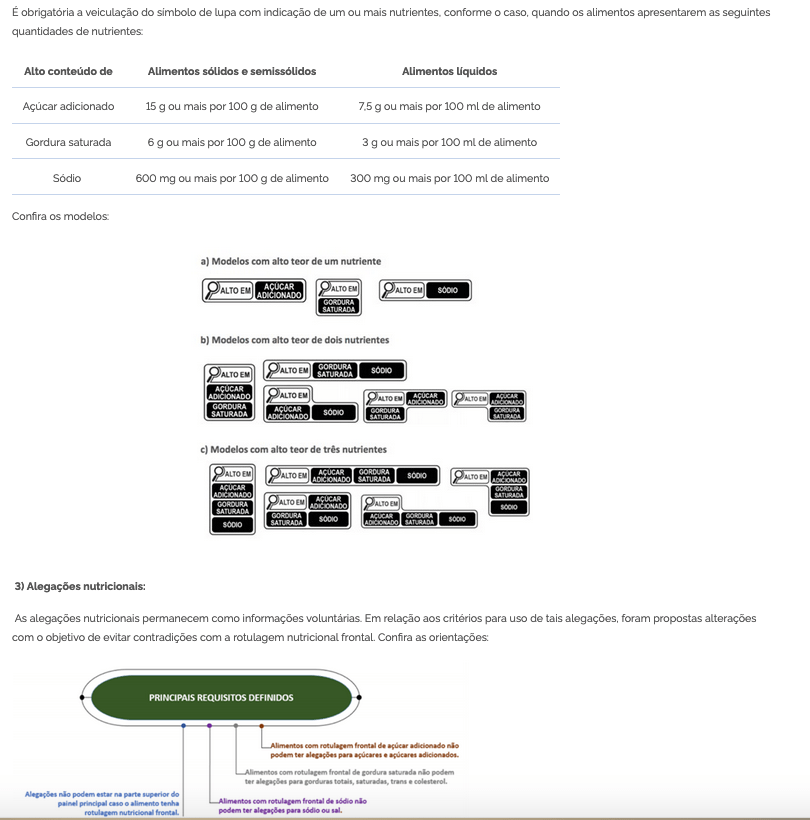
The new rules for food labeling come into force on October 9, 2022. In addition to changes to the table of nutrition information and claims, the novelty will be the adoption of front-of-pack nutrition labeling.

Front-of-pack nutrition labeling

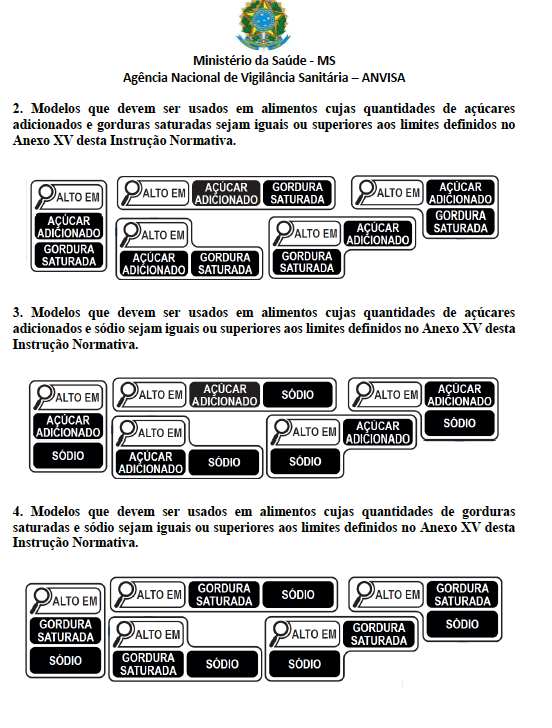
Considered the major innovation of the new regulation, front-of-pack nutrition labeling is an informative symbol that must appear on the front panel of the package. The idea is to clarify to the consumer, in a clear and simple way, the high content of health-relevant nutrients.

Brazil: Nutrition labeling: new rules take effect in 120 days

The new rules (RDC No. 429 and Normative Instruction No. 75) for food labeling come into force on October 9, 2022. In addition to changes in the table of nutritional information and claims, the novelty will be the adoption of front-of-line nutrition labeling.

Therefore, it is important for companies to be aware of the deadline for compliance. New products launched on or after October 9, 2022 must already have labels suitable for the new rules. For products already on the market to date, the deadlines for adaptation are:

  • Until October 9, 2023 (12 months from the effective date of the rule) for food in general;
  • Until October 9, 2024 (24 months from the effective date of the standard) for foods produced by a family farmer or rural family entrepreneur, solidarity economic enterprise, individual micro-entrepreneur, small agro-industry, artisanal agro-industry and artisanal foods; and
  • Until October 9, 2025 (36 months from the effective date of the standard) for non-alcoholic beverages in returnable containers, observing the gradual process of label replacement. The labeling changes were established by Resolution of the Collegiate Board of Directors – DRC No. 429 and Normative Instruction No. 75, published in October 2020. The objective of the standards is to improve the clarity and legibility of food labels and, thus, help the consumer to make more conscious food choices.

Articles – Brazil: Changes brought about by the new nutrition labeling of packaged foods: a review

Nutrition labeling of packaged foods is essential to promote public health, proper and healthy eating, and to combat obesity and chronic non-communicable diseases. Despite this, the information used on food labels can be difficult for consumers to understand, raising doubts about their healthfulness. In this context, it is necessary to use information that is easy to understand for laymen, such as front-of-package nutrition labeling, used in more than 40 countries and approved in Brazil through Resolution RDC No. 429/2020 (nutrition labeling of packaged foods) and Normative Instruction No. 75/2020 (technical requirements for the declaration of nutrition labeling of packaged foods). In view of the above, the objective of the present review was to compare the new legislation for nutrition labeling of packaged foods and the repealed resolutions, focusing on changes in the table of nutrition information, nutrition claims and the introduction of front nutrition labeling on food labels.

Articles – Brazil: The importance of food and nutrition labeling for consumer food autonomy

Food and nutrition labeling is a strategic tool of the Ministry of Health (MS) allied to the National Health Surveillance Agency (ANVISA), developed with the aim of minimizing consumer exposure to industry abuse and misleading information; promote resources for access to more adequate, healthy and safe food, reduce rates of obesity, overweight and food insecurity; and for / beyond the prevention of chronic non-communicable diseases (NCDs).

This research aims to highlight the importance of labeling in promoting consumer autonomy for healthier food choices through nutrition education, reading and proper understanding of labels. It is a literature review, which sought guidelines on mandatory food labeling based on current Brazilian legislation, available on the ANVISA website, of which three resolutions were used.