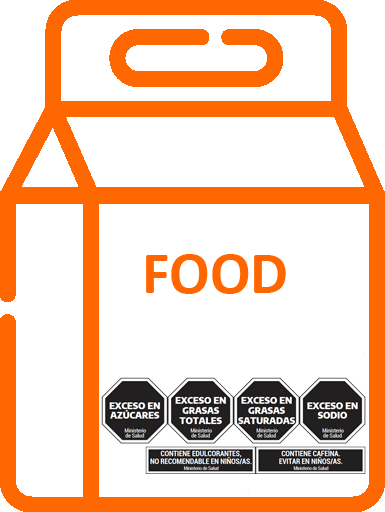
The Americas – Argentina: Concern in the business sector over the “extra cost” of the front labeling law

Jorge Pittón, said that it will have to comply with this regulation, since it will be a requirement to be able to enter supermarket chains and wholesalers. However, he pointed out that for small and medium-sized companies, making a new cliché for each package -the gum used to print the wrappers- implies a significant investment.

The Americas – Argentina: Front-end labeling regulation to be published by end of March

According to official sources, the text of the regulation has already been defined; it will be published at the end of March and contains details on deadlines, as well as some concessions to the industry.

The implementation will take place in two stages. The first one will be in force until the end of the year and will have broader parameters than the final scheme, which should be fully in force in 2023. The regulation provides for a special deadline for companies that distribute beverages in returnable glass containers. According to the firms in the sector, it is necessary to paint the black octagons on the millions of bottles circulating in the country. In the meantime, it was decided that the warnings referring to these products will be covered by advertisements on the sales shelves.

An important point is that the deadlines are established as from the entry into force of the law and not from the publication of the regulation.

The Americas – Argentina: Food additives: challenges for the domestic industry

“The food additives market. Possibilities of development for the national industry” is a work carried out by the National Institute of Industrial Technology (INTI in Spanish), through the Industrial Economics and Prospective Studies Unit belonging to the Institute’s Planning and Commercialization Directorate.

The Americas – Argentina: The INV has defined a new wine product: a drink made of must and wine

By Resolution 02/2022, the National Institute of Viticulture (INV in Spanish) defined a new wine product called Must and Wine based beverage or Must and Wine based product. It is obtained from a minimum of 50% of the sum of must and wine, to which sweeteners, colorants, flavorings, alcohol and food quality products duly authorized by the competent body may be added.

The labeling of these new products must be in accordance with the regulations in force for wine products, and the percentages of the non-wine compounds of which they are composed must also be indicated.

The Americas – Argentina: Authorities remain tight-lipped on content of front-of-package food labeling regulation

Sources from the Ministry of Health assure that the draft is “in the final agreement stage” with the institutions “that participate in the development stage as well as in the subsequent implementation stage”. They do not specify when the final text will be known.

The Ministry of Health confirms that the regulation has been developed under an inter-sectorial agenda with all the actors involved; ministries and public bodies, civil society organizations, representatives of the industry chambers. All voices have been heard in order to carry out a responsible and comprehensive regulation, which allows the correct implementation of a public policy that promotes healthy habits and access to information in a clear and timely manner”.

Among the aspects that remain to be defined, an important one is the calorie seal. On this there is information, although incomplete: “The enforcement authority defined that in food and alcoholic beverages the application of the seal ‘excess calories’ will apply if they have at least one seal of excess sugars and/or total fat and/or saturated fat and when the energy value limits are equal to or greater than those established in Article 6” of the Law on Front Labeling.