In this paper we will address the right to proper nutrition, focusing on its regulation in the International Covenant on Economic, Social and Cultural Rights and we will examine one aspect of this right: food labeling. Accordingly, we will mention the different labelling models used in the world pointing out the complexity and challenges this right present in accomplishing its full effectiveness. Also, we will make a particularized analysis of the Argentinean’s Act 27642 of Healthy Food Promotion (known as “labelling law”), its legislative backgrounds and the protection of vulnerable groups. Then, we will make a critical analysis on where the Argentinean’s proper nutrition right stands. Finally, we will conclude that accomplishing the effectiveness of proper nutrition right re quires a great challenge that demands not only regulatory measures of the normative type (suchas the labelling law) but also concrete, continuous, intense, clear, and interdisciplinary measures. Thus, although labelling law is a big step towards that goal, it cannot solve the problem by itself because it demands a continuous social, political, and economic commitment.
argentina
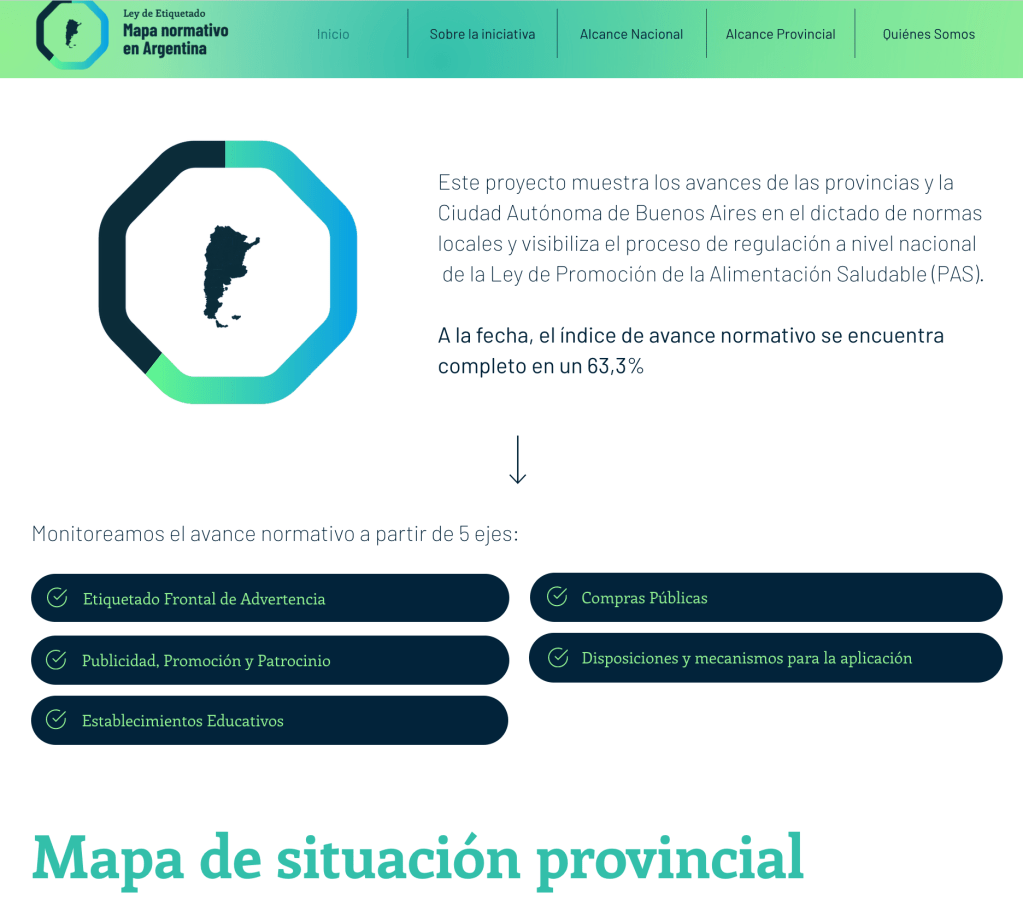
Argentina – Progress made by the provinces and the Autonomous City of Buenos Aires on the national regulation process of the Law for the Promotion of Healthy Eating (PAS)
This project shows graphically the progress of the 23 provinces and the Autonomous City of Buenos Aires (CABA in Spanish) in the enactment of local regulations governing the implementation of the Law on Promotion of Healthy Eating (PAS in Spanish) in the jurisdictions, and makes visible the process of regulation at the national level. It seeks to be a tool to promote and strengthen the full implementation of the law in all territories of Argentina.
Argentina: Authorities set date for the implementation of front-of-package warning label
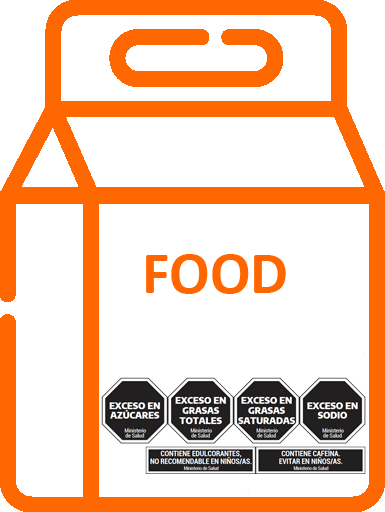
As from August 20, supermarkets and large chains will have to display on their shelves products with their respective black front labels to warn consumers if the product in question has excess sugars, total fat, saturated fat, calories and sodium within the framework of Law 27,642 on Front Labeling, published in the Official Gazette in November 2021.
The Ministry of Health reported that 35% of the 2,658 extension requests for the implementation of the labels were approved. The main items that were submitted are candies, jams, jellies, jams and jams (21.62%); bakery products and cookies (15%); sausages and canned meats (14.45%); dairy products (11.27%); alcoholic beverages (10.63%); processed fruits and vegetables (7.39%). Also cereals and pastas (6.55%); sauces and dressings (5.19%); desserts and powders for preparations (2.96%); snacks (2.16%); ice cream (1.09%); soups and broths (1.02%); coffee and tea (0.67%).

The Americas – Argentina: Medical cannabis and industrial Hemp Bill approved
The initiative, which has been approved by the Senate, creates the regulatory framework for the production and national commercialization for export of the cannabis plant, its seeds and derived products for medicinal use, including scientific research and industrial use, promoting the development of the sector’s production chain.
In addition, a regulatory agency, the Agencia Regulatoria del Cáñamo y del Cannabis Medicinal (ARICCAME in Spanish), will be created. It will regulate the import, export, cultivation, industrial production, manufacture, commercialization and acquisition of seeds, the cannabis plant and its derivative products for medicinal or industrial purposes.

The Americas – Argentina: Products included and excluded by the Healthy Eating Promotion Law
Including
- Analcoholic beverages and foods that are sold packaged and that during their manufacturing process have added sugars, sodium, fats or ingredients containing them.
- Packaged products containing sweeteners or caffeine.
Excludes
- Products without added sugars, fats and/or sodium that do not contain sweeteners and/or caffeine.
- Dietary supplements, foods for specific medical purposes or formulas for infants, children up to 36 months of age.
- Alcoholic beverages.
- Products not packaged and/or not packaged for sale to the public.
- Sugars, herbs, dried fruits, vegetable oils and common table salt.
- Food prepared in restaurants or gastronomic stores.
- Fractioned products at the point of sale and retailed at the consumer’s sight.
 infoAlimentario