Mexico – Proposal in the Chamber of Deputies that sugar-sweetened beverages should warn that excessive consumption can cause obesity and diabetes

Congressman Alcántara Martínez (PT) is promoting an initiative to reform the General Health Law.

Congressman Leobardo Alcántara Martínez (PT) is promoting an amendment to the General Health Law to establish that the labeling of sugary drinks in excess must include a legend warning about the harmful effects caused by their excessive consumption, such as obesity and diabetes.

The initiative that amends Articles 212 and 215 of said legal norm, submitted to the Health Commission for its opinion and to the Economy, Commerce and Competitiveness Commission for its opinion, also proposes that the front labeling of food and non-alcoholic beverages should warn about the ailments associated with the consumption of these products.

In the explanatory memorandum, it recognizes that, in spite of the institutional efforts of the Mexican State to combat the overweight and obesity epidemic, “the data are still alarming”. The National Health and Nutrition Survey (ENSANUT) 2018-2019 points out that overweight and obesity continue to be a problem that is highly present in all age groups and regions of the country, as well as in urban and rural areas.

Article – Editorial: Strengthening food labeling policies in Brazil

Food labeling policies can have different purposes, but consumers’ right to protection, human rights to health and to adequate food, the rights of the child and all other interdependent human rights prevail. For this reason, research that seeks to inform the best policy options in fulfilling, protecting, and respecting these rights is paramount.

Brazil is known for novel research and action that have led to great advance of knowledge and policies on nutrition and health globally. Different sorts of edible and drinkable products have been historically defined as foods and manufactured and labeled to mimic foods.

Unhealthy edible and drinkable commodities industry have insisted on the use of market-forged categorization of products with the purpose of demonstrating an artificial diversification of alike products, for which labeling has been an instrument of consumer deception.

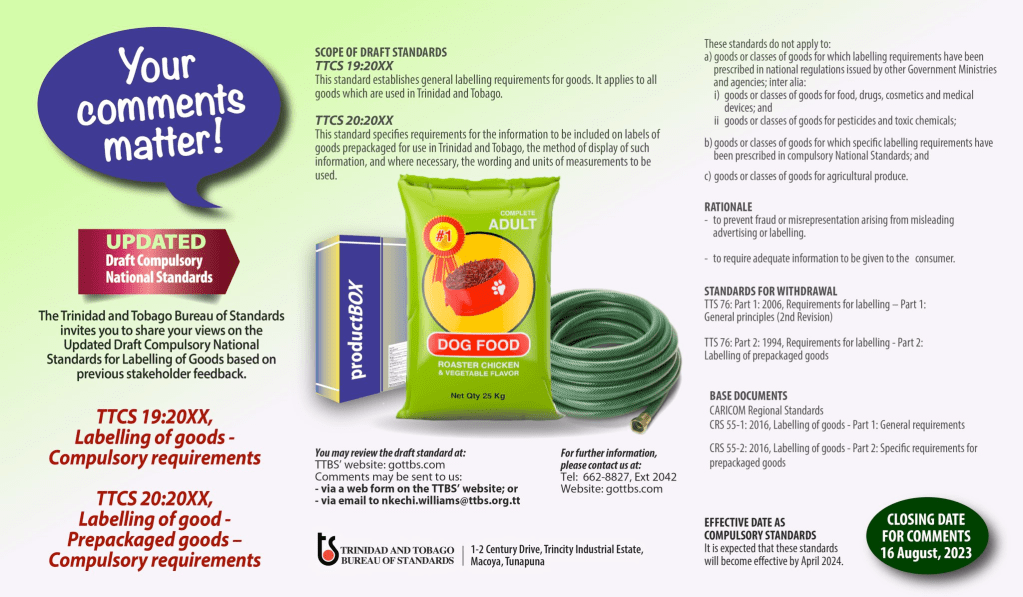
Trinidad and Tobago – Standards on Labelling of goods – Prepackaged goods – Compulsory requirements

The Trinidad and Tobago Bureau of Standards published Labelling of goods – Prepackaged goods – Compulsory requirements.

This standard specifies requirements for the information to be included on labels of goods prepackaged for use in Trinidad and Tobago, the method of display of such information, and where necessary, the wording and units of measurements to be used.


This standard does not apply to the following:


a) goods or classes of goods for which labelling requirements have been prescribed in
national regulations issued by other Government Ministries and agencies; inter alia:
i) goods or classes of goods for food, drugs, cosmetics and medical devices;
ii) goods or classes of goods for pesticides and toxic chemicals.
b) goods or classes of goods for which specific labelling requirements have been
prescribed in compulsory National Standards; and
c) goods or classes of goods for agricultural produce.

Canada – Health Canada’s strategy to manage shortages of infant formula and other foods for a special dietary purpose and to modernize related regulations

The purpose of this notice is to announce Health Canada’s strategy to continue addressing shortages of infant formula and other foods for a special dietary purpose by extending the Interim policy on the importation and sale of infant formulas, human milk fortifiers and dietary products for the treatment of inborn errors of metabolism to mitigate shortages. This notice also communicates Health Canada’s commitment to initiate work on the modernization of the regulations for infant formula and other foods for a special dietary purpose and the department’s plans for a public consultation in the fall of 2023.

USA – FDA Releases Draft Compliance Policy Guide on Major Food Allergen Labeling and Cross-Contact

The U.S. Food and Drug Administration (FDA) has released a draft Compliance Policy Guide to provide guidance for FDA staff on the FDA’s enforcement policy regarding major food allergen labeling and cross-contact.  The draft CPG more accurately reflects FDA’s thinking on major food allergen enforcement policy based on the current regulatory framework and latest science. When finalized, it will replace the existing CPG 555.250 for FDA staff.

Among the updates, the draft CPG describes the labeling requirements for major food allergens and the proper use of the ingredient list and the “Contains” statement for major food allergen declarations. It also describes requirements for firms to implement controls to prevent or significantly minimize allergen cross-contact. Further, the draft CPG describes additional allergen labeling violations. It also directs FDA staff to examine potential product adulteration due to allergen cross-contact as well as potential labeling violations. The updated CPG reflects the FDA’s risk-based and science-based approach for the evaluation of potential allergen violations.