Packaging plays a key role in the food industry due to its various functions, in addition to contributing as a source of information to consumers. In order to promote the protection of the health of the population, RDC n° 429 was published in 2020, whose objective is to establish a new standard on nutritional labeling of foods to evolve, improve the clarity and readability of the nutritional information on food labels. foods. The main alteration of this legislation is the establishment of panels on the front label of packaged products, which are information symbols instituted to inform the consumer about the high content of nutrients (sugar, fat and sodium). In this context, the objective was to evaluate the progress of changes that must be carried out by the food industry in relation to the elaboration of new labels, following the new labeling legislation, as well as the impact of these changes.
The Americas
Regulatory news in the Americas
Jamaica – Bureau of Standards Jamaica published draft Standard Specification for Rice
This standard establishes requirements for grades of paddy, cargo rice, milled rice, cargo parboiled rice, and milled parboiled rice. It also specifies the general conditions for sampling and the methodologies for assessing the various factors used in the determination of the quality of rice. This standard is a modified adoption of CRS 44: 2013. A modified adoption of the standard was conducted to include additional labelling requirements such as the declaration of grades for packaged rice for retail sale.
The new standard is intended to provide assurance that adequate health and safety controls exists for the intended consumers.; Consumer information, labelling; Protection of human health or safety.
Argentina – Agave syrup is included in the Argentine Food Code
The Secretariat of Agriculture, Livestock and Fisheries and Secretariat of Quality in Health publish Joint Resolution 17/2023.
ARTICLE 1º.- Article 778 sixth is hereby incorporated to the Argentine Food Code in Chapter X: “Sugary Foods”, which shall be worded as follows: “Article 778 sixth: Agave syrup is understood as the syrup produced by hydrolysis from fructans (polysaccharides consisting of fructose units with or without a terminal or internal glucose unit joined by ß-2,1 and/or ß-2,6 type glycosidic bonds) coming from plants of the agavaceae family (Agavaceae).
Mexico – Proposal in the Chamber of Deputies that sugar-sweetened beverages should warn that excessive consumption can cause obesity and diabetes
Congressman Alcántara Martínez (PT) is promoting an initiative to reform the General Health Law.
Congressman Leobardo Alcántara Martínez (PT) is promoting an amendment to the General Health Law to establish that the labeling of sugary drinks in excess must include a legend warning about the harmful effects caused by their excessive consumption, such as obesity and diabetes.
The initiative that amends Articles 212 and 215 of said legal norm, submitted to the Health Commission for its opinion and to the Economy, Commerce and Competitiveness Commission for its opinion, also proposes that the front labeling of food and non-alcoholic beverages should warn about the ailments associated with the consumption of these products.
In the explanatory memorandum, it recognizes that, in spite of the institutional efforts of the Mexican State to combat the overweight and obesity epidemic, “the data are still alarming”. The National Health and Nutrition Survey (ENSANUT) 2018-2019 points out that overweight and obesity continue to be a problem that is highly present in all age groups and regions of the country, as well as in urban and rural areas.

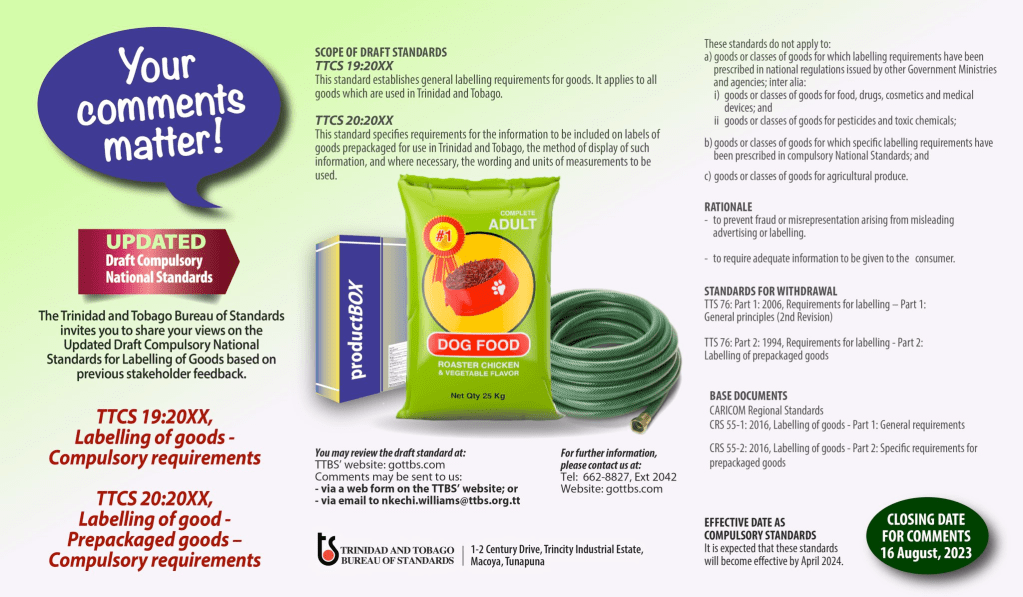
Trinidad and Tobago – Standards on Labelling of goods – Prepackaged goods – Compulsory requirements
The Trinidad and Tobago Bureau of Standards published Labelling of goods – Prepackaged goods – Compulsory requirements.
This standard specifies requirements for the information to be included on labels of goods prepackaged for use in Trinidad and Tobago, the method of display of such information, and where necessary, the wording and units of measurements to be used.
This standard does not apply to the following:
a) goods or classes of goods for which labelling requirements have been prescribed in
national regulations issued by other Government Ministries and agencies; inter alia:
i) goods or classes of goods for food, drugs, cosmetics and medical devices;
ii) goods or classes of goods for pesticides and toxic chemicals.
b) goods or classes of goods for which specific labelling requirements have been
prescribed in compulsory National Standards; and
c) goods or classes of goods for agricultural produce.
 infoAlimentario