Around the World – Spain: Authorities relax labeling rules in response to supply shortages

The Council of Ministers has approved a Royal Decree Law containing exceptional measures on food labeling, as a consequence of the reduction in the supply of some raw materials caused by the war in Ukraine.

The rule will allow companies to relabel products whose composition has been reformulated while the availability of certain resources is compromised for reasons of supply.

Operators will therefore be able to use adhesive labels or stickers, ink-jet printing or other equivalent systems. The mandatory requirement is that they contain updated information on the ingredients replacing those previously used.

Around the World – Ireland: Guidance on Food Labelling Challenges Caused by the Crisis in Ukraine and Russia

Due to the current crisis in Ukraine and the sanctions on Russia and Belarus, the Food Safety Authority of Ireland (FSAI) is aware that food business operators (FBOs) may be experiencing difficulties regarding the supply of some foods, in particular, sunflower oil, but also other raw materials and ingredients used for the production of certain foods. This may result in FBOs having to omit or substitute certain ingredients or change the manufacturing process or recipe, at short notice.

Guidance for FBOs on the food labelling flexibility has been prepared by the FSAI. The flexibility permits the use of additional stickers or inkjet printing to be over labelled on existing food labels.

Around the World – Ireland: Warning Against Using Rice Milk for Infants and Young Children

The Food Safety Authority of Ireland (FSAI) today reiterates its advice that infants and young children up to 4.5 years old should not consume rice milk as substitutes for cows’ milk, breast milk or infant formula. The FSAI previously provided warnings on the dangers of such products due to findings that indicated that there are low levels of inorganic arsenic found in rice milk. It has come to the FSAI’s attention that a rice-based infant and follow-on formula, Prémibio Prémiriz is available to buy online via a co.uk website. Such infant formulas are not legally permitted to be sold on the European market, as they do not meet the legal compositional and nutritional requirements for infants. The FSAI is in contact with authorities in the UK and other Member States to discontinue the sale of this product in Europe from this website. The FSAI is contacting the relevant hospitals and public health professionals to inform them of these online sales.

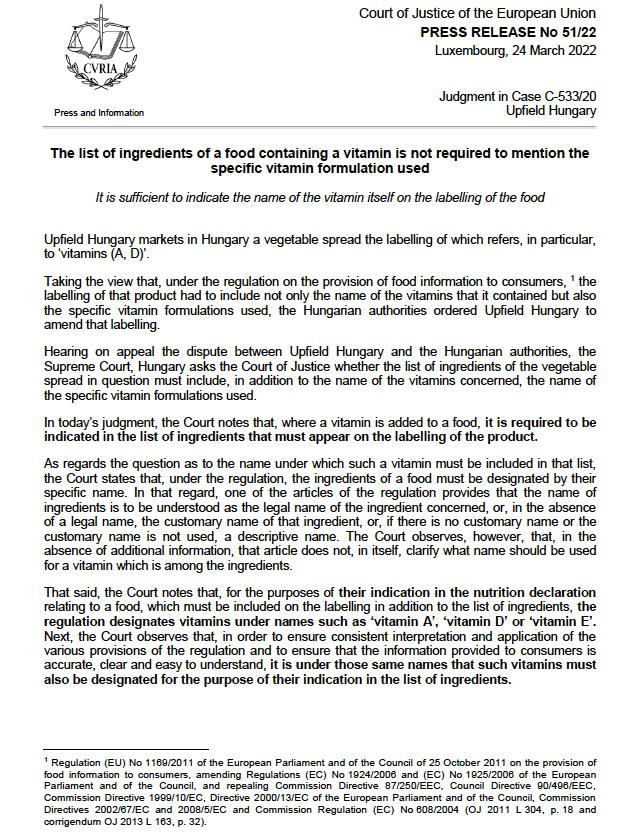
Around the World – EU: EU Court of Justice ruling on the labeling of vitamin formulas

On March 24, press release No. 51/22 of the Court of Justice of the European Union was published in relation to the judgment in case C-533/20 Upfield Hungary, which concludes that “the list of ingredients of a food containing a vitamin does not have to mention the specific vitamin formula used. It is sufficient to include an indication of the name of the vitamin on the label of the food”.

Around the World – EU: Monitoring the presence of furan and alkylfurans in food

COMMISSION RECOMMENDATION (EU) 2022/495

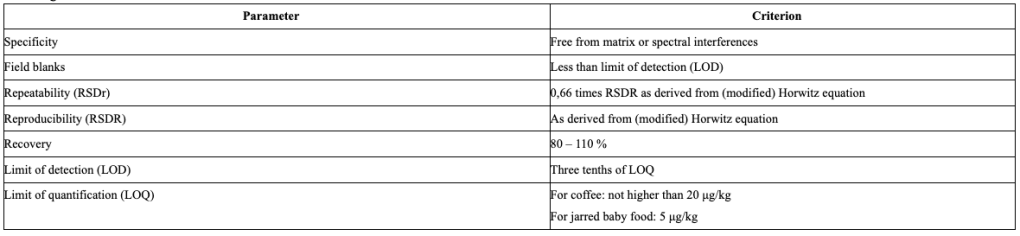
  1. Member States should, with the active involvement of food business operators, monitor furan, 2-methylfuran and 3-methylfuran in food, in particular in coffee, jarred baby food (including baby food in containers, tubes and pouches), ready-to-eat soup, potato-based crisps, fruit juices, breakfast cereals, biscuits, crackers and crispbread.
  2. To ensure that the samples are representative, Member States should follow the sampling procedures laid down in part B of the Annex to Commission Regulation (EC) No 333/2007 Food business operators should also apply this sampling procedure or an equivalent sampling procedure, ensuring the sample is representative.
  3. For the analysis of furan, 2-methylfuran and 3-methylfuran in coffee and jarred baby food, Member States and food business operators should use a method that complies with the following criteria: