Uruguay Food Additive Regulation Changes: Meats and Soft Drinks

The government of Uruguay announces Draft Resolution GMC Nº 03/24 “Modification of GMC Resolutions Nº 09/06 and 63/18 on Food Additives”.
The draft resolution proposes the modification, under certain conditions, of rosemary extract, INS 392, to GMC Resolution Nº 63/18 on additives and their limits in meat and meat products, and of jagua blue additive (genipin-glycine), INS 382, to GMC Resolution Nº 09/06 on aerated and non-aerated non-alcoholic beverages. The text specifies the function for which these additives are admitted in the indicated product categories, as well as their acceptable concentration limits, based on the toxicological evaluations carried out by the Joint FAO/WHO Expert Committee on Food Additives (JECFA).

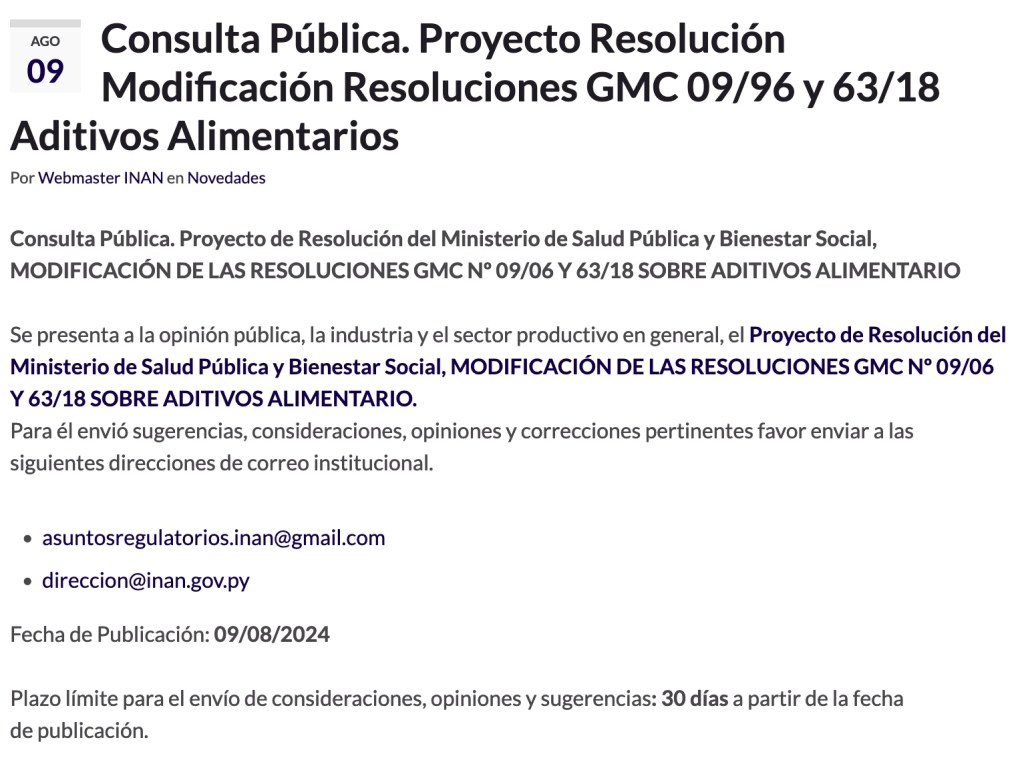
Paraguay – INAN announces public consultation on modification of GMC Resolutions 09/96 and 63/18 Food Additives

The National Institute of Food and Nutrition (INAN in Spanish) published the Draft Resolution for the Modification of Resolutions GMC 09/96 and 63/18 Food Additives. The draft aims to include the additive rosemary extract, INS 392, with antioxidant function, with limit 0.015 g/100 g and with the note “expressed as the sum of carnosic acid and carnosol” in Food Category 8 – Meat and Meat Products, subcategories 8. 2.1.1 Fresh Sausages; 8.2.1.2 Dried Sausages; 8.2.1.3 Cooked Sausages; 8.2.2.1 Raw salted meats; 8.2.2.2.2 Cooked salted meats; 8.2.3.1 Canned and mixed meats; 8.2.3.2 Semi-preserved and mixed meats; and 8.2.4.1 Dehydrated meat products, of MERCOSUR Resolution GMC Nº 63/18.

Screenshot

Venezuela – Draft Venezuelan Standard COVENIN 1766:2024 Canned tuna and bonito. Requirements (4th Revision)

The Decentralized Service for Standardization, Quality, Metrology and Technical Regulations (SENCAMER in Spanish) has published a Draft Venezuelan Standard COVENIN 1766:2024 Canned tuna and bonito. Requirements. (4th Revision). This standard establishes the requirements and general characteristics that must be met by canned tuna and bonito intended for human consumption.

Article – The Limits to Food and Beverage Industry Influence over Fiscal and Regulatory Policy in Latin America

Context: Little is known about the political, institutional, and social contexts contributing to a decline in food and beverage industry power and influence over fiscal (soda taxes) and regulatory (sales/advertising restrictions and food labels) policy. This article addresses this issue by exploring why Mexico and Chile eventually saw such a decline in the food and beverage industry’s influence whereas Brazil was not as successful. I argue that in Mexico and Chile, these outcomes are explained by shifts in presidential, congressional, and bureaucratic interests in pursuing policies that went against industry preferences.

Methods: This article took a qualitative methodological approach to comparative historical research.

Findings: Policymakers’ interest in pursuing stronger food and beverage regulations were shaped by economic and public health concerns, new electoral contexts, epidemiological information, and normative beliefs. In Mexico, the infiltration of nutrition researchers within government facilitated this process. In contrast, Brazil’s government was divided about pursuing regulatory policies, with presidents favoring partnerships with industry to implement a popular anti-hunger program; industry’s power endured there with limited progress in policy reforms.

Conclusion: Governments can eventually overcome industry power and policy influence, but it depends on a whole government commitment to reform.

Article – Reformulation of ultra-processed products in Argentina after the implementation of front-of-pack labeling

The implementation of front-of-package labeling in Argentina encourages product reformulation, promoting healthier food environments. The objective was to analyze the changes in the content of energy, added sugar, total fat, saturated fat, and sodium in ultra-processed products during the first stage and upon completion of the implementation period of the law regulating front- of-package labeling in the country. METHODS: A longitudinal study with non-probabilistic sampling was conducted. Data were collected in two stages: T1 (June-August 2022) and T2 (December 2023-March 2024). Changes were evaluated using the Wilcoxon signed-rank test. RESULTS: The sample comprised 682 products in T1 and 527 in T2. Energy content decreased in dairy and sweet biscuits (p<0.05). There was a notable reduction in total fat (40 %) and saturated fat (38.73 %) content in dairy products (p<0.05), followed by decreases in saturated fat (11.76 %) and sodium (9.69 %) in savory snacks (p<0.05). Added sugar content increased in dairy and sweet spreads (p<0.05), while it decreased in ice cream, chocolates, sweet biscuits, and “alfajores” (p<0.05). DISCUSSION: There was no evidence of a general pattern of product reformulation; this phenomenon was observed in certain groups and specific nutrients such as total fat, saturated fat, and sodium.