Codex – CX/NFSDU 24/44/6 Add.1: DISCUSSION PAPER ON HARMONIZED PROBIOTIC GUIDELINES FOR USE IN FOODS AND FOOD SUPPLEMENTS

During the forty-third session of the Codex Committee on Nutrition and Foods for Special Dietary Uses (CCNFSDU43) on 7-10 March and 15 March 2023, Argentina and Malaysia introduced the revised Discussion Paper and Project Document on Harmonized Probiotic Guidelines for Use in Foods and Food Supplements and provided a response to concerns raised in the Physical Working Group (PWG) which took place on 6 March 2023 (as contained in CRD39).

Develop a revised discussion paper and project document, taking into account comments at CCNFSDU43 and with the aim to consider it at CCNFSDU44 as part of the discussions of new work proposals. The revised discussion paper is attached as Appendix I and the project document as Appendix II.
Peru – Legislative Proposal: Minimum 50% Fruit Pulp for Beverages with Fruit Images

A bill introduced by Congressman José Luna (Podemos Perú) proposes that beverages that use the image of a fruit in their labeling, advertising or commercial presentation must contain at least 50% pulp of that fruit.
Bill No. 8543/2024-CR seeks to protect the health and rights of consumers by ensuring that information on beverage labels and advertising is truthful and accurate.
In his explanatory statement, Congressman Luna Galvez points out that beverage advertising in the Peruvian market often uses images of fruits to attract consumers, generating a perception of freshness and health in the products. He adds that this marketing strategy relies on the positive association consumers have with fruits, seeing them as synonymous with nutrition and wellness.
This suggests that the product contains fresh and natural ingredients, which influences the purchasing decision of consumers looking for healthier options. However, it warns that this practice can be misleading, as many of these beverages contain minimal amounts of fruit pulp or, in some cases, only artificial flavors with no actual fruit content promoted.

ANVISA releases recording of sectoral dialogue on food microbiological standards

The National Health Surveillance Agency (ANVISA in Portuguese) announced that the recording of the virtual sectorial dialogue on the process of periodic updating of the lists of food microbiological standards is available. The meeting was held by Anvisa, on 23/7.

The objectives of the meeting were:

  • To present the inputs received on the normative proposal submitted to Public Consultation no. 1.238/2024, which proposed the exclusion of the criteria for aerobic mesophiles and fungi and yeasts for foods containing microorganisms, such as probiotics and biological yeasts; and.
  • Discuss the main changes proposed by the General Directorate of Food of Anvisa (GGALI in Portuguese).

Colombia – New law on public policy focused on breastfeeding

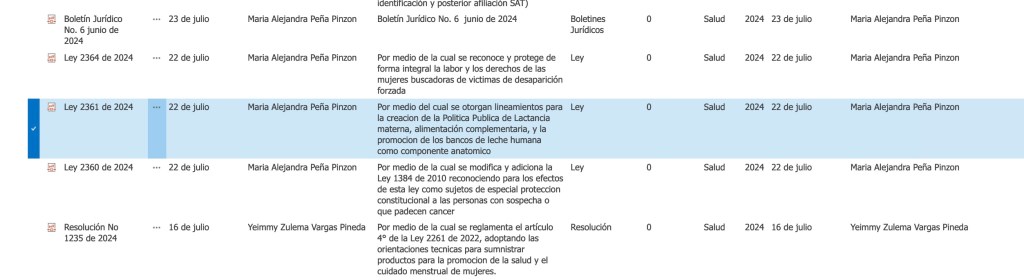
The Congress of the Republic of Colombia has enacted Law 2361 of 2024, whose purpose is to establish general guidelines for the creation of a public policy focused on breastfeeding, complementary feeding and the promotion of breast milk donation for human milk banks. This law aims to promote healthy and sustainable practices in infant nutrition at the national level.

The norm integrates key definitions, highlighting complementary feeding, which begins at six months of age and extends up to 24 months, maintaining breastfeeding. It also defines the concept of human milk banks, describing them as institutions responsible for the collection, quality control, processing, preservation, storage and distribution of breast milk for preventive, therapeutic and research purposes.

Screenshot

Colombia – New draft technical regulation to regulate the uses and maximum contents of industrial trans fats and partially hydrogenated oils in foods

The Ministry of Health has proposed the technical regulation to regulate the uses and maximum contents of industrial trans fats and partially hydrogenated oils in foods.
According to the draft regulation, packaged food products may not contain more than two grams of trans fats per 100 grams of total fat. This measure is complemented by a ban on the use of partially hydrogenated oils, both in food production and in gastronomic preparation. This change is designed to reduce the risks of cardiovascular diseases, one of the main causes of mortality in the country.
One of the highlights is the establishment of specific limits for industrial trans fats. The regulation establishes that foods may not contain more than 2 grams of trans fats per 100 grams of fatty matter. It also prohibits the use of partially hydrogenated oils in food processing.

ccording to the bill, “packaged foods shall express their trans fat content in milligrams (mg) per 100 g or mL of food and per serving of food on their labels, in the terms established in Resolution No. 810 of 2021 of this Ministry, or the rules that modify or replace it. It will also be verified that there is no mention of the use of partially hydrogenated oils in the list of ingredients”. With these indications, consumers will be able to make informed decisions about their food and promote healthier eating habits.