The Committee on Agriculture, Livestock, Supply and Rural Development (CAPADR) of the Chamber of Deputies approved on Wednesday (8) the Requirement 39/2022, which requests the holding of a public hearing to discuss the labeling of plant-based food products that mimic animal products.
Month: June 2022
Brazil: Food manufacturing and import regulations published
It was published in the Official Gazette (DODF) in portuguese, the normative instruction nº 31, which regulates the communication of the beginning of the manufacture and importation of food and packaging exempted from sanitary registration in the Federal District. Briefly, the regulation states that manufacturers and importers must inform the Food Management (Geali in Portuguese), of the Health Surveillance Directorate (Divisa), every time they start manufacturing or importing an edible product.
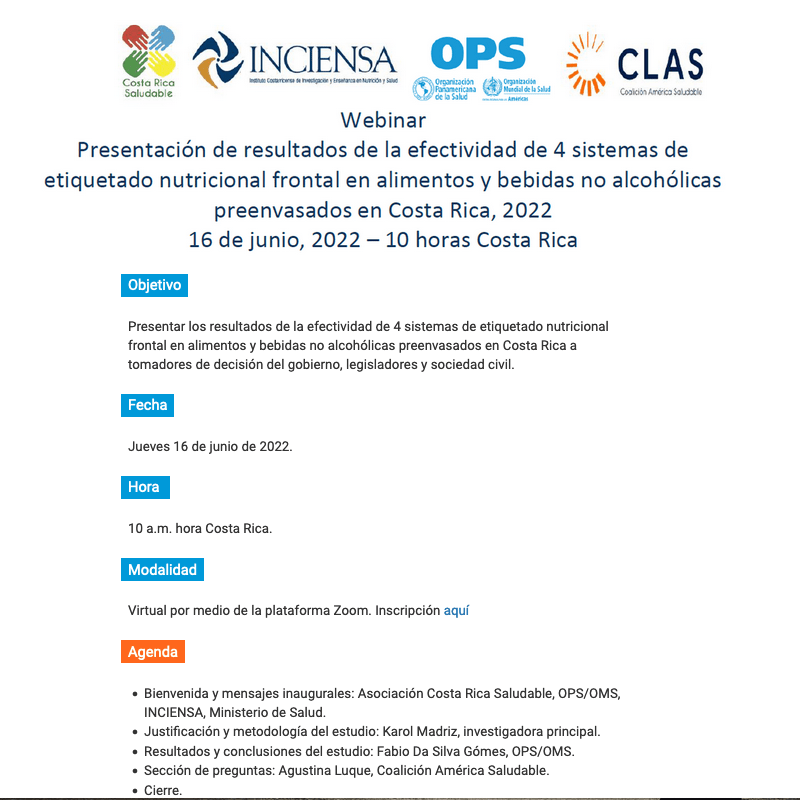
PAHO – Costa Rica: Presentation of results of the effectiveness of 4 front‐of‐pack nutrition labelling systems on prepackaged foods and non-alcoholic beverages in Costa Rica, 2022 (WEBINAR)
To present the results of the effectiveness of 4 front-end nutrition labeling systems on prepackaged foods and non-alcoholic beverages in Costa Rica to government decision makers, legislators and civil society.
Article: Front-end labeling laws as a guarantee of consumer health protection
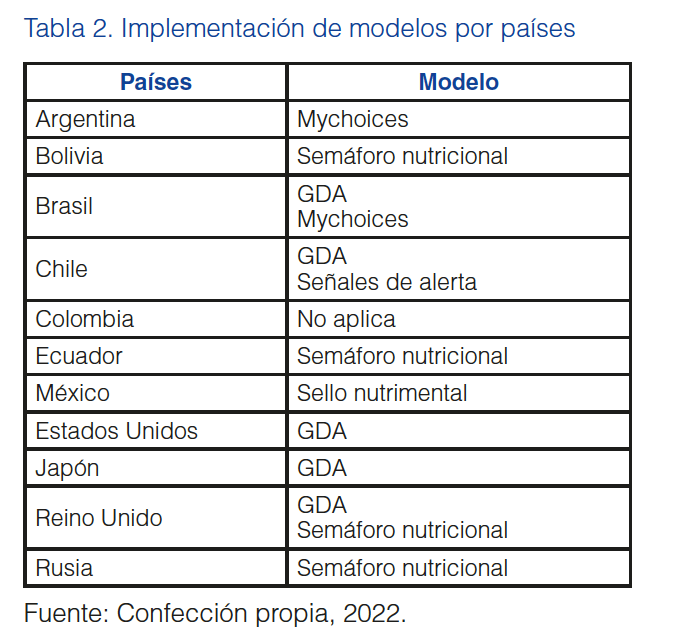
In the communication between producers and consumers, food labeling is fundamental since it allows to know the conformation and nutritional facts of food products. This work is carried out to develop a comparative study on the laws of front labeling as a guarantee of legal protection to consumers, it is a study of doctrinal and jurisprudential review on the protection of the right to health of consumers. It can be evidenced that the main models of front labeling are interpretative, non-interpretative, semi-interpretative and hybrid, of which the most used are the food guides and nutritional traffic lights. The guide system is used in Brazil, Chile, the United States, Japan and Great Britain, while the traffic light system is more widely used in Bolivia, Ecuador, Mexico and Russia.
Chile: Proposed regulation to fortify foods with vitamin D
The members of the Congressional Health Committee approved in general, the bill that provides for the obligation to fortify certain foods with vitamin D. The proposal will now be studied in particular by the same body after the Chamber authorized to continue with its review.
Specifically, the project establishes that:
“Producers of milk and its derivatives of dairy origin, as well as those of wheat flour, cereals and vegetable oils, shall fortify or add, in the amounts defined by the competent authority, the vitamins and minerals required for most human cellular functions, especially vitamin D”.
 infoAlimentario