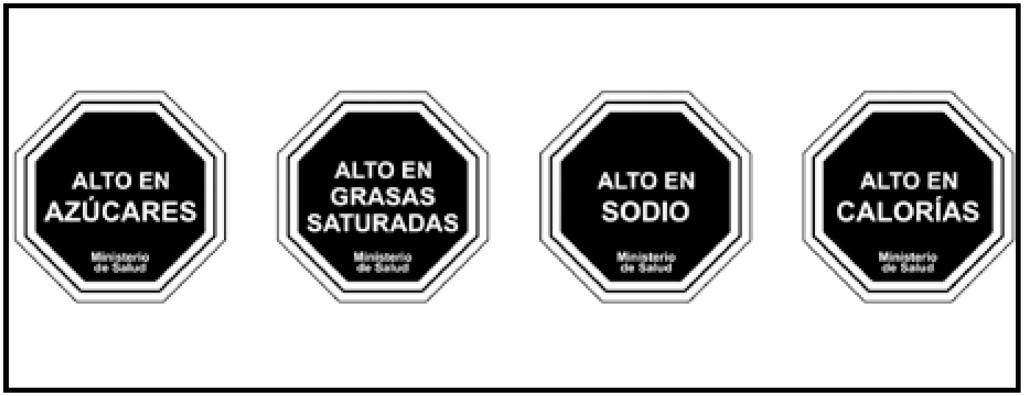
Warning labels have been implemented in different countries around the globe, including Brazil, to encourage healthier food choices. The aims of the present study were to evaluate the relative effect of different warning labels, brands and nutrition marketing claims on the food choice after the implementation of the Brazilian front-of package nutrition labelling regulation. Packages of four categories were designed considering the following factors: brand (familiar vs. unfamiliar), nutritional warning (present or absent), textual nutrition marketing claims (present or absent) and visual nutritional marketing claims (present or absent). A total of 850 Brazilian adults were recruited by a marketing agency. Participants were randomly allocated to one of two experimental conditions: black magnifier (n = 403) and black octagon (n = 447). They completed a choice task involving two out of four product categories: chocolate flavored milk, cookies, granola, and iced tea. The packaging was designed considering four factors: The presence of warning labels encouraged product choice in three of the four categories. However, brand and textual nutrition marketing claims had a larger effect. These results suggest the need to introduce comprehensive packaging regulations to reduce the prevalence of nutrition marketing claims on unhealthy products, as well as communication campaigns to raise awareness of the benefits of taking into account warning labels when making food purchases.
Warning Labels
Honduras – Central America seeks to tackle malnutrition with front warning labels
According to data from the Pan American Health Organization (PAHO), about 44% of annual deaths in the Americas, around 3.1 million people, are caused by arterial hypertension, fasting hyperglycemia, obesity and overweight.
According to the specialized agency, poor nutrition is largely due to the widespread availability and marketing of processed and ultra-processed foods and beverages, all of which contain excessive sugars, fats and sodium.
In this context, and as a measure to reduce public health problems associated with non-communicable diseases, more governments in the region are implementing laws and regulations aimed at reducing the demand and supply of products containing excessive amounts of critical nutrients, as sugars, fats and sodium are classified.
At the regional level, the authorities of Guatemala, El Salvador, Costa Rica, Panama and the Dominican Republic have shown their interest in promoting legislation related to Front-of-Line Nutrition Labeling.

Webinar – The Superiority of Octagonal Warning Labels in Central America and the Caribbean
Join us on Tuesday, 30 August, 2022, to participate on the webinar “The Superiority of Octagonal Warning Labels in Central America and the Caribbean” hosted by the Pan American Health Organization, to present the results of the studies in Cental America and the Caribbean on the efficacy of the different labeling systems. The session will serve to discuss policy implications of the results obtained in these studies and disseminate the knowledge and build partnerships to exchange experiences on front-of-package labeling (FOPL) implementation.

Article – Chile: How Do Nutritional Warning Labels Affect Prices?
Obesity is increasing worldwide and in many countries, the problem is particularly serious among lower income groups. To fight obesity, front-of-pack nutritional warning labels are a prominent regulatory tool that have been implemented or are currently debated in many countries. Existing studies document that warning labels incentivize consumers to substitute away from unhealthy products. However, not much is known about equilibrium price changes in response to consumers’ utility for warning labels. Using household purchase data in the cereal category, this paper studies the adjustments of prices after the mandatory introduction of warning labels in Chile. The authors develop a model which shows that warning labels lead to higher prices of labeled cereals, as is also observed in data. In contrast, prices of unlabeled products tend to drop or at least increase less, incentivizing price sensitive consumers to remain in the category. The authors decompose post-labeling market share adjustments into a pure label effect that fixes prices at initial levels after regulation and a total effect that accounts for price re-optimizations. Their findings point to self-enforcing effects of a warning label regulation as the price adjustments amplify the policy-maker’s goal of reducing unhealthy nutritional intake, especially because market forces incentivize low-income segments to choose healthier alternatives.