The regulation (twentieth additional provision) will allow companies to relabel products whose composition has been reformulated as long as the availability of certain resources is compromised for supply reasons.
Operators will therefore be able to use adhesive labels or stickers, ink-jet printing or other equivalent systems. The mandatory requirement is that they contain updated information on the ingredients replacing those previously used.
The Ministry of Economy, Industry and Commerce (MEIC in Spanish) issued an alert to people who consume fishery products, both pre-packaged and in bulk, regarding non-compliance with the labeling information of these foods.
For bulk products, the evaluation of mandatory labeling was oriented to aspects such as the common name of the species, the country of origin of the product and, in applicable cases, the “fresh or thawed product” legend. In establishments that sell food in this presentation, the main non-compliances were the lack of the name of the species and the country of origin.
Fraudulent labeling is an emerging problem in the food industry worldwide. Many Stevia sweeteners are marketed in Paraguay, and their labels can be confusing. For this reason, 21 packs of sweetener products were analyzed regarding their degree of compliance with the labeling regulations in force in the country. All of the analyzed containers complied with the MERCOSUR regulations on food labeling, and 95.2% complied with MERCOSUR regulations on nutritional labeling. Over half of the containers did not comply with the local regulation for the naming of Stevia products. This is the first study on possible fraudulent labeling carried out in Paraguay, and it highlights the need to monitor compliance of food labeling regulations in the country.
The United Nations urged Costa Rica to identify products high in fat, sodium and sugar through front labeling. It also invited the Legislative Assembly to develop a new bill to move forward on this issue, given that bill #22.065 was recently shelved.
Nydia Amador, member of the Asociación Costa Rica Saludable, explained that in July 2020, bill 22.065 was presented to the legislative stream: “Law of front labeling of prepackaged food and non-alcoholic beverages, to facilitate the understanding and decision making of the consumer, on the content of critical nutrients and ingredients that, by their excessive consumption, represent risks to the health of people”.
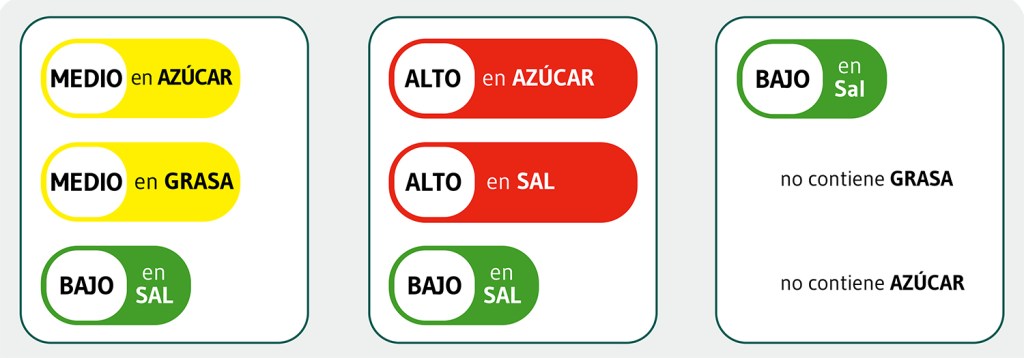
This study analyzes the traffic light signpost labeling that is included in processed foods, through which consumers are informed about added fat, sugar, and salt levels. At the same time, the awareness and use that the public make of this labeling, introduced by the Ecuadorian government as part of their Good Living health program, was also studied. A questionnaire was given to some 419 students from Ambato, Ecuador of both genders and from different economic circumstances. Subsequently, a descriptive analysis of the collected data was carried out, and through inferential statistics, relationships were established between the responses to the questionnaire and the factors identified. The results showed that most people are aware of traffic light signpost labeling at the time of purchase, although some consumers tend to mistakenly associate the indicators (green, yellow, red) with the food-hazard levels of the products. The opinions surveyed demonstrated a vague meaning and usefulness associated with the traffic light system.


 infoAlimentario