We acknowledge the funding of the manuscripts published in this Research Topic by Instituto Brasileiro de Defesa do Consumidor (Idec) through their project with the Global Health Advocacy Incubator (GHAI). We hereby state publicly that Idec or GHAI have had no editorial input in articles included in this Research Topic, thus ensuring that all aspects of this Research Topic are evaluated objectively, unbiased by any specific policy or opinion from these organizations.
Food Labeling Policies
Article – Editorial: Strengthening food labeling policies in Brazil
Food labeling policies can have different purposes, but consumers’ right to protection, human rights to health and to adequate food, the rights of the child and all other interdependent human rights prevail. For this reason, research that seeks to inform the best policy options in fulfilling, protecting, and respecting these rights is paramount.
Brazil is known for novel research and action that have led to great advance of knowledge and policies on nutrition and health globally. Different sorts of edible and drinkable products have been historically defined as foods and manufactured and labeled to mimic foods.
Unhealthy edible and drinkable commodities industry have insisted on the use of market-forged categorization of products with the purpose of demonstrating an artificial diversification of alike products, for which labeling has been an instrument of consumer deception.
Articles – Chile: On the Design of Food Labeling Policies
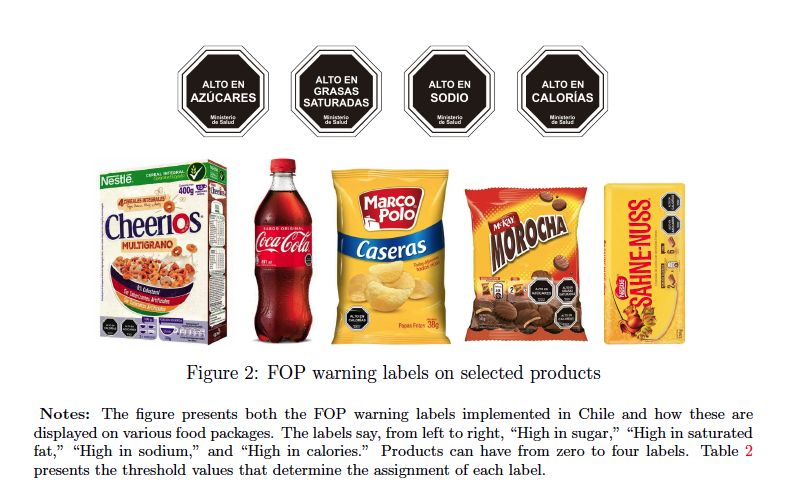
We study a regulation in Chile that mandates front-of-package warning labels on products whose sugar or caloric concentration exceeds certain thresholds. We document an overall decrease in sugar and caloric intake of 7-9%. To unpack the underlying mechanisms, we provide descriptive evidence of the impact of the policy on consumer choice, both across and within categories and firms’ behavior. We find no noticeable substitution of products across food categories and show that most of the demand effect of the regulation comes from within-category substitution. We also find that a substantive portion of the overall effect comes from product o reformulation. We discuss how these findings can inform the design of effective labeling policies.
 infoAlimentario