From March 24 to 28, 2025, representatives of the National Health Surveillance Agency (ANVISA in Portuguese) will participate in the 55th meeting of the Codex Alimentarius Committee on Food Additives, to be held in Seoul, South Korea. The Brazilian delegation is composed of the deputy director of the Second Directorate, Leandro Rodrigues, the advisor of the General Directorate of Food, Rebeca Vinhas, and the official of the Ministry of Agriculture, Livestock and Supply (MAPA), Isabela de Ávila.
In addition, on March 21 and 22, meetings of the food additives working group were held to discuss issues relevant to the development of international food-related standards.
During the meeting, crucial issues related to the safety and regulation of food additives will be discussed, including new safety evaluations and proposed standards aimed at ensuring consumer health. Codex Alimentarius, an initiative of the Food and Agriculture Organization of the United Nations (FAO) and the World Health Organization (WHO), sets international standards that help ensure fair practices in the food trade.
ANVISA
Brazil – Anvisa publishes results achieved in its food regulation agenda in 2024
The National Health Surveillance Agency (ANVISA in Portuguese) released the Activities Report of the General Directorate of Food. The document presents a brief summary of the main results of the area in 2024, with emphasis on the risk and safety assessment processes, regulation of food and packaging, determination of regulatory and service standards, transparency and communication.
The relevant aspects in the report:
- Execution of 46% of the matters of the Regulatory Agenda 2024/2025 under its responsibility.
- Granting of two regulations in the matter with the Seal of Good Regulatory Practices, one in the gold category and another in the silver category.
- 46% reduction in global liability for registration, post-registration and evaluation applications.
- Greater agility in the analysis of requests for competence in the area, with a reduction in time of 30 days in the case of registration and post-registration and 55 days for risk and effectiveness assessments.
- Reduction in the percentage of rejections out of all approved requests, which reached the lowest level in the five-year historical series.
- Reduction in the response time of queries sent to the area by the Call Center, maintaining the percentage of user satisfaction (90%).
Brazil – ANVISA publishes procedures for the collection of income from the Health Surveillance Inspection Board
The National Health Surveillance Agency (ANVISA in Portuguese) has published RDC No. 857 on procedures for the collection of income from the Health Surveillance Inspection Board, which includes procedures related to the registration of food, food additives, beverages, water bottled. y recycled packaging.
Brazil – Anvisa publishes Q&A guide on foods containing whole grains
The National Health Surveillance Agency (Anvisa) has just published the first edition of the document Questions and Answers on Composition and Labeling of Foods Containing Whole Grains.
The publication is a non-regulatory tool, intended to clarify frequent doubts about the new regulation on the subject, i.e., the Resolution of the Collegiate Council (RDC) 712/2022, which provides on the compositional and labeling requirements for foods containing cereals. and pseudocereals for their classification and identification as whole grains and to highlight the presence of whole grain ingredients.
Brazil – ANVISA updates Regulatory Agenda for the year 2023
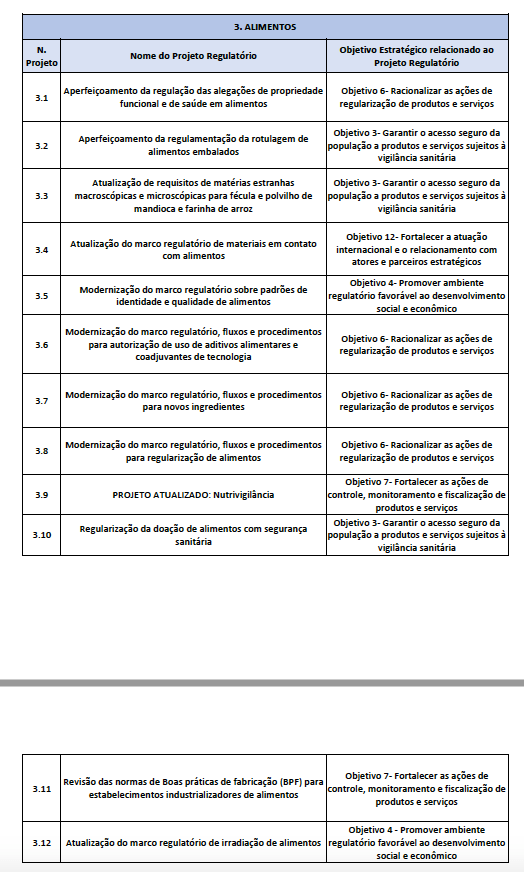
Anvisa’s Collegiate Council approved the second update of the Normative Agenda 2021-2023, which will be published in the Official Gazette of the Federation. The measure was deliberated this Wednesday (12/7), during the 23rd Ordinary Public Meeting of the Agency, and defined the new current list of prioritized regulatory projects for 2023.
Based on the consolidated updates, the new updated list of regulatory projects of the Anvisa Agenda for the period 2021-2023 now comprises 159 regulatory projects, distributed in 16 macro-themes of the Agency’s activities. Consult the list in spreadsheet, with the detail of the projects and the respective justifications of the changes and exclusions made. See also the specific page of the Regulatory Agenda 2021-2023 on the portal.
 infoAlimentario