The U.S. Food and Drug Administration proposed changes to the standards of identity (SOIs) for foods that include salt to permit the use of safe and suitable salt substitutes. The proposed rule would help support a healthier food supply by providing flexibility to facilitate industry innovation in the production of standardized foods to reduce sodium content, in the same manner that is already possible for non-standardized foods. This has the potential to contribute to better health outcomes by helping consumers to gradually reduce their sodium intake.
Argentina – Draft of MERCOSUR Technical Regulation on Silicones for the Manufacture of Materials, Containers Coatings and Equipment in Contact with Foodstuffs
The Draft MERCOSUR Technical Regulation applies to silicones used in materials, packaging, coatings and equipment for and equipment intended to come into contact to come into contact with food. Exceptions are coatings for cellulosic materials cellulosic materials, which must comply with the specific MERCOSUR Technical Regulation. Technical Regulations.
The Project establishes that the materials, containers, rev and equipment made of silicone intended to equipment destined to come into contact with food must be manufactured according to Good Manufacturing Good Manufacturing Practices and be compatible with the food with which they will be in contact and not contact and shall not transfer undesirable substances or contaminants to the food. undesirable substances or contaminants in quantities that may modify the composition of the food and/or its sensory characteristics, or that represent a or that represent a risk to human health.
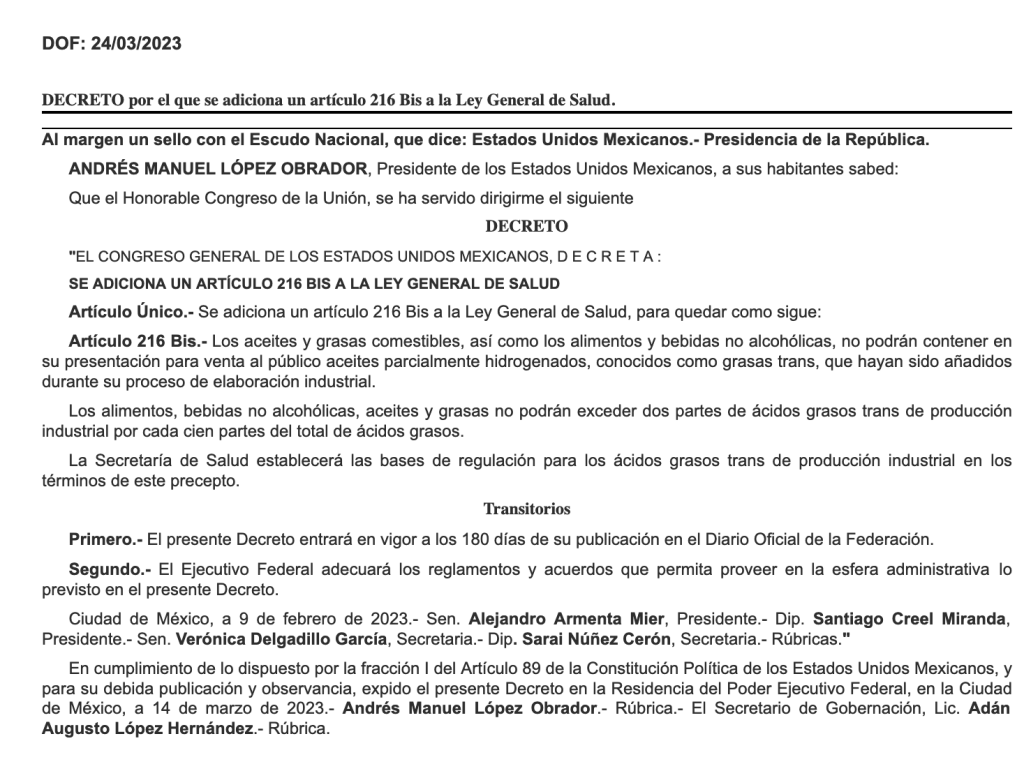
Mexico – Published amendment to the General Health Law on trans fats
DECREE adding an article 216 Bis to the General Health Law.
Sole Article.- An article 216 Bis is added to the General Health Law, to read as follows:
Article 216 Bis.- Edible oils and fats, as well as food and non-alcoholic beverages, may not contain in their presentation for sale to the public partially hydrogenated oils, known as trans fats, which have been added during their industrial manufacturing process.
Foods, non-alcoholic beverages, oils and fats may not exceed two parts of industrially produced trans fatty acids for every one hundred parts of total fatty acids.
The Ministry of Health will establish the regulation bases for industrially produced trans fatty acids under the terms of this precept.
Ecuador/Public consultation – External instructions on technical criteria for the categorization of the sanitary risk of processed foods
The objective of these instructions is to clearly and precisely establish the technical criteria for the categorization of the sanitary risk of processed foods, as well as the methodology for the entry and use of the processed food sanitary risk simulator. This document repeals the content of the External Instructions “Evaluation criteria for the classification of the sanitary risk of processed foods”. the sanitary risk classification of processed foods” (IE-B.2.2.1-ALI-01; Version 5.0);
as well as its annexes, published in June 2021.
Ecuador/Public consultation – NTE INEN 3188 Standard for Chocolate and Chocolate Products (CODEX STAN 87-1981, MOD)
The Ecuadorian Standardization Service (INEN in Spanish) publishes the draft standard that applies to chocolate and chocolate products intended for human consumption and for the products described in Chapter 2. Chocolate and chocolate products must be prepared from cocoa or cocoa derivatives with sugars and may contain sweeteners, dairy products, flavoring substances and other food ingredients.
This Ecuadorian Technical Standard NTE INEN 3188 is a modified translation of the International Standard CODEX STAN 87-1981, Standard for chocolate and chocolate products. The national committee responsible for this standard and its translation is the Comité Técnico de Normalización, Cacao.
 infoAlimentario