Food adulteration and food fraud is as old as food production and processing however, it is increasingly prevalent today. With globalization and increasingly complex food production and distribution systems, adulteration can occur at different points in the food chain and may have far-reaching impacts and even adverse consequences for human health. The international community’s regulatory approaches to confronting and resolving food fraud are scattered and in constant adjustment. A collective and coordinated approach is needed to identify all stakeholders in the food supply chain, certify and qualify them, exclude those who do not meet applicable standards, and trace food in real time. This update provides definitions and background on key concepts associated with food integrity, episodes of food fraud in Chile and the world, main foods vulnerable to food fraud, common fraud practices and analytical techniques, regulations and new actions in Chile and the world to face food safety and the risk of food fraud.
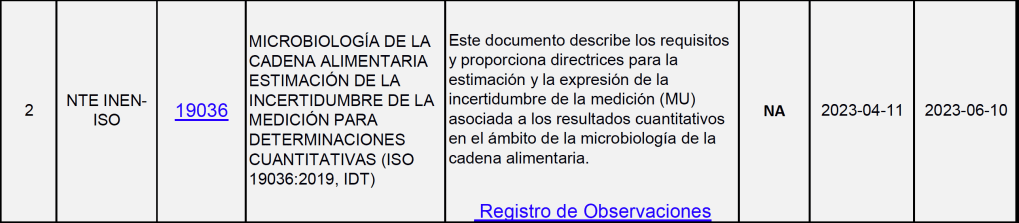
Ecuador – Draft adoption of NTE INEN-ISO 19036 Microbiology of the food chain estimation of measurement uncertainty for quantitative determinations (ISO 19036:2019, IDT)
The Ecuadorian Standardization Service (INEN in Spanish) published in public consultation the Draft adoption NTE INEN-ISO 19036 Microbiology of the food chain estimation of measurement uncertainty for quantitative determinations (ISO 19036:2019, IDT).
Argentina – Project on Sanitary Registration of food exporting companies
Brazil – MAPA approves new ham quality and identity standards
The Ministry of Agriculture and Livestock (MAPA in Portuguese) published Ordinance No. 765 approving the new Technical Regulations of Identity and Quality (RTIQ in Portuguese) for cooked ham, superior cooked ham, tender cooked ham and poultry stew.
The new standards apply to the types of cooked ham that are produced and seek to give identity to the products, guarantee their safety and innocuousness, as well as standardize understandings and meet the requirements of the production sector.
Among the improvements is the definition of 25% as the maximum limit of collagen present in relation to the total protein of the final product in order to maintain the quality of the meat raw materials used, as well as the characteristics of the product. For cooked poultry ham, the amount of collagen in relation to total protein must be a maximum of 10%.
Brazil – MAPA extends the deadline for compliance with the provisions of articles 6 and 15 of the technical regulation on the identity and quality of gelatine, hydrolyzed gelatine and edible collagen
The Brazilian Ministry of Agriculture, Livestock and Supply (MAPA in Portuguese) published SDA Ordinance No. 782, which extends by 180 days the deadline for compliance with the provisions of articles 6 and 15 of SDA Ordinance No. 384, dated August 25, 2021, approving the technical regulation on the identity and quality of gelatin, hydrolyzed gelatin and edible collagen.
Articles 6 and 15 of SDA Ordinance No. 384 describe the following:
Art. 6° In the manufacture of gelatin, the use of technology adjuvants and additives authorized in the specific legislation is allowed.
Art. 15. In the preparation of collagen, the use of technology adjuvants and additives, authorized in the specific legislation, is allowed.

 infoAlimentario