In this paper we will address the right to proper nutrition, focusing on its regulation in the International Covenant on Economic, Social and Cultural Rights and we will examine one aspect of this right: food labeling. Accordingly, we will mention the different labelling models used in the world pointing out the complexity and challenges this right present in accomplishing its full effectiveness. Also, we will make a particularized analysis of the Argentinean’s Act 27642 of Healthy Food Promotion (known as “labelling law”), its legislative backgrounds and the protection of vulnerable groups. Then, we will make a critical analysis on where the Argentinean’s proper nutrition right stands. Finally, we will conclude that accomplishing the effectiveness of proper nutrition right re quires a great challenge that demands not only regulatory measures of the normative type (suchas the labelling law) but also concrete, continuous, intense, clear, and interdisciplinary measures. Thus, although labelling law is a big step towards that goal, it cannot solve the problem by itself because it demands a continuous social, political, and economic commitment.
Panama – CCCF17/ President of Panama gives opening speech for contaminants meeting
The 17th session of the Codex Committee on Contaminants in Food (CCCF) was declared officially open in Panama City, 15 April, following speeches from His Excellency the President of the Republic of Panama, Laurentino Cortizo Cohen and other distinguished guests. The opening ceremony paved the way for what promises to be an intensive week of discussions around a variety of current CCCF texts and future work for the Committee.
His Excellency the President expressed appreciation that Panama was chosen to co-host this Committee meeting. “Panama has always been a crossroads in the world,” he said, “and an ideal place for dialogue, and a place to find consensus.” He underlined the fundamental role that food safety plays in Panama: “food safety is one item that is anchored in our constitution as a fundamental right,” he continued, commenting that in his role as President of the Republic, he believes it is his duty to ensure food safety for the population. Panama, he remarked, seeks to “ensure protection of all our citizens, as does the Codex Alimentarius.” In reference to the Committee meeting, he concluded that “altogether we shall be able to achieve for our respective populations a system where our food is safe, if we give this matter the attention it deserves at all levels.”
Over the next three days, CCCF17 will address the topics of industrial, environmental, and naturally occurring toxicants in some foods, including maximum levels for lead and sampling plans for methylmercury in fish. Under the topic of toxins, delegates will discuss the definition of and maximum level for total aflatoxins in ready-to-eat peanuts, sampling plans for total aflatoxins and ochratoxin A in certain spices and the new code of practice or guidelines for the prevention and reduction of ciguatera poisoning. Five discussion papers have also been put forward for debate. There will also be a review of the Code of Practice for the Reduction of Aflatoxin B1 in Raw Materials and Supplemental Feedingstuffs for Milk-Producing Animals (CXC 45-1997) and discussion on the development of a code of practice for the prevention and reduction of cadmium contamination in foods.
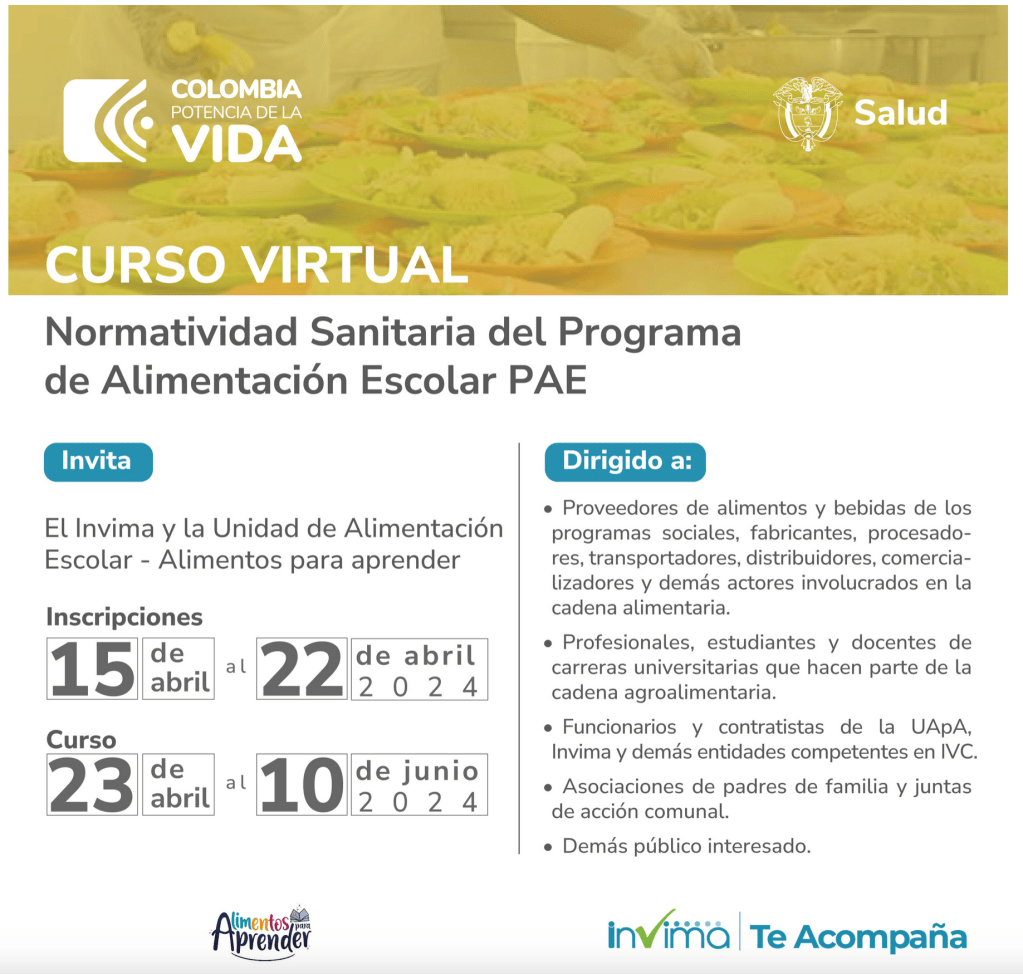
Colombia – INVIMA announces virtual seminar on sanitary regulation of the School Feeding Program
The Instituto Nacional de Vigilancia de Medicamentos y Alimentos (INVIMA in Spanish) and the Unidad de Alimentación Escolar -Alimentos para Aprender (UApA in Spanish) inform those interested that, from April 15 to 22, registrations are open for the Virtual Course on Sanitary Regulations of the School Feeding Program (PAE in Spanish) to be held from April 23 to June 10, 2024.
This course is free, self-study, 100% virtual and with an intensity of 40 hours. A certificate of approval will be granted online by INVIMA.
The course is aimed at food and beverage suppliers of social programs, manufacturers, processors, transporters, distributors, marketers and other actors involved in the food chain; as well as professionals, students and teachers of university careers that are part of the agri-food chain; officials and contractors of the UApA, Invima and other competent entities in IVC; parents’ associations and Community Action Boards.
Article – Sociodemographic differences in nutrition labels effect on Chilean and Mexican youth
Objective. To examine sociodemographic differences in the awareness, understanding, use and effect of nutrition labels among Mexican and Chilean youth.
Methods. Online surveys among youth (10-17 years) were obtained in 2019 (n=2631). Participants reported their awareness, understanding, and use of their country-specific nutrition facts tables (NFT) and front-of-pack labels (FOPL) (Chile: warning labels [WLs]; Mexico: guideline daily amounts [GDA]). Additionally, participants reported their perceived healthfulness of a sweetened fruit drink after viewing one of six versions of it withdifferent FOPL (no-label control, Health Star Rating, WLs, GDAs, Traffic Light, or Nutri-Score) during an exper-imental task.
Results. Higher self-reported nutrition knowledge was associated with higher NFT and FOPL awareness, understanding, and use, except for WL use. WLs were the most effective FOPL in decreasing the perceived healthfulness of the sweetened fruit drink compared to a no-label condition and other FOP labels. In Chile, the effect of GDA differed by income adequacy, while in Mexico Nutri-Score differed by age.
Conclusions. Results suggest that nutrition label awareness, use, understanding, and impact differ across demographics, favoring higher income and nutrition knowledge. Despite this, WLs are likely to have a positive impact on nutrition-related knowledge and behaviors among Mexican and Chilean youth, independently of their socio-demographic groups.
Brazil – Proposed regulatory instruction on compositional and quality requirements, nutritional content and claims and list of authorized constituents for infant formulae, transitional foods and cereal-based foods for infants and young children, formulas for enteral nutrition and dietary therapeutic formulas for inborn errors of metabolism
The National Health Surveillance Agency (ANVISA in Portuguese) has published Public Consultation No. 1.243/2024 , on the proposed Normative Instruction (IN) on composition and quality requirements, nutritional content and declarations and list of authorized constituents for infant formulas, transitional foods and base foods. It establishes composition and quality requirements, content and nutritional declarations and list of authorized constituents for infant formulae, transitional foods and base foods for cereals for infants and young children, formulas for enteral nutrition and dietary therapeutic formulas for inborn errors of metabolism.
 infoAlimentario