México – Civil organizations present a reconsideration appeal to recognize sugary or sweetened beverages with sweeteners as health risk products

In an urgent effort to protect the health of Mexican consumers, El Poder del Consumidor, a member organization of the Alianza por la Salud Alimentaria, filed an appeal requesting the Federal Commission for Protection against Health Risks (Cofepris in Spanish) to recognize sugar-sweetened beverages or beverages sweetened with sweeteners as health risk products.

The appeal is supported by the international scientific consensus, recognized by the World Health Organization (WHO) itself, which acknowledges that the consumption of sugar-sweetened beverages is linked to the prevalence of chronic diseases such as diabetes, obesity and cardiovascular problems. Scientific evidence has also been presented on the addictive potential of sugar, sweeteners and caffeine, which are present in several of these beverages.


Brazil – Anvisa announces that recordings of sectorial dialogues in the area of Food are available

The National Health Surveillance Agency (ANVISA in Portuguese) announces that sectoral dialogues in the area of Food are now available on its platform. Two of the virtual meetings were held on July 4, at different times:

Periodic update of Regulatory Instruction (IN) 211/2023, which establishes technological functions, maximum limits and conditions of use of food additives and technological aids authorized for use in food.

Guatemala – Project on frontal food warning labeling is reactivated

The Regional Integration Commission of the Congress of the Republic dusted off a 2018 bill that seeks to force the food industry to adhere to the packaging, the main nutritional information of its products sold in the local market.

Bill 5504, Law for the Promotion of Healthy Eating, already known in second reading, would establish factories to put a label with nutritional warnings.

These recommendations would consist of black octagons that would explain whether the content is high in sugars, saturated and total fats, or sodium, in addition to other details of processed foods marketed in the country.

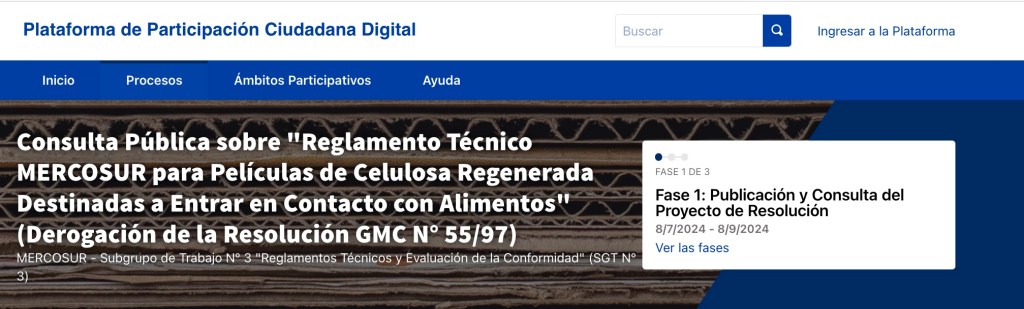
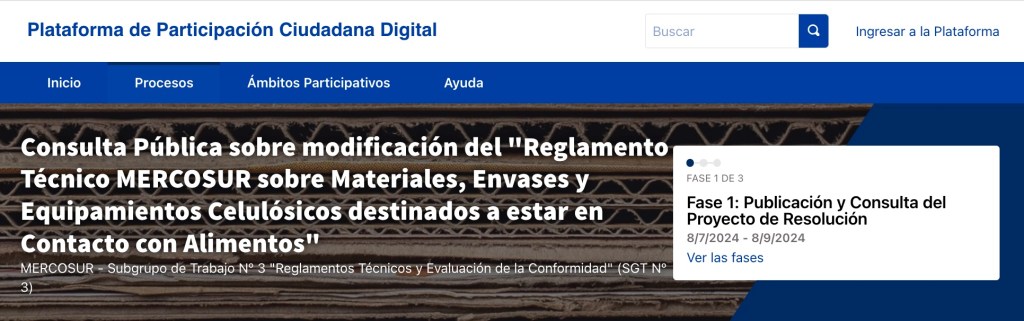
Uruguay – Uruguay announces two public consultation processes on Mercosur Technical Regulations on food contact materials

The National Directorate of Industries (DNI) of the Ministry of Industry, Energy and Mining (MIEM) submits for public consultation the GMC Draft Resolutions No. 01/24 and 02/24, prepared within the scope of the Food Commission (CA) of the Mercosur Sub-Working Group No. 3 Technical Regulations and Conformity Assessment (SGT No. 3). The deadline for participation is September 8.

- Draft Resolution No. 01/24: its purpose is to "establish the requirements to be met by regenerated cellulose films intended to come into contact with food" and covers both those that constitute a finished product and those that are part of a finished product containing other materials. Regenerated cellulose synthetic casings are not part of the scope of this Mercosur Technical Regulation.

- Draft Resolution No. 02/24: the replacement of item f) of point 1.2 of Part II Positive list of components for cellulosic materials, packaging and equipment in contact with food of Resolution GMC No. 40/15 Mercosur Technical Regulation on cellulosic materials, packaging and equipment intended to be in contact with food is submitted for public consultation. This amendment refers to the maximum admissible content of the contaminant diisopropylnaphthalene in finished products that use recycled fibers in their production.

Screenshot

Brazil – New market access modalities according to type of food and supplement will come into effect as of September 1

The new regulatory framework for access (registration, notification and communication) to the market for supplements and foods, published by the National Health Surveillance Agency (ANVISA), will come into force as of September 1. According to the authority, RDC 843/2024 and Normative Instruction (IN) 281/2024 aim to improve the pre-marketing control of foods, based on risk criteria.

The measure reduces the administrative burden for both the regulatory agency and the food sector, in cases of lower risk; and maintains or increases the rigor, in the case of high-risk products or those with a history of complaints and denunciations.

The new rules define three forms of regularization. These are registration with ANVISA, notification to the agency and, finally, communication to local health surveillance bodies at the start of manufacture or import.

According to the regulatory framework for supplements, products with mandatory registration require ANVISA approval prior to marketing. In this group, infant formulas and enteral nutrition formulas were maintained, and diethotherapeutic formulas for inborn errors of metabolism were included.

For products considered intermediate risk, such as desalinated seawater, transitional foods and cereals for infant feeding, recycled packaging and foods with claims, registration was waived and a new form of regularization was created.