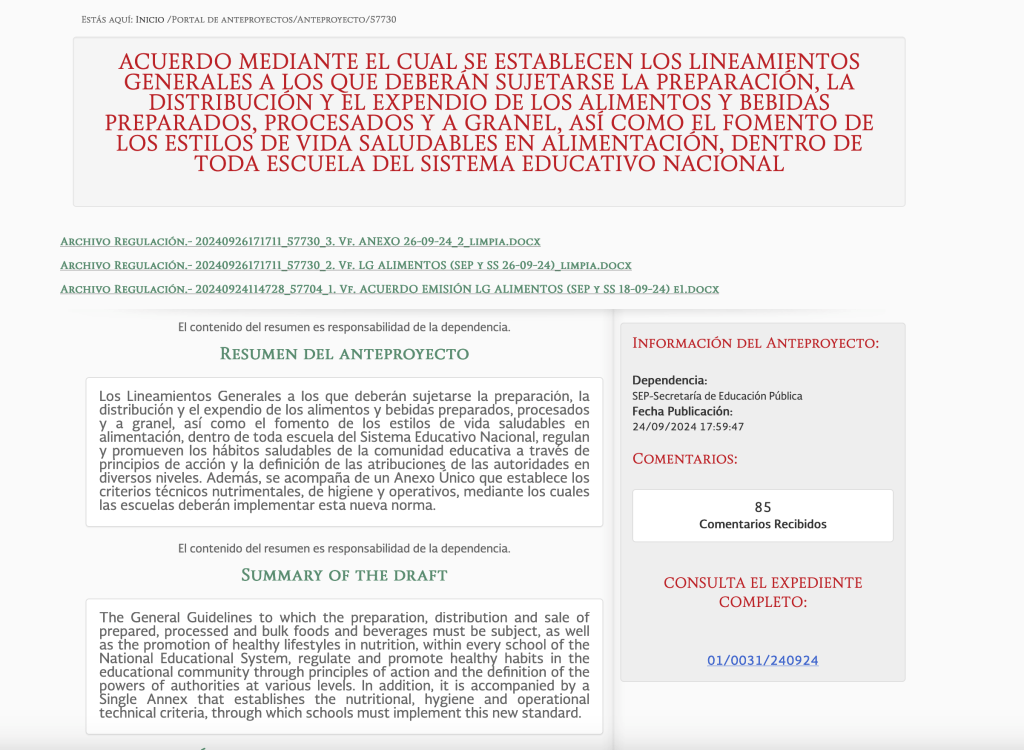
Mexico – CONAMER will implement a draft of General Guidelines to regulate cooperatives, canteens, vending machines or businesses that sell food and beverages to students in all schools of the National Education System

In order to promote healthy eating lifestyles, the federal government through the National Commission for Regulatory Improvement (CONAMER) will implement a draft of General Guidelines to regulate cooperatives, canteens, vending machines or businesses that sell food and beverages to students in any school of the National Education System.

The draft bill seeks to stop the sale of processed products with high levels of sodium, sugars or fats in educational centers at preschool, elementary, middle, high school, technological institutes and universities.

What foods will no longer be sold?

- Chilaquiles
- Quesadillas
- Tacos
- Fried foods
- Cookies
- Sweets
- Sugary drinks
- Donuts
- Ice cream
- Boxed cereals
- Juices
- Chewing gum
- Nectars or puddings
- Products with front labeling and that are used to prepare foods such as panpizza, banderillas or hot dogs.

It also seeks to eliminate the advertising of foods and beverages with sugar, salt and high caloric or fat content.
Costa Rica – Labeling, responsible and sustainable food consumption: Consumer perception in Costa Rica

Over the last few decades, there has been growing interest on the part of consumers in sustainable agri-food products. As a result, voluntary standards have emerged as a tool to promote sustainability in production and consumption in agri-food value chains. Objective. To evaluate the profile of consumers and the degree of knowledge of sustainability seals for agricultural products in Costa Rican markets. Materials and methods. During October and November 2021, a nationwide virtual survey was conducted through the Qualtrics platform, from which 397 valid responses were collected. The sustainability seals considered were certifications of organic production, fair trade, denomination of origin, country-essential Costa Rica brand and carbon neutral. The Poisson regression model (PRM) was used to study the behavior of the variables, using Stata software version 16.0. Results. The Essential Costa Rica seal is the most recognized. People residing in the Greater Metropolitan Area (GAM) are more familiar with various seals. The income variable turned out to be a significant factor; those with higher incomes tend to identify and value sustainability seals more. The level of knowledge and consumption of certified products increases when the consumer has some link to the agricultural sector. Conclusions. People’s interest in certified products is not reflected in their purchasing behavior, due in part to the price of the products, lack of trust or excessive information on labels. The findings of the study allow companies to define their marketing strategies according to the characteristics of the consumers of these differentiated products.

Brazil – Anvisa provides guidance on the safe use of infant formulas

The National Health Surveillance Agency (ANVISA in Portuguese) alerts the population on the regularization, safe use and reporting of adverse events related to the consumption of infant formulas.
Infant formulas are products, in liquid or powder form, specially manufactured to meet the nutritional needs of specific audiences. These products must be registered with the Agency, as required by law, and should only be used under medical prescription by a qualified health professional, such as a pediatrician or nutritionist.
Infant formulas may be classified as foods intended for the feeding of infants (0 to 6 months of age) and/or follow-on foods for infants (6 to 12 months of age) and/or young children (1 to 3 years of age).

Colombia – Invima presents the new ‘Practical guide for alcoholic beverage procedures’, boosting efficiency and regulatory compliance in the industry

The Instituto Nacional de Vigilancia de Medicamentos y Alimentos (INVIMA in Spanish) , officialized the launch of the ‘Guía práctica de trámites de bebidas alcohólicas’, in coordination with the Embassy of the United Kingdom and the Delegation of the European Union. This event was attended by representatives of the alcoholic beverage industry, becoming a key space for the presentation of this important tool, whose purpose is to facilitate the processes of sanitary registration and associated procedures for these products.

The guide, developed by the Food and Beverages Directorate, details the technical and legal aspects to be considered in the study of the procedures, in accordance with the technical regulations governing alcoholic beverages in the country. In addition, it seeks to streamline and optimize the procedures for approval, efficiently ensuring compliance with sanitary and regulatory requirements.

Brazil – MAPA calls for a public hearing to discuss the proposal to regulate plant products of animal origin

The Ministry of Agriculture and Livestock (MAPA in Portuguese), through Ordinance SDA/MAPA No 1.176, called for a public hearing to review the proposed regulation of plant products analogous to animal products.

The proposed ordinance under review aims to establish minimum identity and quality requirements for plant products analogous to products of animal origin.

Analogous plant product: food product, including beverages, formulated with raw material of plant, algal or fungal origin or a mixture of these and which has a counterpart of animal origin regulated by the Ministry of Agriculture and Livestock.