The National Health Surveillance Agency (ANVISA) has issued Normative Instruction ANVISA No 414/2025, which amends Normative Instruction IN No. 367/2025, establishing the lists of components, usage limits, and property claims for infant formulas, nutritional formulas for high-risk newborns, transitional foods, cereal-based foods for infants and young children, enteral nutrition formulas, and dietary formulas for inborn errors of metabolism.
The Americas
Regulatory news in the Americas
Panama – Ministry of Health orders that safety information be included in the monographs and package inserts of registered products containing probiotics in their formulation
The National Directorate of Pharmacy and Drugs, under the Ministry of Health, has published Resolution No. 226, which orders the inclusion of safety information in the monographs and package inserts of registered products, those undergoing sanitary registration or renewal, and all new registration applications containing probiotics in their formulation.
Brazil – Deadline for submitting the modification protocol provided for in RDC 839/2023 has passed
The National Health Surveillance Agency (ANVISA) informs that the deadline for food companies to submit the modification provided for in Collegiate Board Resolution (RDC) 839/2023 (which establishes the verification of safety and authorization for the use of new foods and new ingredients) ended on December 18, 2025.
Companies that had requested safety assessments for new foods and ingredients and had pending processes at the start of the regulation’s implementation could choose from three options:
- Submit additional documentation via an addendum to comply with the new regulations;
- Maintain the analysis in accordance with the previous standard; or
- Withdraw the request.
For those who opted for the modification, the 24-month period defined in Article 68, § 3, of RDC 839/2023 ends on December 18, 2025.
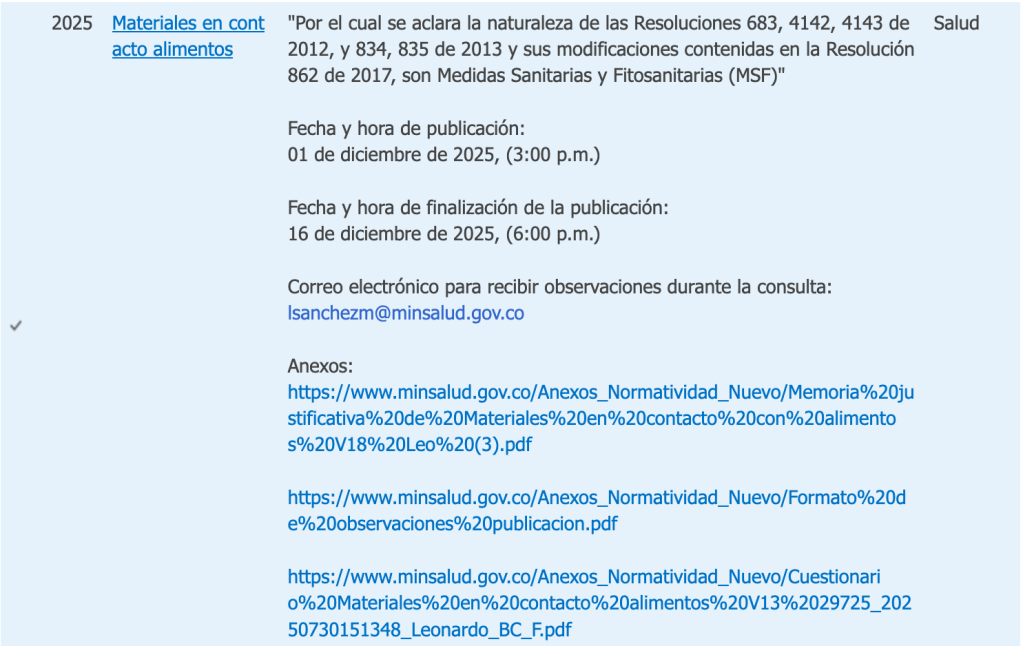
Colombia – The Ministry of Health’s project proposes a resolution that redefines food contact material regulations as sanitary measures
The Ministry of Health and Social Protection has published a draft resolution aimed at redefining the regulations on food-contact materials (Resolutions 683, 4142, and 4143 of 2012; 834 and 835 of 2013; and Resolution 862 of 2017) as Sanitary and Phytosanitary Measures (SPS) under the World Trade Organization (WTO) Agreement.
In its Article 1, dedicated to the scope of the regulation, the Ministry of Health and Social Protection is explicit: all of these resolutions “constitute Sanitary and Phytosanitary Measures (SPS)”. The text also stipulates that, from this clarification onward, any reference to the term “technical regulation” contained in those provisions shall be understood as “sanitary and phytosanitary measure.” In other words, it is an act that directs the legal interpretation of the existing regulations, without altering the material scope of the requirements already in force for these materials.
The project adopts the definition contained in Annex A of the SPS Agreement, according to which a sanitary or phytosanitary measure comprises any mandatory provision intended, among other purposes, to protect human or animal health from risks arising from additives, contaminants, toxins, or pathogenic organisms present in food, beverages, or feed, as well as to prevent the spread of pests and diseases. It also notes that SPS measures encompass a wide range of instruments: laws, decrees, regulations, production processes and methods, testing procedures, inspection, certification, quarantine, risk assessment methods, sampling, and packaging and labeling requirements when directly linked to food safety.
Mexico – Ministry of Economy proposes a consultation to modify NOM-051 and update nutritional warning labels
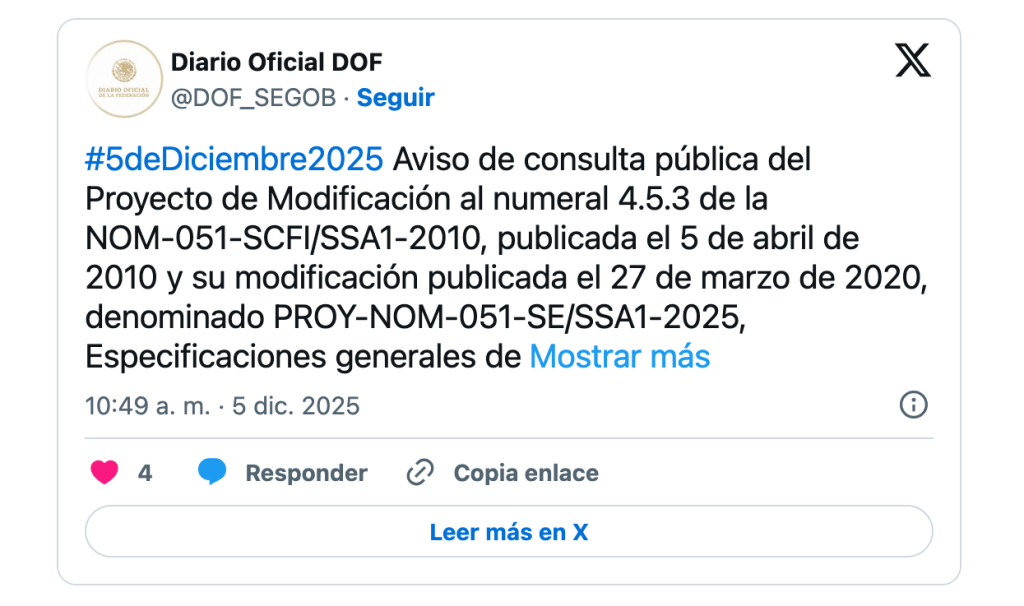
The Ministry of Economy opened for public consultation the draft PROY-NOM-051-SE/SSA1-2025, an update to the food and non-alcoholic beverage labeling standard that seeks to adjust the criteria for evaluating added critical nutrients and define when a product must bear warning seals.
The proposal focuses on modifying section 4.5.3 of NOM-051-SCFI/SSA1-2010, a technical component that had already been reviewed in 2020. Now, the objective is to refine the parameters that determine the limits for sugars, sodium, fats, and calories, in order to update how the presence of added critical nutrients is calculated.
This review means that companies will need to re-evaluate their product formulations, as the updated criteria could change the number and type of warnings on packaging. The measure reflects an international trend: periodically adjusting labeling parameters to align them with the latest scientific evidence.
The notice was published in the Official Gazette of the Federation on December 5, initiating a regulatory process that will impact the industry and consumers in 2026.
 infoAlimentario