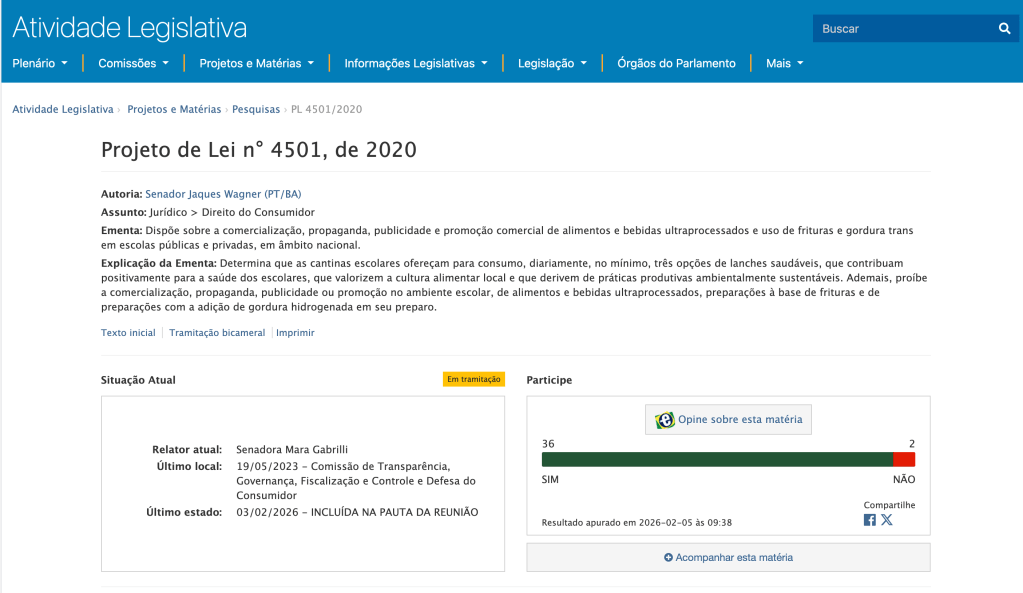
Brazil – The Consumer Protection and Oversight Committee is reviewing a bill to ban the sale of ultra-processed foods in schools

The Consumer Protection and Oversight Committee (CTFC) will on Wednesday (4) consider a bill that prohibits the sale of ultra-processed foods in public and private school cafeterias. Proposals are also included to facilitate the services of consumer protection agencies and to address the rights of hospitalized children and adolescents.

Bill 4.501/2020, drafted by Senator Jaques Wagner (PT-BA), proposes a series of regulations prohibiting the sale and distribution of ultra-processed (highly industrialized) foods and beverages or those high in calories, sugar, and fat in educational establishments. Additionally, the text requires cafeterias to offer healthy snack options or those tailored to individuals with dietary restrictions (such as diabetics and celiacs).

Colombia – Constitutional Court ratifies the tax on sugary and ultra-processed beverages

The Constitutional Court upheld the tax rate on ultra-processed and sugary beverages, as included in the first tax reform of President Gustavo Petro’s government, which had been challenged for imposing tax burdens on consumers who, for example, choose plant-based beverages.

The Full Chamber, by a 7-0 vote, approved the report by Justice Jorge Enrique Ibáñez, which called for endorsing the rule imposing a tariff on any beverage with an alcohol content not exceeding 0.5% and to which any amount of added sugar has been incorporated.

Although the regulation had already been given the green light by the Court in 2023, this ruling stems from a lawsuit alleging unfair treatment in the exclusion from the tax.

Mexico – The Ministry of Health publishes the new Mexican Dietary Guidelines 2025–2030

The Ministry of Health has published the new Mexican Dietary Guidelines 2025–2030, a technical document that updates the criteria for health promotion and the prevention of chronic diseases in the country. This regulation becomes the guiding framework for national public health, steering the transition toward healthy and sustainable food systems. The text, developed thru a consensus of experts from the National Institute of Public Health (INSP in Spanish) and international organizations, is now available for download and implementation in healthcare facilities.

The new 2025–2030 Healthy and Sustainable Dietary Guidelines are a strategic tool to improve the nutrition of the Mexican population without compromising the environment, and are therefore aimed at everyone, with special attention to school-age children and adolescents, said Anabelle Bonvecchio Arenas, Director of Nutrition Policy and Programs Research at the National Institute of Public Health (INSP in Spanish).

Colombia – INVIMA will update fees for food-related procedures in 2026

The National Institute for Drug and Food Surveillance (INVIMA) announces the update of the Fee Schedule, which includes the payment of fees for services related to:

  • Sanitary registration, sanitary permit, and food health notification.
  • Renewal of health registration, sanitary permit, and food health notification.
  • Sanitary registration and renewal of sanitary registration for food supplements.
  • Laboratory analysis to verify the quality of foods, beverages, and other materials for human consumption and use.
  • Alcoholic beverages.

Colombia – INVIMA announces that the new amendments to the alcoholic beverage regulations are now in effect

The National Institute for Food and Drug Surveillance (INVIMA) announces that, as of January 14, 2026, Decree 1083 of 2025 will enter into force, amending Decree 1686 of 2012, Decree 162 of 2021, and Decree 1366 of 2020, which pertain to the sanitary requirements that must be met for the manufacture, production, hydration, packaging, storage, distribution, transportation, marketing, sale, export, and import of alcoholic beverages intended for human consumption.

Most relevant aspects of Decree 1083 of 2025:

  1. Elimination of mandatory Good Manufacturing Practices (GMP) certification. Elimination of mandatory Good Manufacturing Practices (GMP) certification. The Good Manufacturing Practices (GMP) certification is eliminated as a mandatory requirement for obtaining the sanitary registration of alcoholic beverages, both domestic and imported. However, the implementation of GMP remains mandatory, and certification becomes voluntary.
  2. Recognition of the Certificate of Free Sale (CFS) for imported products. For imported alcoholic beverages, the requirement to submit a valid Certificate of Free Sale (CFS) issued by the competent health authority of the country of origin or its equivalent remains in place as proof of compliance with sanitary requirements.
  3. Extension of the validity of previously issued GMP Certificates. The validity of Good Manufacturing Practice (GMP) certificates previously issued by Invima is extended for an additional two (2) years, counted from the entry into force of Decree No. 1083 of 2025, in accordance with a gradual and proportionate approach.
  4. Specific adjustments for micro-entrepreneurs: the provisions contained in Decree 1366 of 2020 are updated, maintaining a differentiated regime for micro-entrepreneurs. Within this framework, the validity of previously issued Good Manufacturing Practices (GMP) certifications is extended by five (5) years.