Peru – Draft regulations for the fortification of rice

The purpose of the draft regulation is to establish the regulatory regulatory provisions of Law No. 31348, Law that proposes the enrichment of rice in Peru, which apply to national or foreign natural or legal persons (millers, importers, providers of social food programs, among others), involved in the rice production and consumption chain, within the framework of their competences.

Husked rice (cargo rice or brown rice) (HS Code(s): 100620); – Semi-milled or wholly milled rice, whether or not polished or glazed (HS Code(s): 100620)
Semi-milled or wholly milled rice, whether or not polished or glazed (HS Code(s): 100630); – Broken rice (HS Code(s): 100640).
Brazil – Amendment to the Technical Regulation on identity and quality requirements to be met by cream cheese

The Ministry of Agriculture, Livestock and Supply/Secretariat of Agricultural Defense (MAPA in Portuguese) published ORDINANCE SDA No. 653 that modifies Normative Instruction No. 71, of July 24, 2020, approving the Technical Regulation that establishes the identity and quality requirements to be met by cream cheese.

Normative Instruction No. 71, of July 24, 2020, comes into force with the following changes:

XXVI – vinegar;

XXVII – dulce de leche;

XXVIII – condensed milk; and

XXIX – whey.

Brazil – Food of plant origin. Report of the virtual workshops to identify the regulatory problem and the affected agents

The workshops were held in October 2021 to analyze the regulatory issue of these foods. This was Anvisa’s first action to obtain data and information in order to identify and analyze the regulatory problem, its causes and consequences, in addition to mapping the affected agents. Representatives of institutions, civil society and the productive sector participated in the meetings.

Although there is still no legal definition, plant-based products include processed foods that are formulated with ingredients of plant origin. They seek a similarity in appearance, texture, flavor and other attributes to traditional animal products such as meat, fish, eggs, milk and dairy products.

It is important to note that Anvisa has followed and participated in discussions related to innovations in the food sector. Among the innovations are plant-based products, which have also prompted action by food regulatory authorities in other countries.

Argentina – Front-of-package warning label regulations incorporated into the Food Code

The Secretariat of Health Quality and the Secretariat of Agriculture, Livestock and Fisheries published Joint Resolution 7/2022, which incorporates in Article 225 and 226 in Chapter V STANDARDS FOR FOOD LABELLING AND ADVERTISING of the Argentine Food Code the rules on front-of-package warning label:

Article 225: Analcoholic foods and beverages packaged in the absence of the client or customer, which must carry nutritional information shall declare the content of total sugars and added sugars in the nutritional labeling. The declaration of total and added sugars shall be made on the nutrition labeling immediately after the declaration of carbohydrates.

Article 226: The declaration of the front nutritional labeling is mandatory in those foods and non-alcoholic beverages packaged in the absence of the client or customer to which sugars, sodium, fats or ingredients containing them have been added in their elaboration process, when in their final composition the amounts of added sugars, saturated fats, total fats, sodium and/or energy are equal or higher than the limits and conditions defined in the present article. Likewise, those foods containing sweeteners and/or caffeine must declare the cautionary legend in accordance with the provisions of this article.

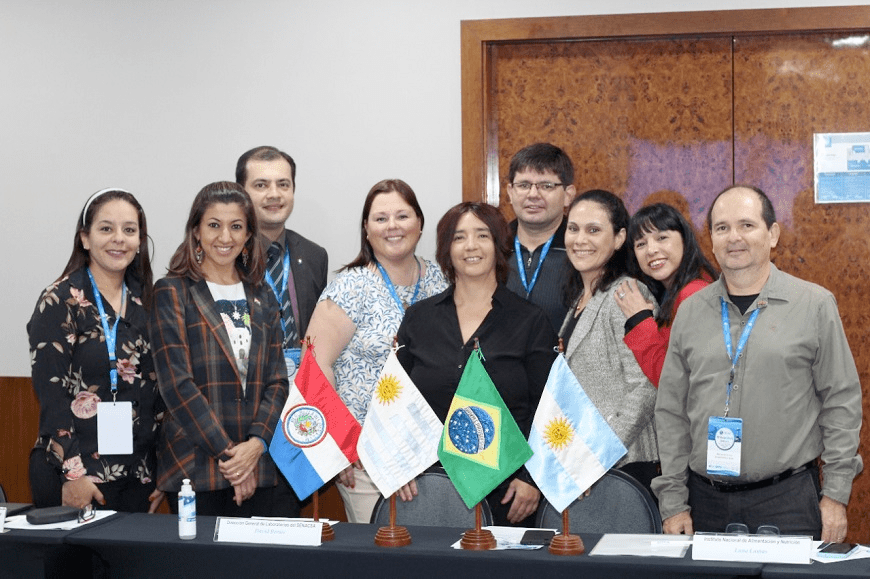
Paraguay – INAN present at international food analysis assembly

Professionals from the National Institute of Food and Nutrition (INAN in Spanish) represented the country at the event, which had as objectives, among others, to evaluate compliance with the 2021 – 2022 action plans, share knowledge and regional and international experiences on risks and contaminants in food, as well as the election of new members of the executive committee of the Inter-American Network for Food Analysis.