Articles – Paraguay: Confusion or fraud? Labeling of Stevia Sweeteners

Fraudulent labeling is an emerging problem in the food industry worldwide. Many Stevia sweeteners are marketed in Paraguay, and their labels can be confusing. For this reason, 21 packs of sweetener products were analyzed regarding their degree of compliance with the labeling regulations in force in the country. All of the analyzed containers complied with the MERCOSUR regulations on food labeling, and 95.2% complied with MERCOSUR regulations on nutritional labeling. Over half of the containers did not comply with the local regulation for the naming of Stevia products. This is the first study on possible fraudulent labeling carried out in Paraguay, and it highlights the need to monitor compliance of food labeling regulations in the country.

Articles – Brazil: A comparative assessment of two different front-of-package nutrition label designs: A randomized experiment in Brazil

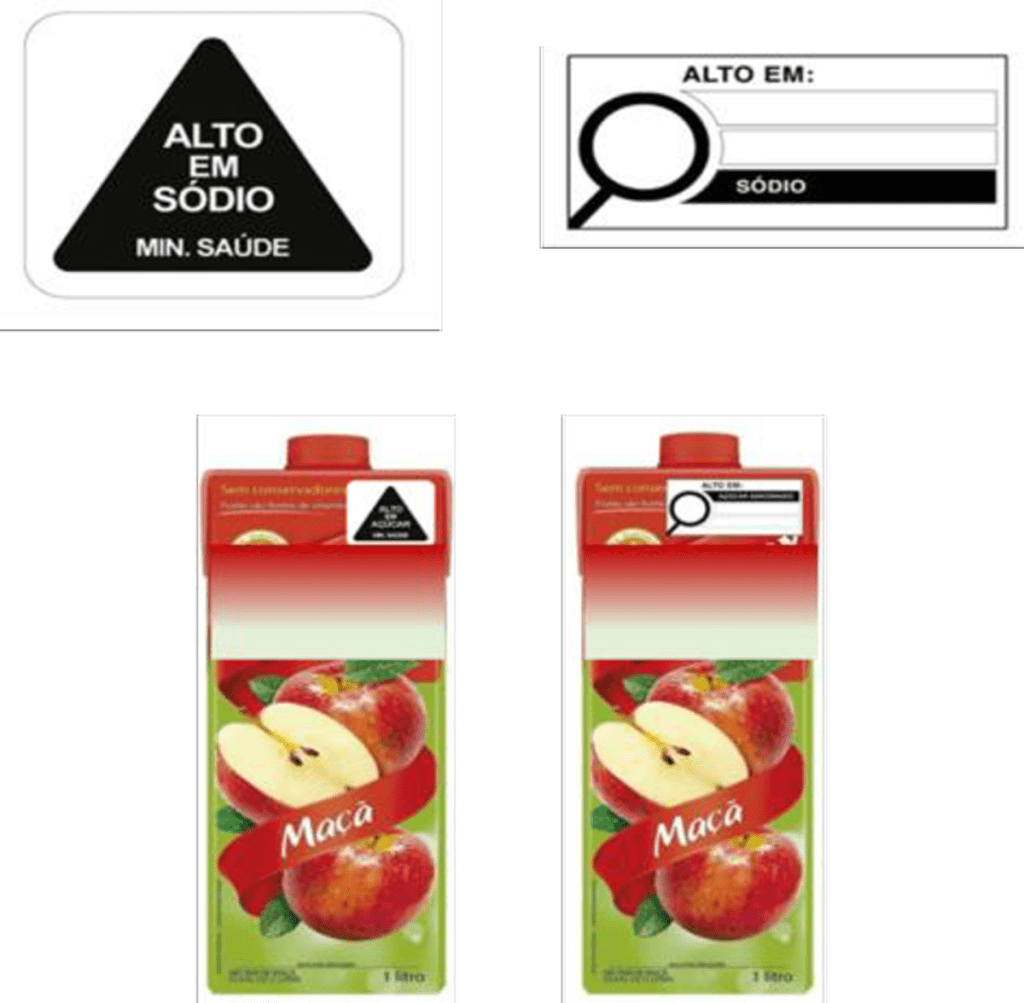
This study compares the effectiveness of different front-of-package label designs in a Brazilian sample (n = 1384). Eligible adults were randomized to one of two study arms and viewed images of snacks with either a triangular warning label (TL) or a rectangular ‘high in’ label with a magnifying glass (ML). They responded to a series of questions that captured label usefulness, understanding, and purchase intentions. Compared to participants in the ML arm, those in the TL arm agreed that the TL communicated important information [Mean (SD) – 5.47 (0.07) vs 4.49 (0.08), p-value <0.001], was a useful tool [Mean (SD) – 6.12 (0.06) vs 5.75 (0.07), p-value <0.001], and was easier to understand as measured subjectively [Mean (SD) – 4.96 (0.07) vs 4.44 (0.08), p-value <0.001]. However, both the TL and the ML performed similarly in communicating nutrient information as measured by the objective understanding of nutrient content [57.09% vs 54.65%, p-value 0.259]. The ML performed marginally better at improving purchase intentions [Mean (SD) – 2.57 (0.07) vs 2.79 (0.08), p-value <0.049]. The current study adds to the growing evidence base on the pathways through which FoP labels, particularly ‘high in’ labels, might influence consumer perceptions and behavior. It is also one of the first studies to provide evidence on the utility of the ML design for Brazil.

Articles – Uruguay: Consumer perspectives on the inclusion of nutritional warnings in retail food establishments

The present work aimed to assess Uruguayan consumers support of the inclusion of nutritional warnings on four types of retail food establishments and to obtain consumer insights on how the warnings could be implemented in such establishments. For this purpose, an online survey was conducted with a non-probabilistic sample of 547 participants recruited via an advertisement on social media. Participants were requested to indicate their degree of agreement with the implementation of nutritional warnings in bakeries, delicatessens, fast-food restaurants and while ordering food online, and to provide ideas on how to include this information for each establishment. Results suggested that the inclusion of nutritional warnings in retail food establishments was positively perceived by participants. Participants highlighted that warnings should be highly visible to customers while making purchase decisions, so they become a relevant cue for making food choices. In particular, the retail display case and menu boards were identified as key locations for warnings in bakeries, delicatessen, and fast food restaurants, respectively. These results contribute valuable insights on how to implement the extension of nutritional warnings to unpackaged foods or foods made and packaged at the point of purchase.

Article: Responsible Marketing in the Traffic Light Labeling of Food Products in Ecuador: Perceptions of Cuenca Consumers

Responsible marketing (RM) helps companies make products that improve people’s lives and is in line with public policies that provide a positive impact on society; an example of this is traffic light nutritional labelling (TLNL). Ecuador was a pioneer in Latin America in the mandatory implementation of TLNL. For this reason, this research aimed to analyze RM in the TLNL of food products from the perception of consumers in the urban area of Cuenca, Ecuador. Specifically, the research aimed to answer: What is the degree of consumer understanding of TLNL in the urban área of Cuenca, Ecuador? A cross-sectional investigation was undertaken, with 384 surveys conducted. A chi-square test ( 2) was performed, which showed the relationship between variables reflecting RM knowledge and the understanding and use of TLNL. An ordinal logit model (OLM) was applied, showing that the variables of education, knowledge of labeling, and knowledge of marketing were associated with a greater probability of having some level of understanding of TLNL. Finally, a binomial logit model (BLM) revealed that the variables of income level, knowledge of TLNL, illnesses, confidence in TLNL, the influence of COVID-19 on eating habits, and knowledge of marketing were associated with people being more likely to use TLNL. RM is present in the TLNL through the clear and understandable dissemination of information.

Article: Brazilian Consumers’ Perception towards Food Labeling Models Accompanying Self-Service Foods

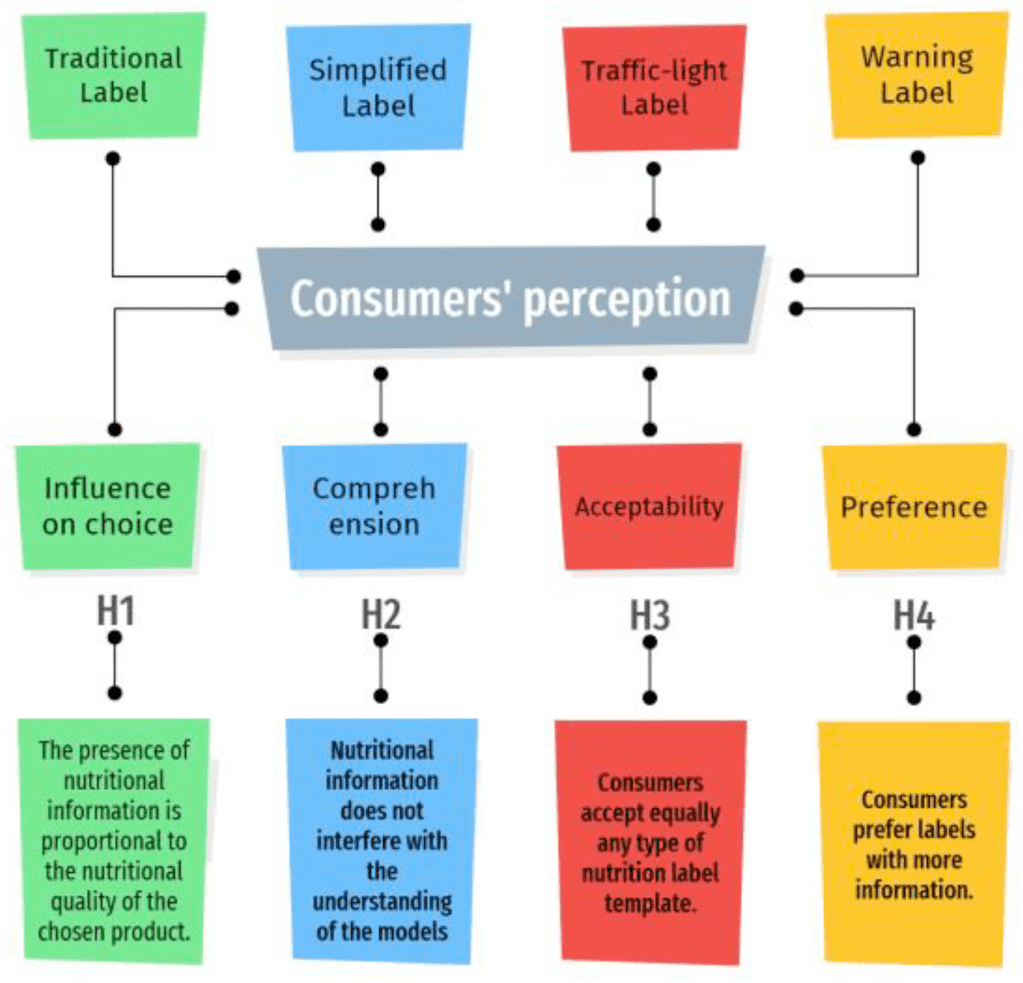
The study aimed to evaluate consumers’ perception of self-service foods’ nutrition labels. This qualitative and quantitative assessment was performed with potential consumers at food services. Four food labeling formats, traditional, simplified, traffic-light, and warning, were proposed to evaluate three types of sandwiches: simple, chicken, and hamburger. Data were collected via an online survey from April to May 2020. The study included 413 subjects. The respondents preferred the traffic-light format, but there was a good understanding and acceptability of all four models. The traffic-light and warning nutrition labeling models, which showed health warnings, led to a reduction in the choice of the Simple Sandwich and the Hamburger. Most respondents (96.1%, n = 397) agreed that it is necessary to complement the information on food labels with ingredients and the number of calories per serving. Therefore, it is essential to have legislation regulating such issues. Consumers’ choices improved with the increase in the information placed on the products.