Article – Efficacy of Brazilian and Mexican front-of-package nutrition labeling systems on simulated online purchase of non-alcoholic beverages by adolescents: A randomized controlled study

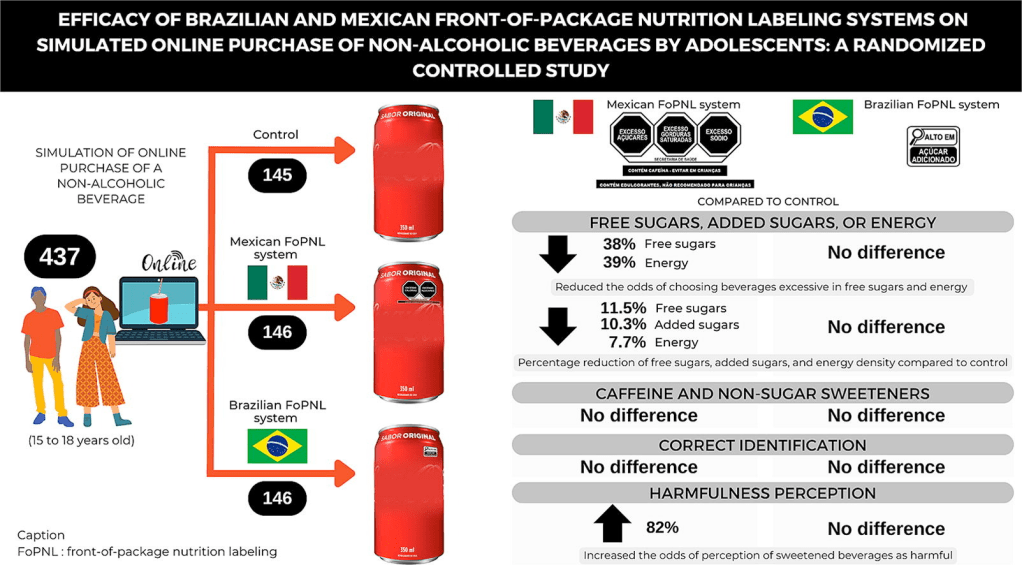
Front-of-package nutrition labeling (FoPNL) has been gaining prominence as a strategy to reduce the consumption of sugar-sweetened beverages as it helps consumers to clearly identify products with excess sugars. This study aimed to evaluate the efficacy of the Brazilian and Mexican FoPNL systems on simulated purchases of non-alcoholic beverages by adolescents in a fictitious online store. A total of 437 Brazilian adolescents (15 to 18 years old) participated in the study and were randomized into three experimental groups: control (online store with products displayed without FoPNL), Mexican FoPNL system (products with “excess in” octagonal black warning labels based on the Mexican nutritional profile), and Brazilian FoPNL system (products with “high in” magnifying glass icons following the Brazilian nutritional profile). FoPNL systems have been applied in accordance with the legislation of each country. Participants selected a non-alcoholic beverage to be purchased from 30 options in the experimental online store. After completing the simulated purchase, they responded to questionnaires regarding their perceptions of healthfulness, harmfulness, and excess nutrient content of the beverages, as well as their socioeconomic status. Compared to the control, the Mexican FoPNL system significantly reduced the prevalence of adolescents choosing beverages in the highest tertile of free sugar density (PR: 0.74, 95 %CI: 0.58 – 0.94), added sugar density (PR: 0.76, 95 %CI: 0.57 – 0.99), and energy density (PR: 0.75, 95 %CI: 0.58 – 0.96). Participants in the Mexican FoPNL system group selected beverages containing 11.5 %, 10.3 %, and 7.7 % less free sugars, added sugars, and energy density, respectively, compared to the control group. Regarding total quantities, the Mexican FoPNL system led to the choice of beverages with 5.3 %, 5.0 % and 3.7 % less free sugars, added sugars, and energy, respectively, than those in the control group. The Brazilian FoPNL system resulted in a 2.3 % reduction in the calories purchased compared to the control group but was ineffective in changing the amount of free and added sugars in the simulated purchases. Additionally, the Mexican FoPNL system increased the odds and the prevalence of participants perceiving sweetened beverages as harmful to health by 82 % and 30 %, respectively, compared to the control. In conclusion, the Brazilian FoPNL system was ineffective in reducing the simulated purchase quantities and densities of free sugars, added sugars, and energy. In contrast, the Mexican FoPNL system was effective, outperforming the Brazilian system by reducing the prevalence of participants choosing beverages in the highest tertiles of free sugar density, added sugar density, and energy density, and by increasing the odds and prevalence of adolescents recognizing sweetened beverages as harmful to health.
Food Research International Available online 2 January 2025, 115539

Article – Nutritional labeling of prepackaged food products for human consumption in Central America: The importance of its mandatory enforcement

In Central America, the prevalence of overweight and obesity continue to rise, contributing to the double burden of malnutrition, which encompasses both micronutrient deficiency and excess weight. This phenomenon is attributed to changes in dietary patterns, driven by the growth of consumption of ultra processed foods, regardless of economic income. Nutritional labeling emerges as a useful element for consumers, allowing them to make informed decisions about their diet and prevent diseases related to it. However, understanding nutritional labeling remains a challenge, especially in Central America, where education levels are low. The information on labels can be complex and difficult to interpret for many. This article advocates for mandatory nutritional labeling on packaged products and beverages in Central American countries, supported by available scientific evidence on the nutritional situation and consumption of ultra-processed foods. Recommendations are proposed for its implementation, monitoring and evaluation, mainly highlighting the transition to front labeling to facilitate consumer decision-making, promoting the right to health and the choice of healthy foods, in a society that is more aware and informed about its health, food and nutrition.

Article/Brazil – Relative effect of warning labels on food choice: Case study with four product categories after the implementation of the Brazilian regulation

Warning labels have been implemented in different countries around the globe, including Brazil, to encourage healthier food choices. The aims of the present study were to evaluate the relative effect of different warning labels, brands and nutrition marketing claims on the food choice after the implementation of the Brazilian front-of package nutrition labelling regulation. Packages of four categories were designed considering the following factors: brand (familiar vs. unfamiliar), nutritional warning (present or absent), textual nutrition marketing claims (present or absent) and visual nutritional marketing claims (present or absent). A total of 850 Brazilian adults were recruited by a marketing agency. Participants were randomly allocated to one of two experimental conditions: black magnifier (n = 403) and black octagon (n = 447). They completed a choice task involving two out of four product categories: chocolate flavored milk, cookies, granola, and iced tea. The packaging was designed considering four factors: The presence of warning labels encouraged product choice in three of the four categories. However, brand and textual nutrition marketing claims had a larger effect. These results suggest the need to introduce comprehensive packaging regulations to reduce the prevalence of nutrition marketing claims on unhealthy products, as well as communication campaigns to raise awareness of the benefits of taking into account warning labels when making food purchases.

Article – Analysis of the law for the promotion of healthy eating from the geography of the food (Argentina)

This work aims to carry out an analysis, from the geography of food or nutrition, about the application of the Law for the Promotion of Healthy Eating in Argentina. This law is well known as “front labeling” but beyond the labeling of food, it covers a broader panorama to bring the right to health and food closer to the population. The geography of food, for many authors, includes a perspective of food from the multiple branches of geography: economic, health, environmental, physical and cultural. Therefore, following this line, it is presented how the law has impacted people’s interest and disinterest in the consumption of packaged foods, as it has influenced the food industry (based on a market study focused on new products that companies offer “without seals”) and what are the points that still need to be taken up to guarantee food security, and the food safety of the population in terms of food and nutritional education. The situation in Quilmes (Province of Buenos Aires) was analyzed regarding the products presented in supermarkets and warehouses to know the changes in the marketing of food within the district and to carry out an analysis of the educational needs in relation to the law. To do this, an exploratory approach was started from the cultural geography of food. The results show industries have begun a process of reformulation and product development to reduce the number of stamps and legends. Finally, it is still necessary to evaluate and raise awareness about the risks related to the food safety of unpackaged products.

Article – Decreases in purchases of energy, sodium, sugar, and saturated fat 3 years after implementation of the Chilean food labeling and marketing law: An interrupted time series analysis

In 2016, Chile implemented a multiphase set of policies that mandated warning labels, restricted food marketing to children, and banned school sales of foods and beverages high in nutrients of concern (“high-in” foods). Chile’s law, particularly the warning label component, set the precedent for a rapid global proliferation of similar policies. While our initial evaluation showed policy-linked decreases in purchases of high-in, a longer-term evaluation is needed, particularly as later phases of Chile’s law included stricter nutrient thresholds and introduced a daytime ban on advertising of high-in foods for all audiences. The objective is to evaluate changes in purchases of energy, sugar, sodium, and saturated fat purchased after Phase 2 implementation of the Chilean policies.