The Bolivian Institute for Standardization and Quality (IBNORCA in Spanish) has published two draft standards related to Dairy Products and Flours of Plant Origin for public consultation.
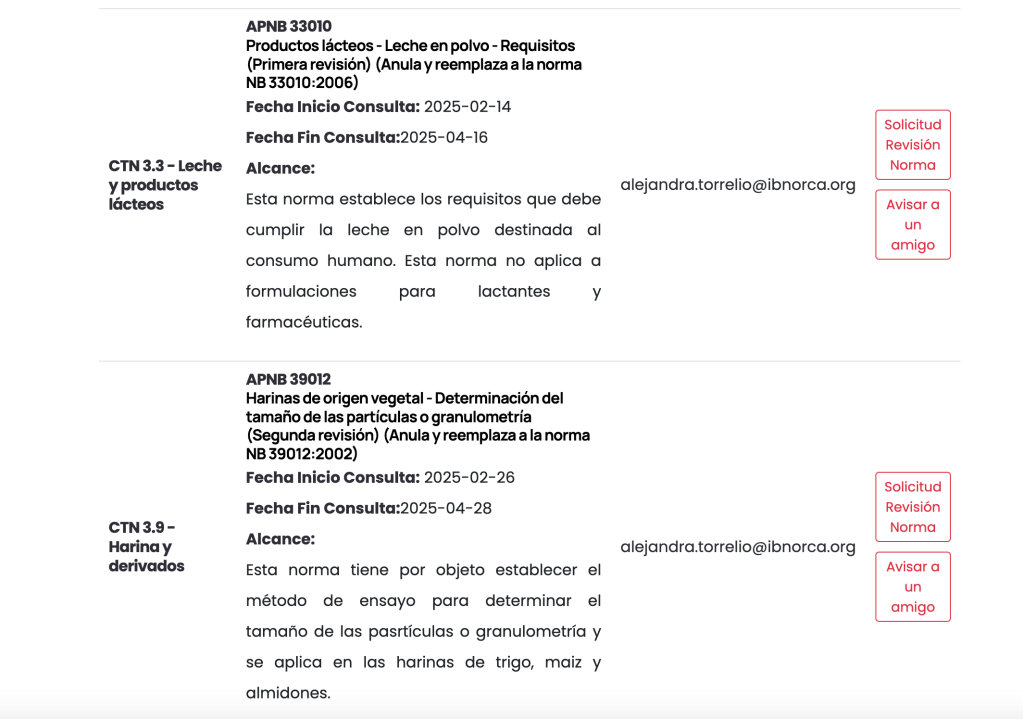
The Bolivian Institute for Standardization and Quality (IBNORCA in Spanish) has published two draft standards related to Dairy Products and Flours of Plant Origin for public consultation.
The National Service for Agricultural Health and Food Safety (SENASAG in Spanish) has published the Regulations for the issuance of the Hazard Analysis and Critical Control Points (HACCP) Plan Validation Certificate for food companies.
All natural or legal persons, owners or holders of food companies established in the national territory, that have a valid Sanitary Registration, and that have implemented their HACCP Plan as a food safety assurance system and request their Validation Certificate are subject to the validation of the Hazard Analysis and Critical Control Points (HACCP) Plan.
The Ministry of Health has presented a draft of the “Guidelines Establishing the Requirements and Procedures to be Observed by Advertising Officials, Advertisers, Advertising Agencies, and Media Outlets to Obtain Permission to Advertise Prepackaged Food and Non-Alcoholic Beverages on Broadcast and Non-Broadcast Television, Movie Theaters, the Internet, and Other Digital Platforms.”
Purpose: To establish the requirements and procedures to be observed by advertising officials, advertisers, advertising agencies, and media outlets to obtain permission to advertise prepackaged food and non-alcoholic beverages on broadcast and non-broadcast television, movie theaters, the Internet, and other digital platforms, in accordance with the provisions of Articles 22 Bis, 24 Bis, and 79, Section X of the Regulations of the General Health Law on Advertising, and in compliance with the principle of the best interests of children established in Article 4 of the Political Constitution of the United Mexican States.
The requirements and procedures established in these Guidelines are mandatory.
Relevant aspects:
The National Health Surveillance Agency (ANVISA in Portuguese) has published Normative Instruction IN No. 351/2025 amending Normative Instruction – IN No. 160/2022, which establishes the maximum tolerated limits (MRLs) for contaminants in food.
The National Directorate of Sanitary Surveillance (DINAVISA) has released a draft of the technical regulation that outlines the composition and labeling requirements for gluten-free packaged foods sold within the national territory, along with a guide for good manufacturing and storage practices.
The aim of this regulation is to establish the criteria that must be met by packaged foods, whether domestically produced or imported, that are marketed as “gluten-free,” “free of gluten,” “exempt from gluten,” or “does not contain gluten.” Additionally, it includes control measures designed to ensure that consumers receive accurate, clear, and truthful information regarding the absence of gluten in the composition of these packaged foods.
 infoAlimentario