Argentina – Amendment to the Food Code regarding cinnamon pepper

Through Joint Resolution 10/2025, the Secretariat of Health Management and the Secretariat of Agriculture, Livestock, and Fisheries have issued an amendment to the Food Code regarding canelo pepper.

ARTICLE 1.- The Article 1236 bis is hereby added to Chapter XVI: “Correctives and Adjuvants” of the Argentine Food Code, which shall be stated as follows: “Article 1236 bis: The term ‘canelo pepper’ refers to the mature, dried berries of the species Drimys winteri J.R. Forst. & G. Forst., whether whole or ground. Canelo pepper, in either whole or ground form, must meet the following requirements:

Moisture at 100-105°C: Maximum 7%

Total ash at 500-550°C: Maximum 3%.

Ash insoluble in 3% hydrochloric acid: Maximum 1%.

Fixed ether extract: Minimum 6%.

Foreign matter in whole canelo pepper:

a) Maximum 1.5% of foreign matter (any plant material from the specific plant except for the required part),

b) Maximum 0.5% of extraneous materials (any visible and/or apparent matter that is not typically associated with the product).”

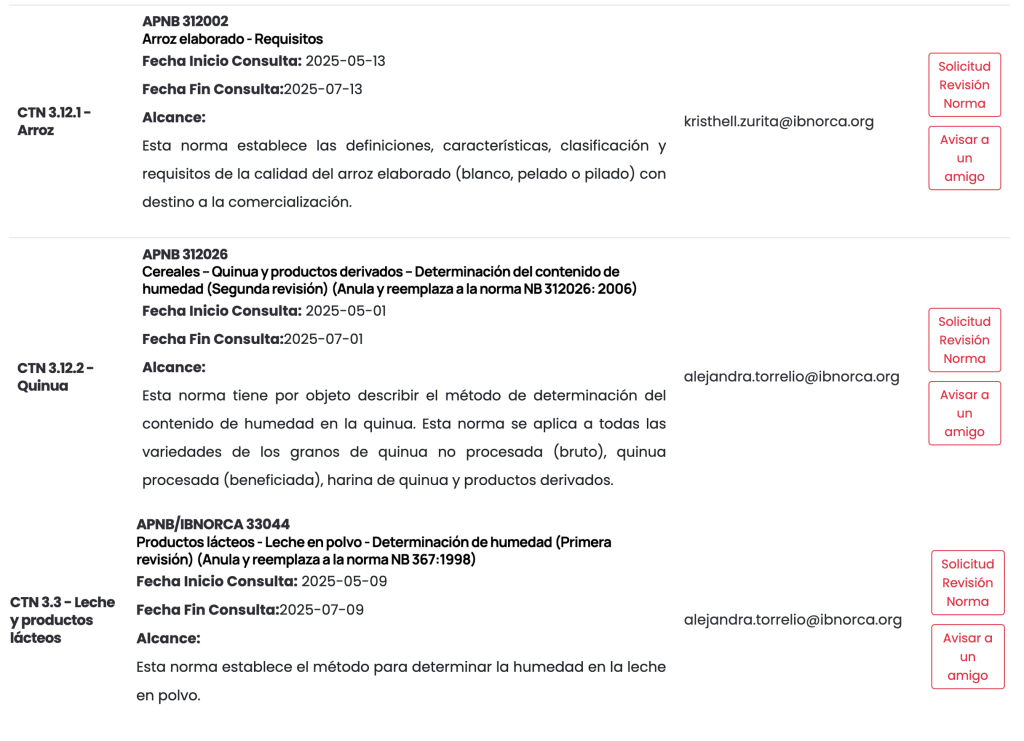
Bolivia – IBNORCA announces two draft standards for dairy products and plant-based flours in public consultation

The Bolivian Institute for Standardization and Quality (IBNORCA in Spanish) has published two draft standards related to Dairy Products and Flours of Plant Origin for public consultation.

Bolivia – SENASAG publishes Regulations for the issuance of the Hazard Analysis and Critical Control Points (HACCP) Plan Validation Certificate for food companies

The National Service for Agricultural Health and Food Safety (SENASAG in Spanish) has published the Regulations for the issuance of the Hazard Analysis and Critical Control Points (HACCP) Plan Validation Certificate for food companies.
All natural or legal persons, owners or holders of food companies established in the national territory, that have a valid Sanitary Registration, and that have implemented their HACCP Plan as a food safety assurance system and request their Validation Certificate are subject to the validation of the Hazard Analysis and Critical Control Points (HACCP) Plan.

Mexico – New Guidelines for Advertising Prepackaged Foods in Mexico

The Ministry of Health has presented a draft of the “Guidelines Establishing the Requirements and Procedures to be Observed by Advertising Officials, Advertisers, Advertising Agencies, and Media Outlets to Obtain Permission to Advertise Prepackaged Food and Non-Alcoholic Beverages on Broadcast and Non-Broadcast Television, Movie Theaters, the Internet, and Other Digital Platforms.”

Purpose: To establish the requirements and procedures to be observed by advertising officials, advertisers, advertising agencies, and media outlets to obtain permission to advertise prepackaged food and non-alcoholic beverages on broadcast and non-broadcast television, movie theaters, the Internet, and other digital platforms, in accordance with the provisions of Articles 22 Bis, 24 Bis, and 79, Section X of the Regulations of the General Health Law on Advertising, and in compliance with the principle of the best interests of children established in Article 4 of the Political Constitution of the United Mexican States.
The requirements and procedures established in these Guidelines are mandatory.

Relevant aspects:

  • Terms and definitions (Children’s characters, cartoons, celebrities, animations)
  • Establishes the permitted media for advertising prepackaged foods and non-alcoholic beverages.
  • Prohibits the inclusion of children’s characters, animations, cartoons, celebrities, athletes, or mascots, interactive elements, such as visual-spatial games or digital downloads, aimed at children that incite, promote, or encourage the consumption, purchase, or selection of such products.
  • Comparisons with foods and non-alcoholic beverages of natural origin must be included in the upper right corner of the advertising, in a clear, visible, and legible manner, the elements of the front-of-package labeling system for the advertised product(s).
  • Establishes the requirements and procedure for evaluation and ruling.

Brazil – ANVISA amends the regulations on maximum tolerated limits for contaminants in food

The National Health Surveillance Agency (ANVISA in Portuguese) has published Normative Instruction IN No. 351/2025 amending Normative Instruction – IN No. 160/2022, which establishes the maximum tolerated limits (MRLs) for contaminants in food.