Peru – INACAL publishes 6 new Peruvian Technical Standards on food

The National Institute of Quality (INACAL), thru Directoral Resolution No. 000014-2026-INACAL/DN, has published 6 Peruvian Technical Standards (NTP), which establish requirements, testing methods, guidelines, and technical criteria for activities related to agro-industry and food.

  1. NTP 011.711:2026. VEGETABLES AND DERIVED PRODUCTS. Carrot. Requirements. 1st Edition. It establishes the requirements that fresh carrots, intended for direct human consumption, must meet, applicable to carrot varieties and vegetables belonging to the Apiaceae family, genus Daucus, species Carota L.
  2. NTP 011.713:2026. VEGETABLES AND DERIVED PRODUCTS. Red onion. Requirements. 1st Edition. It establishes the requirements that red onion (Allium cepa L.) must meet for commercialization and consumption in fresh state.
  3. NTP 105.005:2026. MILK AND DAIRY PRODUCTS. Creamy cheese. Requirements. 1st Edition. It establishes the requirements that butter cheese must meet.
  4. NTP-ISO 10520:2026. Native starches and flours. Determination of starch content. Ewers’ Polarimetric Method. 1st Edition. Specifies a polarimetric method to determine the starch content in native starches and flours, with the exception of starches with a high amylose content.
  5. NTP 106.010:2026. BREAD, PASTRY, AND COOKIE MAKING. Doña Pepa Nougat. Requirements. 1st Edition. The present Peruvian Technical Standard establishes the requirements that Doña Pepa Nougat must meet.
  6. NTP-ISO 8128-2:2026. Apple juice, apple juice concentrates, and beverages containing apple juice. Determination of patulin content. Part 2. 1st Edition. Specify a method using thin-layer chromatography for the determination of patulin content in apple juice, apple juice concentrates, and beverages containing apple juice.

Peru – INACAL publishes 16 Peruvian Technical Standards (NTP in Spain) related to agroindustry, food, and alcoholic beverages

The National Institute of Quality (INACAL in Spain), thru Directoral Resolution No. 000013-2026-INACAL/DN, has published 16 Peruvian Technical Standards (NTP in Spain) related to agroindustry, food, and alcoholic beverages

  1. NTP 205.055:2017 (revised in 2026). ANDES GRAINS. Kiwicha in grain. Testing methods. 2nd Edition. Describe the testing methods to be followed for determining the degrees, mass of 1,000 grains, total damaged grains, and foreign matter of amaranth seeds.
  2. NTP 012.502:2021 (revised in 2026). BLUEBERRY. Good Agricultural Practices. 1st Edition. It establishes good agricultural practices for blueberry production, with the aim of ensuring its commercial quality and that it is a safe, healthy product free from contaminants that could harm consumer health.
  3. NTP 210.027:2021 (revised in 2026). ALCOHOLIC BEVERAGES. Labeling. 4th Edition. It establishes the minimum information that must be included on the labeling of alcoholic beverages packaged in the country or abroad, for their commercialization.
  4. NTP 211.011:2021 (revised in 2026). ALCOHOLIC BEVERAGES. Rum. Requirements. 4th Edition. It establishes the technical characteristics, definitions, classification, requirements, sampling and analysis methods, labeling, and packaging that the alcoholic beverage known as rum must meet.
  5. NTP 211.041:2012 (revised in 2026). ALCOHOLIC BEVERAGES. Testing method. 2nd Edition. It establishes the method for determining the total dry extract in alcoholic beverages.
  6. NTP 212.008:2009 (revised in 2026). ALCOHOLIC BEVERAGES. Wines. Determination of chlorides. 3rd Edition. It establishes the method for quantitatively determining chlorides in wine, applicable to both domestically produced and imported wines.
  7. NTP 212.039:2009 (revised in 2026). ALCOHOLIC BEVERAGES. Wines. Determination of malvidin diglucoside. 1st Edition. It establishes the method for quantitatively determining malvidin-3-glucoside in wines, applicable to all wines, both domestically produced and imported.
  8. NTP 212.052:2017 (revised in 2026). WINE ALCOHOLIC BEVERAGES. Wines. Determination of arsenic. 1st Edition. It establishes the method for quantitatively determining the arsenic content in wines, applicable to both domestically produced and imported wines, using atomic absorption spectrometry.
  9. NTP 212.036:2009 (revised in 2026). ALCOHOLIC BEVERAGES. Wines. Determination of total dry extract. 1st Edition. It establishes the method for quantitatively determining the total dry extract in wines, applicable to all wines, both domestically produced and imported.
  10. NTP 212.032:2017 (revised in 2026). WINE ALCOHOLIC BEVERAGES. Wines. Determination of methanol. 2nd Edition. It establishes the method for determining the methanol content in wine, by molecular spectrophotometry (UV/VIS) or gas chromatography, applicable to all wines, both domestically produced and imported.
  11. NTP 212.037:2009 (revised in 2026). ALCOHOLIC BEVERAGES. Wines. Determination of citric acidity. 1st Edition Establishes the method for quantitatively determining citric acidity in wines, applicable to all wines, both domestically produced and imported.
  12. NTP 212.031:2009 (revised in 2026) ALCOHOLIC BEVERAGES. Wines. Determination of volatile acidity. 2nd Edition. It establishes the method for the quantitative determination of volatile acidity in wines, applicable to all domestically produced and imported wines.
  13. NTP 110.300:2021 (revised in 2026). MALT NUTRITIONAL BEVERAGE. Determination of pH. 1st Edition. It establishes the method for determining pH in malt nutritional beverages.
  14. NTP-ISO 18606:2021 (revised in 2026) Packaging and the environment. Organic recycling. 1st Edition. It establishes the procedures and requirements for packaging that is suitable for organic recycling. The packaging is considered recoverable thru organic recycling only if all individual components meet the requirements.
  15. NTP-ISO 4832:2021 (revised in 2026) Microbiology of food for human and animal consumption. Horizontal method for the enumeration of coliforms. Colony counting technique. 1st Edition. It provides general guidelines for the enumeration of coliforms, applicable to products intended for human consumption and animal feed; and environmental samples in the area of food production and handling.
  16. NTP-ISO 4833-1:2021 (revised in 2026). Microbiology of the food chain. Part 1: Colony Count at 30 °C Using the Pour Plate Technique. 1st Edition. This part of ISO 4833 specifies a horizontal method for the enumeration of microorganisms that are capable of growing and forming colonies on a solid medium after aerobic incubation at 30 °C.

Panama – Deputies propose to discuss front labeling in the first debate of the Commission on Labor, Health, and Social Development

The bill 402, which establishes the mandatory nutritional labeling on all food at the national level, is on the agenda to be discussed in the first debate, once the Labor, Health, and Social Development Commission is installed.

The initiative presented by Deputy Jairo Salazar aims to promote healthy eating and protect the health of the population by supporting the national health system.

The project presented in the past legislative period was subjected to a consultation process with all sectors involved in the matter, which included the participation of the Ministry of Health.

According to the regulation, the established provisions are intended to be applicable to all products produced or imported in the country and intended for human consumption.

According to Deputy Salazar, his proposal will be beneficial, as it could be an effective tool to help consumers choose healthy foods, making the most of the potential of nutritional labels and health claims to improve their health.

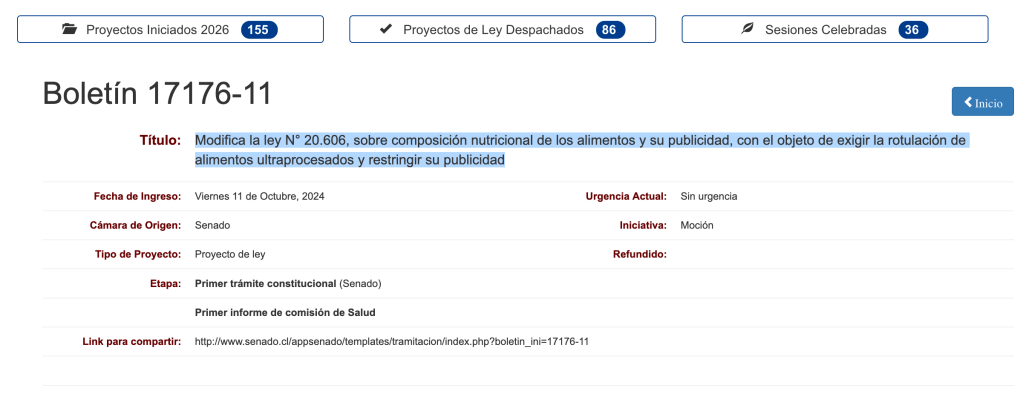
Chile – Senators propose amending Law No. 20,606, on the nutritional composition of foods and their advertising, with the aim of requiring the labeling of ultra-processed foods and restricting their advertising

The week of August 3, the Health Commission would begin voting on the amendments, most of which would focus on the definition of these types of products.

The Commission agreed to present indications by Thursday, July 30, after which they will proceed to vote on the proposed amendments. The idea is to legislate promptly considering the high rates of overweight and obesity in the population, and their incidence in non-communicable diseases.

The motion authored by Senator María José Gatica and sponsored by Senator Ximena Ordenes and Senators Juan Castro and Alejandro Kusanovic, as well as former Senator Francisco Chahuán, seeks to label as ultra-processed those food products that contain more than five ingredients formed from chemical-industrial processes.

Moreover, the initiative states that the advertising of these products cannot be directed at children under fourteen years old. It establishes that advertising will be understood as any form of promotion, communication, recommendation, propaganda, information, or action intended to promote the consumption of a specific product, including that developed on digital platforms and paid internet ads.

Argentina – New regulation approved for the commercialization of genetically modified microorganisms

The Secretariat of Agriculture, Livestock, and Fisheries of the Ministry of Economy of the Nation updated the procedures for the submission and evaluation of applications related to Genetically Modified Microorganisms (GMM in Spanish), thru new regulations that unify and simplify the currently existing procedures.

The measure, thru Resolution No. 96/2026, establishes a Regulation and a Single Form, which organizes the procedures into three types: authorization to conduct trials or experimental activities under controlled conditions with viable GMOs; risk assessment as a prerequisite for requesting commercial authorization; and determination of the absence of viable GMOs in products derived from GMOs.

The new framework replaces the previous scheme, which included separate procedures for the experimental stage and for the pre-commercial authorization evaluation. This new update allows for the organization of processes, avoids information duplication, reduces administrative burdens, and facilitates the submission of applications by developers, researchers, companies, and institutions within the scientific and technological system. Likewise, the new scheme reduces the duplication of required information and simplifies the application submission process, adapting to the different types of users and evaluation stages.