Brazil – Anvisa provides information regarding the cannabis plantation regularization process

The National Health Surveillance Agency (ANVISA in Portuguese) has presented an update regarding the measures taken by the Agency to comply with the ruling of the Superior Court of Justice (STJ in Portuguese) concerning the cultivation of cannabis solely for medicinal and pharmaceutical purposes.

The ongoing work aims to adhere to the aforementioned STJ ruling, which acknowledged the right to import hemp seeds, as well as to plant, cultivate, and market industrial hemp exclusively for medicinal and pharmaceutical uses.

The report highlighted several issues that need to be addressed in the regulatory debate, which are already being tackled by ANVISA’s technical teams. These include:

  • Compliance with the judicial decision.
  • The definition of scientific research involving cannabis.
  • The potential impacts of future regulations on existing judicial decisions and the judicialization process.
  • The necessary timelines for regulatory compliance and the internal implementation of the proposed regulation.
  • The effects that establishing a maximum percentage of THC (tetrahydrocannabinol) could have on cannabis-based medications and products already registered with the Agency that exceed this percentage.

According to the speaker, the discussion regarding the THC percentage limit is one of the central points that must be analyzed in the regulatory process to ensure it does not become an obstacle to the research and development of new medications.
Brazil – The Health Surveillance Agency of Natal announces the release of the brochure and technical manual on Dietary Supplements, Traditional Chinese Medicine, and Herbal Products

The Health Surveillance Agency of Natal (VISA Natal in Portuguese), in partnership with Sebrae-RN and with the support of the Federal University of Rio Grande do Norte (UFRN), conducted a Technical Seminar on Dietary Supplements, which addressed health regulations, industrialization, and the marketing of these products. The event also marked the launch of a brochure and a technical manual containing guidelines for the public and entrepreneurs in the sector.

During the event, the brochure and the technical manual on Dietary Supplements, Traditional Chinese Medicine, and Herbal Products were launched. This material is the result of collaboration between Gabrielle Medeiros, a Nutrition student at UFRN, and VISA Natal. “The brochure is aimed at the general consumer, while the technical material is intended for companies and technical managers, with the goal of promoting safer marketing and production of supplements in the municipality,” Sônia explained.

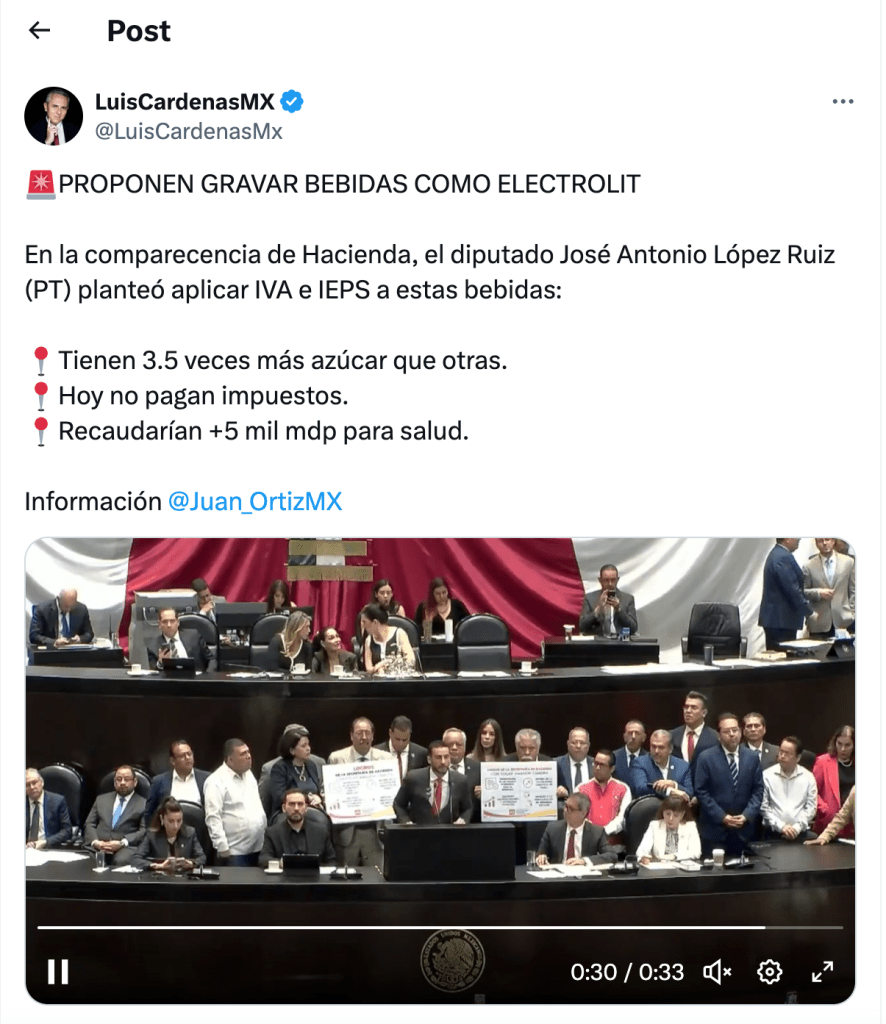
Mexico – Lawmakers propose to impose taxes on electrolyte beverages due to their high sugar content

The Ministry of Finance and Public Credit (SHCP) is considering the implementation of taxes on beverages classified as sweetened oral rehydration solutions, such as Electrolit and Suerox. This measure could contribute up to 5 billion pesos to the public budget in 2026, according to estimates from legislators in Congress. This statement arises during the discussion of the Economic Package 2026 in the Chamber of Deputies, in response to criticisms regarding the current tax treatment of these products, which are registered as medications.

Federal Deputies from the PT and the Green Party proposed to the Secretary of Finance, Édgar Amador Zamora, to include the taxation of oral electrolytes in the economic package, arguing that these beverages do not meet health standards and contain high levels of sugar.
Deputy Ernesto Núñez Aguilar from the PVEM stated that some companies register their beverages as “medications” to circumvent the warning labels mandated by the Official Mexican Standard 051 and to avoid taxes, thereby creating unfair advantages over other sweetened beverages.

Peru – INACAL has approved 5 new Peruvian Technical Standards regarding food for human consumption

The National Institute of Quality (INACAL in Spanish), through Directoral Resolution No 021-2025-INACAL/DN, has published 5 new Peruvian Technical Standards concerning food for human consumption.

  1. NTP 202.030:2025 Milk and dairy products. This standard establishes qualitative testing methods to assess the acceptability of milk upon receipt. Application: dairy production, dairy processing plants, quality control laboratories, cooperatives, and collection centers.
  2. NTP 202.119:2025 Milk and dairy products. This standard specifies the testing method for determining total nitrogen in milk using the Kjeldahl method. Application: dairy production and processing sectors, quality control, food industry, and regulatory bodies.
  3. NTP 011.714:2025 Vegetables and derived products. Celery. This standard sets the requirements for fresh celery intended for direct human consumption. Application: agriculture, marketing and distribution of fresh food, wholesale and retail markets, export, quality control, and safety.
  4. NTP 011.715:2025 Vegetables and derived products. Cabbage. This standard outlines the requirements for fresh cabbage intended for direct human consumption. Application: agriculture, marketing and distribution of fresh vegetables, wholesale and retail markets, export, quality control, and safety.
  5. NTP 011.457:2025 Quinoa and its derivatives. This standard establishes the requirements for extruded flour derived from quinoa grains intended for direct human consumption or other industrial uses. Application: agriculture, food, marketing, export, quality control, and research.

Peru – Ministry of Health approves the health regulation for food transportation

The Ministry of Health has approved NTS No. 234-MINSA/DIGESA-2025, the Sanitary Standard for food transportation. This Sanitary Standard is mandatory at the national level and applies to both natural and legal persons, whether public or private, involved in the transportation of industrialized food, whether in bulk or pre-packaged, as well as culinary preparations, within the national territory, as follows:

  • Transportation of food intended for various distribution establishments (warehouses) and marketing outlets (markets, grocery stores, restaurants, and similar venues, self-service stores, convenience shops, among others);
  • Transportation of culinary food intended for collective feeding services operating in various establishments (health facilities, food programs, civil organizations, school cafeterias, companies, factories, mining camps, among others);
  • Transportation of bulk food placed in containers, intended for the food industry and for portioning.
  • Delivery of food from production and marketing establishments to the final consumer.

Transportation intended for export is excluded from the scope of this Sanitary Standard.