Article: Efforts in adopting the ultra-processed food and soft drinks labeling legislation in a COVID-19 environment: The cases of Colombia and Mexico

Diabetes contributes to COVID-19 deaths in Colombia and Mexico, where the latter having the highest prevalence of diabetes among OECD countries. Some reports consider that advertising influences diabetes by confusing labels on ultra-processed foods and soft drinks that lead to unhealthy food choices. Both countries are in the process of modifying their labeling legislation; however, governments and food industries have pushed to delay its implementation. Using a mixed research design, we interviewed 550 consumers in both countries during June–July 2020; a high number of respondents misunderstand today’s food labeling and are unaware of the new labeling legislation. Respondents strongly agree that the food industry should be in charge of changing the labels; otherwise, they would consider not buying their products. Using cluster analysis, we identified three groups that would help design public policies, nutritional and educational campaigns. Although changes in food labeling alone are not enough to reduce obesity and diabetes rates, food labels constitute public health tools due they assist consumers to make food and nutritional choices (considering that nutrition can help prevent and overcome COVID-19). The costs of maintaining current labels could increase Colombians and Mexicans illnesss and poverty. These deceptive practices of the food industry would harm their brands.


Colombia: Colombia Issues Nutrition and Front of Pack Labeling Requirements for Processed Foods

On June 16, 2021, Colombia’s Ministry of Health and Social Protection (MINHEALTH) issued Resolution No. 810 establishing the technical regulation for nutrition and front-of pack labeling requirements for packaged food for human consumption, which will go into effect on December 16, 2022. This report includes the original regulation and an English translation.

Costa Rica: Draft Costa Rican Technical Regulation (RTCR) No. 506: 2022. Sauces and like products. Mayonnaise. Specifications

The purpose of the notified Technical Regulation is to establish the technical specifications to be met by mayonnaise, whether produced domestically or imported for human consumption, which is offered to the end consumer or for catering purposes, and which is marketed throughout the national territory.

EU -EFSA: Public Consultations/Draft opinion on review of existing health based guidance values for copper

EFSA’s Methodology and Scientific Support (MESE) Unit has launched an open consultation on the draft Scientific Opinion on an Acceptable Daily Intake (ADI) for exposure to copper, in response to a mandate by the European Commission (M-2020-0087). The approach applied in this assessment is the first case of a compound that falls within the context of the 2021 EFSA Statement on “Establishing health-based guidance values for regulated products that are also nutrients”. The aim of this public consultation is to collect constructive input on the establishment of an ADI for copper, within the context of the 2021 EFSA Statement and other relevant EFSA Guidance.

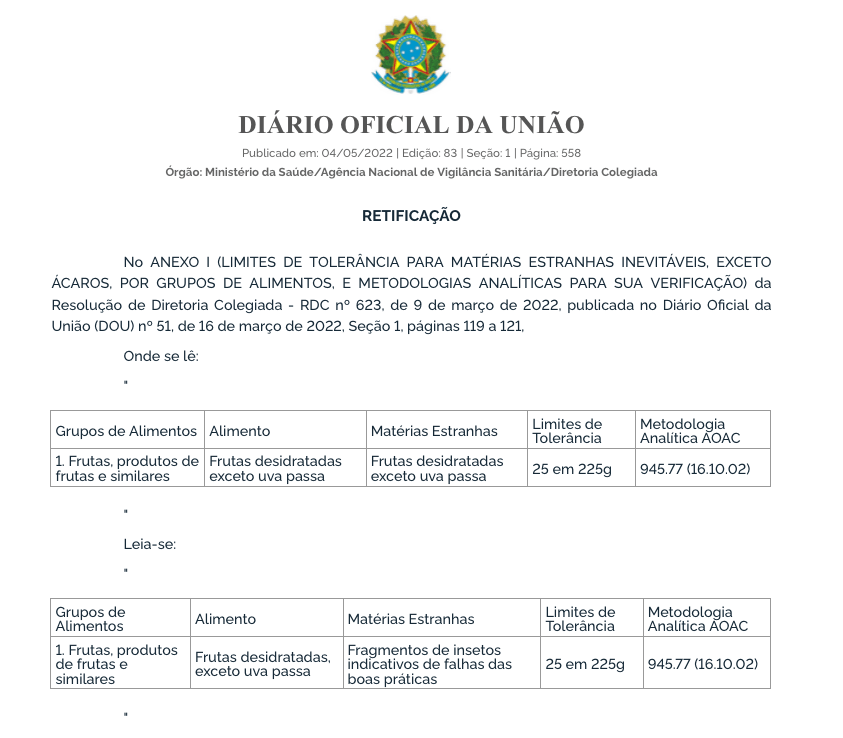
Brazil: Tolerance limits for inevitable foreign matter, except mites in food

In ANNEX I (TOLERANCE LIMITS FOR UNEVITABLE FOREIGN MATTER, EXCEPT FOR CARBON, BY FOOD GROUPS, AND ANALYTICAL METHODOLOGIES FOR THEIR VERIFICATION) of the Resolution of the Collegiate Council – DRC No. 623, of March 9, 2022, published in the Official Journal of the Federation (DOU ) No. 51, of March 16, 2022, paragraph 1, folios 119 to 12.