Peru – Zero Hunger Commission addressed use of pesticides, trans fats and octogons for healthy eating

The Special Multi-Party Commission for Monitoring, Control and Oversight of the Zero Hunger Program organized a working group to address the challenges in nutrition and public health related to the use of pesticides, trans fats in processed foods and the optional deficient labeling of products offered in the market.

According to its president, Roberto Kamiche Morante (APP), the objective is to promote healthier family diets, reduce the risks of toxic substances, ultra-processed foods and improve the nutritional information available, all with the aim of reducing chronic diseases and improving public health in the long term.

This is a crucial task, said the representative for La Libertad, “to move towards a public health model that promotes healthier nutrition and results in the prevention of chronic diseases, such as cancer”.

For Kamiche Morante, the “implementation of stricter policies and consumer education are essential to generate a healthier food environment, where people have access to clear information and make conscious decisions that favor their wellbeing”.

Mexico – Published amendment to the General Health Law on trans fats

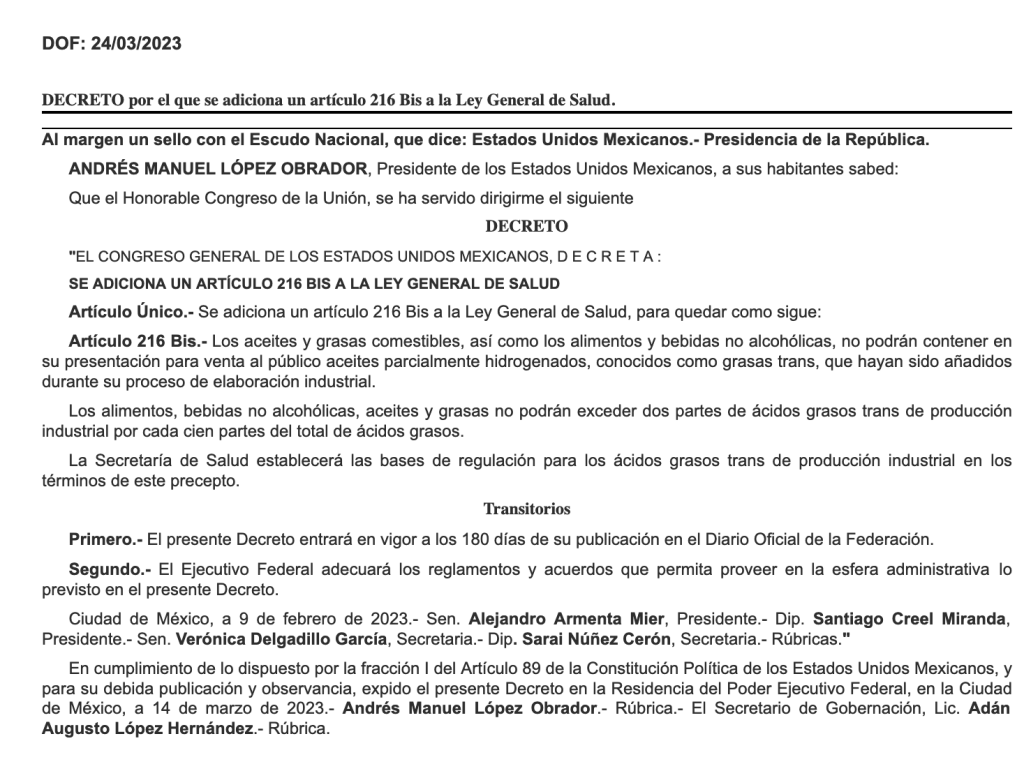
DECREE adding an article 216 Bis to the General Health Law.

Sole Article.- An article 216 Bis is added to the General Health Law, to read as follows:
Article 216 Bis.- Edible oils and fats, as well as food and non-alcoholic beverages, may not contain in their presentation for sale to the public partially hydrogenated oils, known as trans fats, which have been added during their industrial manufacturing process.
Foods, non-alcoholic beverages, oils and fats may not exceed two parts of industrially produced trans fatty acids for every one hundred parts of total fatty acids.
The Ministry of Health will establish the regulation bases for industrially produced trans fatty acids under the terms of this precept.

Mexico – Reform to the General Health Law to regulate trans fats in foods

The Chamber of Deputies unanimously approved the amendment to the General Health Law that eliminates the use of trans fats in food and alcoholic beverages.

With 472 votes in favor, the opinion to the bill that adds Article 216 Bis establishes that “edible oils and fats, as well as food and non-alcoholic beverages, may not contain in their presentation for sale to the public partially hydrogenated oils, known as trans fats, that have been added during their industrial elaboration process”.

The ruling, which was sent to the Federal Executive for its constitutional effects, adds that the Ministry of Health will establish the regulation bases for these industrially produced trans fats.

Brazil – Changes in the legislation related to Trans Fats

In December 2019, for example, the National Health Surveillance Agency (Anvisa) published Resolution of the Collegiate Council of Administration (RDC) 332/2019, with rules limiting the use of industrial trans fats in food. The rule provides for the implementation of the resolution in three phases.
The first phase involved imposing limits on industrial trans fats in the production of refined oils, limiting their presence in these products to 2% (maximum 2 grams per 100 grams of total fat). This restriction came into force on July 1, 2021.
On the same date, the restriction of trans fats in other foods, industrialized and sold at retail and wholesale, came into force. This change is effective until January 1, 2023.
The last phase of implementation, which will begin on January 1, 2023, provides for the prohibition of the ingredient “partially hydrogenated fat”, the main source of industrial trans fats in foods. Thus, the production, import, use and supply of partially hydrogenated oils and fats for use in foods and foods formulated with these ingredients will be prohibited.

Prof.ª Dr.ª Denise Pinheiro Soncini da Costa

Argentina – CONAL meeting reviews progress on front-of-package warning label and trans fats

The 146th regular meeting of the National Food Commission (CONAL in Spanish) was held recently. The following topics were reviewed:

  • Importance in the integration of the sanitary system of food control, as each area contributes to achieve better health.
  • Advances in the implementation of the access to the affidavit and the public search engine of the nutritional seals and warnings system.
  • Sending to administrative procedure the Draft Joint Resolution that establishes the new maximum limits for trans fatty acids in finished products and raw materials and the prohibition of the processing of partially hydrogenated vegetable oil of industrial production.
  • Sending to administrative procedure the projects referred to the modification of article 1353 bis of the Argentine Food Code (CAA) on the update in the specifications of infant formulas, the incorporation of new enzymes and native vegetable species.
  • The Commission agreed to consider new topics, among which are the integral proposal of the articles on peanuts and their derivatives, the incorporation of alcoholic beverages of artisanal production and the determination of the limit of arsenic in edible algae.