Colombia – Invima continues to monitor nutrition labeling on packaged and packaged foods

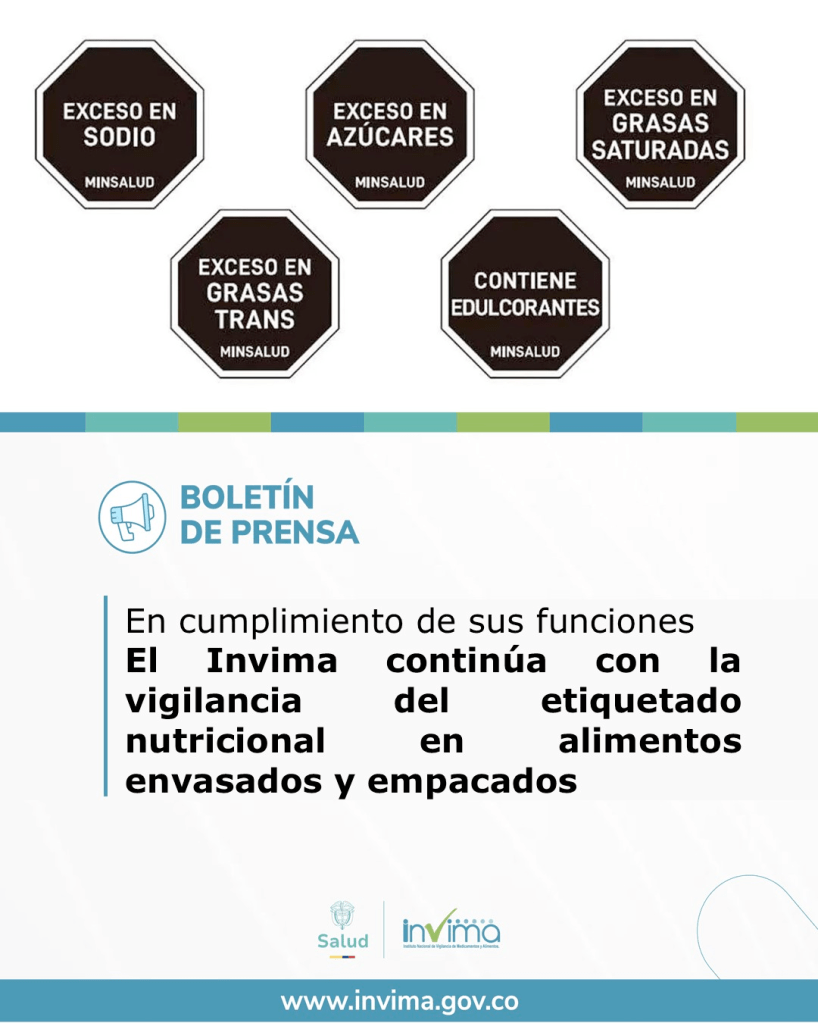
The National Institute for Drug and Food Surveillance (INVIMA in Spanish), in exercise of its inspection, surveillance and control functions, has been implementing rigorous actions to verify compliance with the technical regulation of nutritional and front labeling of packaged and/or packaged foods, in accordance with Resolution 810 of 2021, modified by Resolution 2492 of 2022 and by Resolution 254 of 2023).

Since the entry into force of these regulations, INVIMA has worked with the productive and commercial sector to ensure compliance with the requirements that allow consumers to have clear, understandable and truthful information on the products they consume.

These requirements include warning seals for foods that exceed certain levels of sodium, sugars and fats or contain sweeteners, allowing consumers to make better decisions focused on nutritional information.

During the transitional period, manufacturers, producers and sellers were able to use up stocks of previous labels without the need for authorization. Subsequently, the regulations empowered INVIMA, according to its procedures, to grant food manufacturers the exhaustion of labels and the use of adhesives.
Mexico – Ministry of Economy and Health extend deadline to implement next phases of nutrition labeling

The Ministry of Economy, through the Regulations, Competitiveness and Competition Unit, in coordination with the Ministry of Health, through the Federal Commission for the Protection against Health Risks (COFEPRIS in Spanish), inform companies in the pre-packaged food and non-alcoholic beverages sector that, through a joint agreement, it has been decided to extend the deadline for the second phase of implementation of the criteria for the evaluation of complementary nutritional information established in the Mexican Official Standard NOM-051-SCFI/SSA1-2010.

This decision, taken based on the applicable legal frameworks and considering the principles of legal certainty, transparency and regulatory improvement, was published today in the Official Journal of the Federation (DOF in Spanish) and responds to the need for adequate technical conditions for the transition to the third phase of compliance.

  • The period of the second phase of complementary nutritional labeling is extended from October 1, 2023 to December 31, 2025, thus granting three additional months for compliance under the current criteria.
  • The start of the third phase is deferred to January 1, 2026, at which time it will be mandatory to fully apply the provisions contained in numeral 4.5.3 and Table 6 of the NOM-051 amendment.
  • The measure allows the National Standardization Advisory Committees of the SE and COFEPRIS to move forward with the technical analysis of numeral 4.5.3, in accordance with the National Quality Infrastructure Program 2025, published on February 17 of this year.

Brazil – ANVISA published the 4th edition of the questions and answers document related to nutrition labeling

The National Health Surveillance Agency (ANVISA in Portuguese) has published the 4th edition of the questions and answers document related to nutrition labeling.

In this edition, changes were made to questions 44, 45 and 173 on the nutritional labeling of sweeteners, due to changes in the definition and framing of these products, made by Resolution of the Collegiate Council (RDC) 818/2023.

Questions 17 and 19 were modified to adapt the information related to DRC 839/2023, which seeks to demonstrate the safety of the use of novel foods and novel ingredients, and which repealed RES 16/1999.

Questions 46 and 47 were included in the document to clarify the additional nutrients to be declared mandatory in the nutritional table of special purpose foods.

Questions 55 and 60 have been revised to provide greater clarity and precision with respect to added sugars present in ingredients used as a source of dietary fiber, in accordance with the diversity of nomenclature, composition and methods used in the production of these ingredients.

Questions 160 and 161 were also added to clarify some readability requirements for the simplified declaration and the linear declaration of the nutrition table, and question 198, which addresses the application of tolerance values to the %DV declaration.

Caribbean Subregion – Healthy Caribbean Coalition works to create healthy environments through nutrition labeling

The Healthy Caribbean Coalition (HCC) is the only alliance of civil society organizations dedicated to noncommunicable diseases (NCDs) in the Caribbean sub-region, which has the highest NCD mortality rates in the Region of the Americas.
HCC has maintained official relations with the Pan American Health Organization (PAHO) since 2012. Collaboration between the two was formalized in 2020 through a series of letters of agreement that have facilitated significant achievements in several priority strategies related to NCDs in the Caribbean.
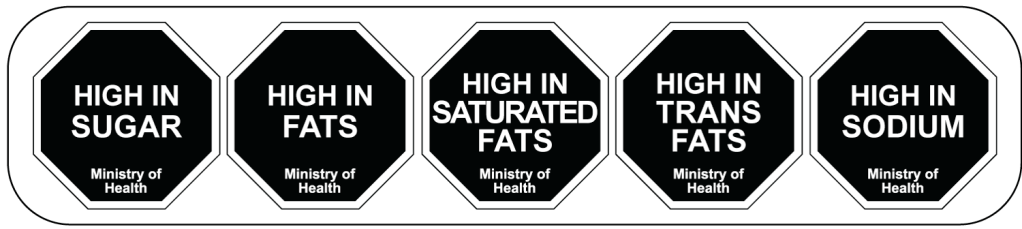
Nutrition labeling is a key area of joint work. The Caribbean subregion has long been engaged in the complex process of incorporating warning labels on the front of food products. As a strategic partner of PAHO, HCC is advocating for octagonal warning labels on the front of food products to be included in the Caribbean standard for the labeling of prepackaged foods.
As part of broader regional efforts to communicate and promote healthy food policies, PAHO and HCC have led a series of digital campaigns in several countries with regional partners such as the Caribbean Public Health Agency (CARPHA), the United Nations Children’s Fund (UNICEF), the Organization of Eastern Caribbean States (OECS) Commission, national civil society organizations and nearly 1500 individuals in the Caribbean who have expressed support for the inclusion of octagonal warning labels and have called for greater transparency and accountability in the standard setting process.

Brazil – Nutrition labeling: defined deadline for using old labels

Anvisa published, on 10/09, Resolution of the Collegiate Council (RDC) 819/2023, which specifically amends RDC 429/2020. As a result, the stock of containers and labels acquired by companies is allowed to be used up before October 8 of this year. These materials may be used until October 9, 2024.

The Agency’s decision considered, above all, the impacts of the pandemic on the food sector, including imbalances in the logistic supply chain, as well as the variation in the purchasing power of Brazilians and the consequent impact on the consumption of products.

It is important to note that DRC 819/2023 allows the use of only the existing stock of containers purchased up to October 8. Any and all packaging purchases made after October 9 of this year must comply with the provisions of RDC 429/2020 and Normative Instruction (IN) 75/2020.