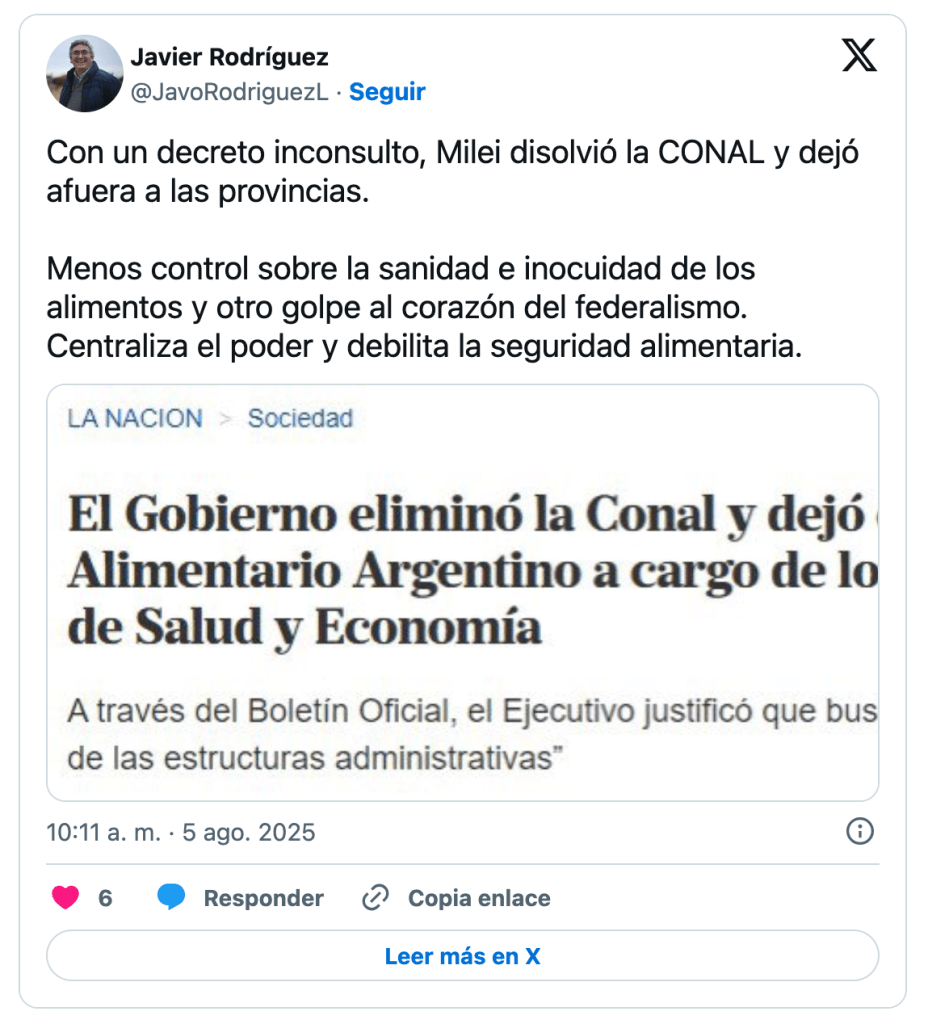
In a new offensive against the technical and participatory bodies of the State, the government of Javier Milei has dissolved the National Food Commission (CONAL in Spanish), a crucial institution for food security in the country. What was previously decided in a federal, scientific, and pluralistic space is now left in the hands of a few officials and companies, without opportunities for debate or citizen oversight.
The dismantling of CONAL was formalized through decree 538/2025, which amends the Argentine Food Code and transfers decision-making authority to the National Institute of Food (INAL in Spanish), which is under the National Administration of Medicines, Foods and Medical Technology (ANMAT in Spanish), and the National Service of Health and Quality of Agro-Food (SENASA in Spanish). Although these agencies possess technical expertise, what disappears with this measure is the participatory and federal architecture that ensured balanced regulation aimed at the public good.
The elimination of this space signifies much more than an administrative restructuring: it represents a setback in terms of transparency, social control, and the safeguarding of public interest against market interests. The official argument — ‘to streamline processes’ through platforms like SIFEGA — conceals the true impact: without plural deliberation, the Argentine food system becomes more vulnerable to corporate pressures and discretionary decisions.
Experts and sector leaders are already warning of the consequences: weakening of health consensus, loss of citizen and federal participation, and increased opacity in regulatory decisions. All of this occurs in a context where ultra-processed foods, controversial additives, and misleading advertising strategies, particularly aimed at children and adolescents, are proliferating.
 infoAlimentario