Article: Front-end labeling laws as a guarantee of consumer health protection

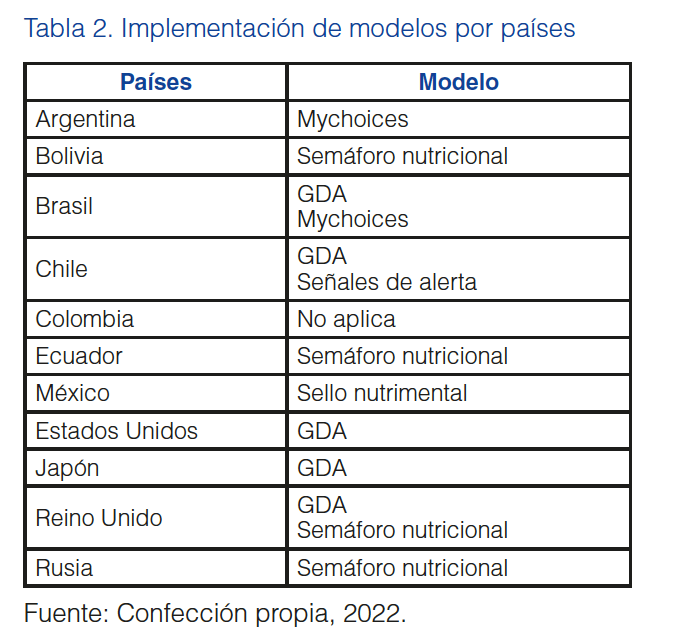
In the communication between producers and consumers, food labeling is fundamental since it allows to know the conformation and nutritional facts of food products. This work is carried out to develop a comparative study on the laws of front labeling as a guarantee of legal protection to consumers, it is a study of doctrinal and jurisprudential review on the protection of the right to health of consumers. It can be evidenced that the main models of front labeling are interpretative, non-interpretative, semi-interpretative and hybrid, of which the most used are the food guides and nutritional traffic lights. The guide system is used in Brazil, Chile, the United States, Japan and Great Britain, while the traffic light system is more widely used in Bolivia, Ecuador, Mexico and Russia.
Article: Weight stigma in Mexico and front-of-package labeling. A systemic review

Front-of-package food labeling is a public health strategy implemented to reduce the consumption
of processed food to decrease the incidence of obesity in Mexico. Although there is an increasing focus among public health officials on implementing policies designed to address obesity, much less attention has been paid to how these policies could impact those with disordered eating, despite the fact that millions suffer from such illnesses. Objective. The aim of this article is to present scientific literature related to front-of-package labeling and its impact on obesity and eating disorders. Method. Papers related to nutrition labels and obesity and eating disorders were reviewed. Results. The papers reviewed found no significant improvement regarding the consumption of processed food. Other measurements, including nutritional education, availability, physical education, and body-image acceptance, have a better impact on nutritional health. Discussion and conclusion. Front-of-package labeling is regarded as an important measure in the attempt to reduce obesity levels. However, there is insufficient scientific evidence to suggest that this type of labeling reduces the consumption of processed foods in patients with obesity.

Articles – Mexico: Effect of stakeholders’ perspectives on the Front-of-Pack Labeling regulation in Mexico

In Mexico, the inclusion of a Front-of-Pack Label in the Official Mexican Standard-051 (NOM-051 for its Spanish acronym) has been widely discussed for years by different stakeholder groups. In 2019, the NOM-051 modification project was proposed, which included front-of-pack warning labels. To be modified, it went through a public consultation period where stakeholders sent their comments to be reviewed and considered. The purpose of this study was to analyze the perspectives of key stakeholders during the public consultation of the NOM-051 modification project in order to understand their positions and their effect on the final public policy.

Articles – Mexico: Weight stigma in Mexico and front-of-package labeling. A systemic review

Front-of-package food labeling is a public health strategy implemented to reduce the consumption of processed food to decrease the incidence of obesity in Mexico. Although there is an increasing focus among public health officials on implementing policies designed to address obesity, much less attention has been paid to how these policies could impact those with disordered eating, despite the fact that millions suffer from such illnesses. Objective. The aim of this article is to present scientific literature related to front-of-package labeling and its impact on obesity and eating disorders. Method. Papers related to nutrition labels and obesity and eating disorders were reviewed. Results. The papers reviewed found no significant improvement regarding the consumption of processed food. Other measurements, including nutritional education, availability, physical education, and body-image acceptance, have a better impact on nutritional health. Discussion and conclusion. Front-of-package labeling is regarded as an important measure in the attempt to reduce obesity levels. However, there is insufficient scientific evidence to suggest that this type of labeling reduces the consumption of processed foods in patients with obesity.

The Americas – Mexico: Draft amendment to implement front labeling of transgenic products

Congresswoman Celeste Sánchez Romero (PT) presented an initiative to reform several provisions of the General Law on Health and Biosafety of Genetically Modified Organisms, with the purpose of guaranteeing the consumer’s right to information, through front labeling.

He stated that the information contained in the labels must be truthful, objective, clear, understandable, precise and useful for the consumer, in order to allow identifying at a glance the content of transgenic products.

In a press release, he stated that Mexico has a severe delay in the front labeling of transgenic products, which have a strong impact on the health of those who consume them, when they are consumed over a long period of time.