The National Health Surveillance Agency (ANVISA) has published Public Consultation No. 1,357, dated October 31, 2025, regarding the revision of the regulations on the general labeling of packaged foods.
Labeling of packaged foods
Argentina – ANMAT publishes changes in the front labeling of packaged foods
The National Administration of Drugs, Food and Medical Technology (ANMAT in Spanish) has published 2 new Resolutions 11378/2024 and 11362/2024, which amend the Application Manual of Law No. 27642 and Decree 151/22 on the front labeling system.
Resolution 11362/24: Nutritional declaration and advertising restrictions
Introduced the “Application Manual”, which establishes new guidelines for front nutritional labeling. According to this regulation, foods and alcoholic beverages formulated, manufactured and packaged without the presence of the customer must include these seals, provided that they contain added sugars, sodium or fats, either as main or secondary ingredients. In addition, the labeling must detail the amounts of added sugars, saturated fats, total fats, sodium and energy in the ready-to-eat product.
Regarding advertising, it is prohibited to include on the packaging any type of endorsement granted by civil or scientific associations, as well as the use of children’s characters, promises of prizes, contests or events. In short, the product cannot be promoted through elements that condition the purchase decision outside the genuine interest of the consumer.
Resolution 11378/24: Restrictions for products aimed at minors
It establishes the prohibition of advertising, promoting or sponsoring packaged food and alcoholic beverages that are especially aimed at children and adolescents.
The annex of this provision emphasizes advertising methods, requiring that the labels be visible and proportional to the size of the container. In the case of audiovisual advertising, they must remain on screen for a sufficient time, avoiding inducing errors or confusion in consumers.
Current regulations and transition
Products that are already labeled according to the previous regulations will continue to be marketed until stock runs out. From then on, companies will have to adapt to the new provisions established in provision 11362/2024.
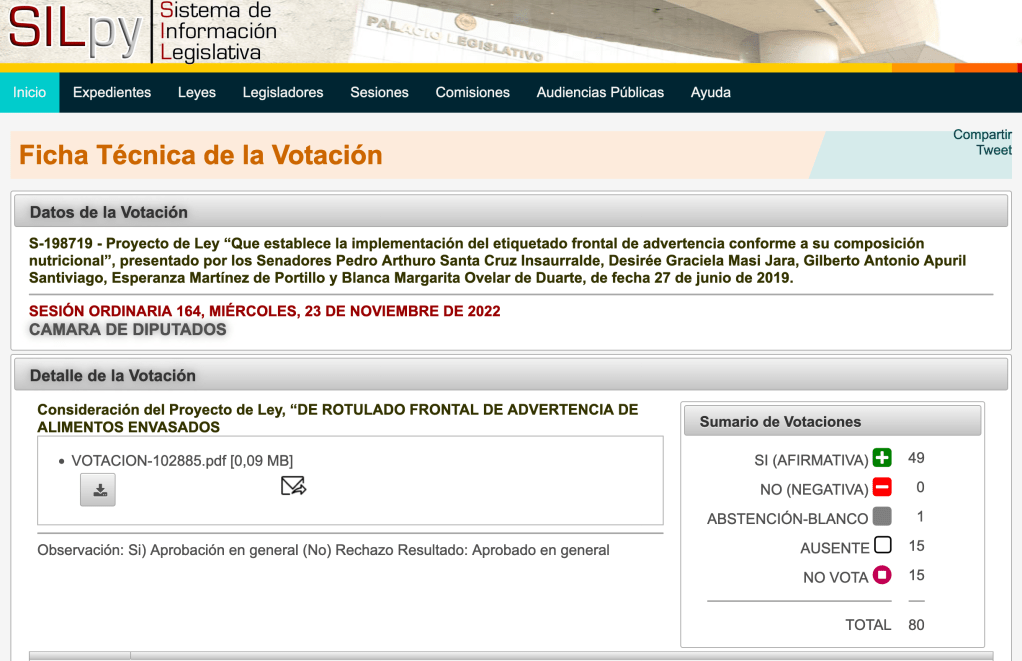
Paraguay – The Senate approved the bill on front labeling of packaged foods
The Senate approved the law on front labeling of packaged foods, with the amendments introduced in the House of Representatives. With this version, products will no longer carry the inscription “high in calories”, since they will have the exact amount of calories.
The head of the Public Health Commission, Jorge Querey, insisted on the need to establish mandatory labeling, according to the nutritional composition of sugars, saturated fats and sodium, incorporating the information of the “high calorie” content, in a visible, quick and easily understandable way for the consumer’s decision making.
Brazil: ANVISA updates rules on labeling of packaged foods
The National Health Surveillance Agency (ANVISA in Portuguese) published Resolution – RDC N° 727/ 2022 on the labeling of packaged foods. This Resolution applies to packaged foods in the absence of consumers, including beverages, ingredients, food additives and technological aids, including those intended exclusively for industrial processing or food services.
This Resolution enters into force on September 1, 2022.
Brazil: Food regulation: consolidation of regulatory acts
Continuing with the process of reviewing and consolidating regulatory acts, 18 Resolutions of the Collegiate Board of Directors (RDC) and four Normative Instructions (IN) related to food regulation. These 22 regulations replace 51 regulations that were repealed. The new laws will come into force on September 1, except for DRC 729/2022, which will begin on October 9.
- RDC 711/2022: Sanitary requirements for starches, cookies, wholemeal cereals, processed cereals, bran, flours, wholemeal flours, pasta and bread. Result of the revision of the RDC 236/2005.
- DRC 712/2022: Compositional and labeling requirements for foods containing cereals and pseudocereals for classification and identification as wholegrain and to highlight the presence of wholegrain ingredients. Result of the revision of DRC 493/2021.
- DRC 713/2022: Health requirements for edible ice cream and edible icy preparations. Result of the revision of DRC 266/2005.
- RDC 714/2022: Sanitary requirements for food fortification and restoration. Result of the revision of Ordinance SVS/MS 31/1998.
- RDC 715/2022: Sanitary requirements for low sodium salt, foods for weight control, foods for nutrient-restricted diets and foods for sugar-controlled diets. Resulting from the revision and consolidation of Ordinances SVS/MS54/1995; SVS/MS 29/1998; SVS/MS 30/1998 and RCD 135/2017 and 155/2017.
- RDC 716/2022: Sanitary requirements for coffee, barley, teas, yerba mate, spices, condiments and sauces and EN 159/2022, establishing the lists of parts of plant species authorized for the preparation of teas and for use as spices, resulting from the revision and consolidation of RDC 267/2005; 276/2005; 277/2005, 219/2006 and arts. 2 and 3 and Annexes I and II of RDC 450/2020.
- RDC 717/2022: Sanitary requirements for bottled water and ice for human consumption. Result of the revision and consolidation of DRC 274/2005 and 316/2019.
- CDR 719/2022: Sanitary requirements for mixtures for food processing and ready-to-eat foods. Result of the revision of RDC 273/2005.
- RDC 720/2022: Sanitary requirements for nutritionally modified foods. Result of the revision of RDC 3/2013.
- RDC 722/2022: Maximum tolerated limits (MRLs) of contaminants in food, general principles for their establishment and methods of analysis for conformity assessment purposes, as a result of the revision of RDC 487/2021 and IN 160/ 2022, which establishes the maximum tolerated limits (MRLs) of contaminants in food, as a result of the revision and consolidation of IN 88/2021, 115/2021 and 152/2022.
- RDC 723/2022: Sanitary requirements for sugar, liquid invert sugar, powdered sugar, table sweetener, caramel, bonbon, cocoa powder, soluble cocoa, chocolate, white chocolate, chewing gum, cocoa butter, cocoa mass, molasses, treacle and rapadura. Result of the revision and consolidation of CNNPA Resolution 3/1976 and RDC 264/2005; 265/2005; 271/2005 and 450/2020.
- RDC 724/2022: Food microbiological standards and their application, as a consequence of the revision of RDC 331/2019 and IN 161/2022, establishing food microbiological standards, resulting from the revision and consolidation of INs 60 /2019; 79/2020 and 110/2021.
- RDC 725/2022: Flavoring food additives. Result of the revision and consolidation of DRC 2/2007 and IN 15/2017.
- CDR 726/2022: Health requirements for edible mushrooms, fruit and vegetable products. Resulting from the revision and consolidation of DRC 17/1999; 91/2000; 268/2005; 272/2005 and 85/2016.
- CDR 727/2022: Labeling of packaged foods. Resulting from the revision and consolidation of DRC 259/2002; 123/2004; 340/2002; 35/2009; 26/2015; 136/2017; 459/2020 and EN 67/2020.
- CRR 728/2022: Enzymes and enzyme preparations for use as processing aids in the production of food for human consumption. Resulting from the revision and consolidation of RDC 53/2014 and 54/2014.

 infoAlimentario