Chile – Ministry of Health proposes modifying the gluten level for certain foods

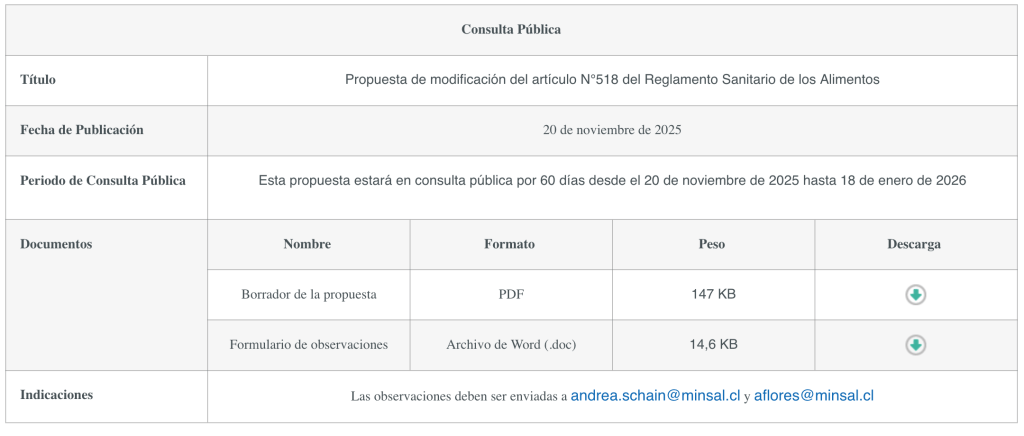
The Ministry of Health announces a public consultation to amend Article 518 of the Food Sanitary Regulations. The purpose of the proposed amendment is to stipulate that, for foods that have undergone fermentation and/or protein hydrolysis processes or that contain hydrolyzed ingredients, the limit for using the term “gluten-free” will be 10 ppm.

The health authority deems it necessary to amend Article 518 of the RSA, since gluten in hydrolyzed and fermented foods can only be quantified using the competitive ELISA method, which measures gluten at levels of 10 mg/kg or higher. This technique will not accurately determine gluten levels below 10 mg/kg with acceptable precision, and it will be impossible to meet the requirements set forth in the article. And if the sandwich ELISA technique were applied to these foods, small peptides would not be detected and the gluten content would be underestimated.

Article 518 of the RSA, since gluten in hydrolyzed foods as well as in fermented foods Fermented foods can only be quantified using the competitive ELISA method, but this method it quantifies gluten from 10 mg/kg. This technique will not determine gluten with acceptable accuracy gluten levels below 10 mg/kg cannot be accurately determined, and it will be impossible to meet the established requirements. in the article. And if the sandwich ELISA technique were applied to these foods, small peptides would not be detected and the gluten content would be underestimated. Small-sized peptides will not be detected, and the gluten content will be underestimated.

Brazil – Anvisa is the competent authority for regulating the labeling of foods containing gluten

The Attorney General’s Office (AGU) ensured the enforcement of legislation mandating the labeling of processed food products sold in the country with “contains gluten” or “does not contain gluten.” It also confirmed the regulatory authority of the National Health Surveillance Agency (ANVISA in Portuguese) regarding such labeling.

A consumer association has filed a lawsuit against a food company, requesting that the packaging of processed food products include the message: “contains gluten: gluten is harmful to the health of individuals with celiac disease.” The lower court accepted this request.

Subsequently, the AGU, through the Federal Regional Attorney’s Office for the 3rd Region, representing Anvisa, appealed the ruling. The appeal emphasized that this decision overlooked health regulations and the specific technical and regulatory aspects of food labeling.

In its appeal, the AGU argued that if the association’s claim were accepted, the information on the packaging would be incomplete and could mislead consumers into believing that only individuals with celiac disease are intolerant to gluten.

According to information from ANVISA presented during the proceedings, gluten “is also harmful to consumers with other conditions, not just those with celiac disease.” Therefore, “current regulations require labels to indicate the presence or absence of this substance without additional specifications, while providing significantly more informative content,” states an excerpt from the agency’s technical communication.

Thus, the clear indication of gluten presence or absence on processed food labels, as mandated by Law No. 10,674 of 2003, is deemed sufficient to alert individuals with celiac disease about the risks associated with consuming gluten-containing foods.

The Americas – Brazil: Congressman introduces gluten amendment bill for food labeling regulation

Bill 907/22 has been introduced in Congress, which aims to modify the regulation on labeling of processed foods to include the following warning: “contains gluten – harmful to the health of consumers with celiac disease” or “does not contain gluten”.

Currently, the law defining the labeling of products containing gluten (Law 10.674/03), which establishes that industrialized foods must contain on their label and insert, mandatorily, only the inscriptions “contains gluten” or “does not contain gluten”.

Chile: Normativa sobre información de glutén en la regulación del etiquetado será vista en Sala del Senado

Listo para ser votado en Sala, quedó el proyecto que incorpora a la enfermedad celiaca y al gluten en la legislación sobre composición de los alimentos y su rotulación, la que cursa su segundo trámite en el Senado.

En esa línea, la norma que analizan los senadores persigue al menos terminar con la incertidumbre a la hora de saber si lo que se está comprando tiene o no esta proteína (Fuente).

Resultado de imagen de gluten