This study investigated the presence of front-of-package labeling on food products in major retailers in Brazil after its implementation in 2022. Carried out from May to October 2023, we analyzed 2145 products of brands present in five Brazilian states. A total of 541 products presented front-of-package warnings. The categories varied in their adherence to front-of-package labeling, highlighting a prevalence of combined warnings, such as high in added sugar and high in saturated fat on sweet biscuits and chocolates. Sausages showed a high prevalence of high in sodium and high in saturated fat warnings. Beverages stood out as high in added sugar, while fats, dairy products, frozen preparations, seasonings, and sauces presented diversity in the warnings. Other products, such as panettone, showed a high presence of alerts. The study demonstrated the widespread presence of front-of-package labeling on ultra-processed products highly consumed by the Brazilian population. Considering the alarming presence of these foods in the Brazilian diet, it is concluded that front-of-package nutrition labeling is crucial to inform and raise awareness among consumers, allowing healthier choices and potentially contributing to a reduction in chronic diseases and the costs associated with treatment in the health system.
front-of-package labeling
USA – FDA Issues Second Procedural Notice on Consumer Research on Front-of-Package Labeling
The U.S. Food and Drug Administration has issued a 30-day procedural notice on its plans to conduct a study entitled “Quantitative Research on Front of Package Labeling on Packaged Foods.” The study is a follow up to focus groups conducted in 2022 to further explore consumer responses to various front-of-package labeling schemes. As part of the Paperwork Reduction Act, federal agencies are required to publish a notice in the Federal Register on each proposed information collection to give the public the opportunity to comment.
The FDA is conducting this consumer research to help explore the development of a front-of-package labeling scheme, which is part of the National Strategy on Hunger, Nutrition, and Health, issued as part of the White House Conference held in September 2022 focused on ending hunger and reducing diet-related disease. Front-of-package labeling is intended to complement the Nutrition Facts label on packaged foods by giving consumers additional context to help them identify healthier food selections. A standardized, science-based scheme could help consumers, particularly those with less nutrition knowledge, quickly and easily identify foods that can help them build a healthy eating pattern. The experiences of countries worldwide that have adopted front-of-package labeling suggest that such labeling may help nutrition comprehension and the ability to make healthier choices.
Article – The challenges of front-of-package labeling in Brazil
The Brazilian legal system has plenty of mechanisms to ensure the public right to access clear information. The Federal Constitution (FC), enacted in 1988 and known as the “Citizen Constitution,” has as its principle to guarantee the right to human dignity. Protection of consumers, as well as their inviolable right to life and safety, are guaranteed by the FC as basic rights. The FC limits the country’s economic order when establishing that its goal is to provide dignity for all Brazilians. Therefore, economic development cannot put people at risk, and its processes must be aligned with principles of goodwill and balance between consumers and suppliers. Collectively, FC establishes that health, food, and youth protection are social rights; hence, the government is responsible for providing policies for its implementation.
Articles – Mexico: Weight stigma in Mexico and front-of-package labeling. A systemic review
Front-of-package food labeling is a public health strategy implemented to reduce the consumption of processed food to decrease the incidence of obesity in Mexico. Although there is an increasing focus among public health officials on implementing policies designed to address obesity, much less attention has been paid to how these policies could impact those with disordered eating, despite the fact that millions suffer from such illnesses. Objective. The aim of this article is to present scientific literature related to front-of-package labeling and its impact on obesity and eating disorders. Method. Papers related to nutrition labels and obesity and eating disorders were reviewed. Results. The papers reviewed found no significant improvement regarding the consumption of processed food. Other measurements, including nutritional education, availability, physical education, and body-image acceptance, have a better impact on nutritional health. Discussion and conclusion. Front-of-package labeling is regarded as an important measure in the attempt to reduce obesity levels. However, there is insufficient scientific evidence to suggest that this type of labeling reduces the consumption of processed foods in patients with obesity.

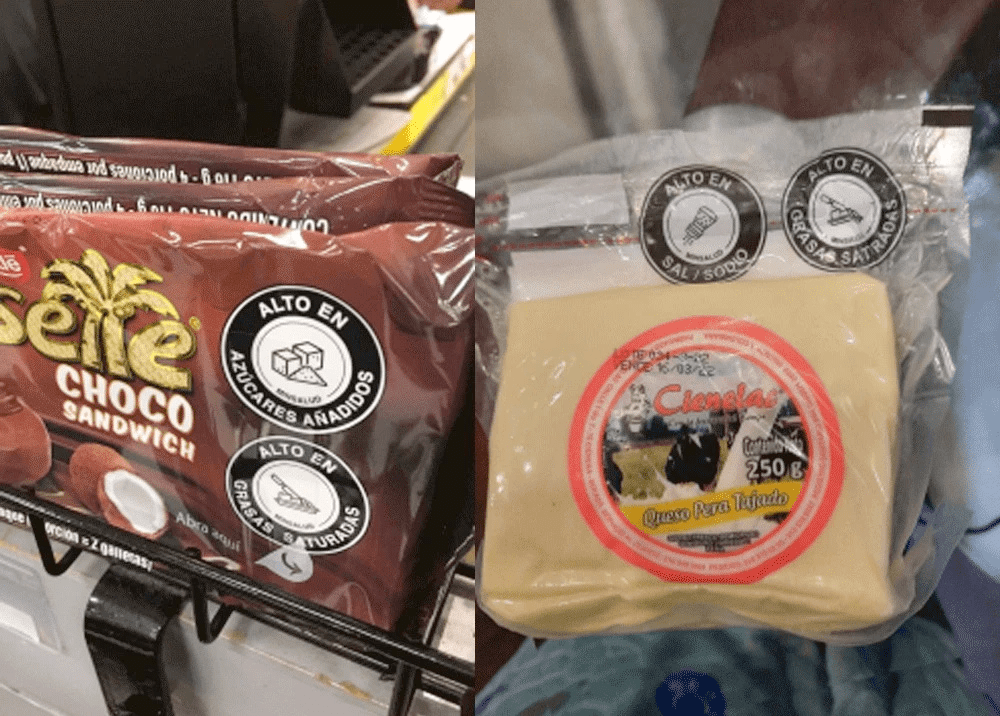
The Americas – Colombia: Foods with front-of-package labeling appear on the market
There are already some food packages with circular warning seals, in accordance with resolution 810 of the Ministry of Health, despite the fact that different social organizations have requested octagonal seals.
However, the debate that has been generated in several instances is that after the resolution was issued in the Congress of the Republic, a law was issued that modified some guidelines. Among them, it was requested that the front seals be chosen based on the best scientific information, which according to the civil society are the octagonal seals.
 infoAlimentario