The General Directorate of Food Management (GGALI in Portuguese) under the National Health Surveillance Agency (ANVISA in Portuguese) has published a manual “Sanitary Regulation of Food Supplements.” This material is part of the training itinerary on the Sanitary Regulation of Food Supplements and systematically and progressively compiles the content developed throughout the six modules of the course. The material was designed to facilitate technical understanding and practical application of the current regulatory framework, considering the responsibilities of the regulated sector and the National Health Surveillance System. It addresses the fundamentals that define what dietary supplements are and who they are intended for, the registration and electronic notification procedures, the composition criteria, and the evaluation of the safety and efficacy of their components, as well as the applicable regulations for general and nutritional labeling. The content articulates normative concepts, regulatory flows, and practical examples, allowing the reader to understand not only what the legislation requires but also why these requirements exist and how they should be implemented in daily professional practice.
food supplements
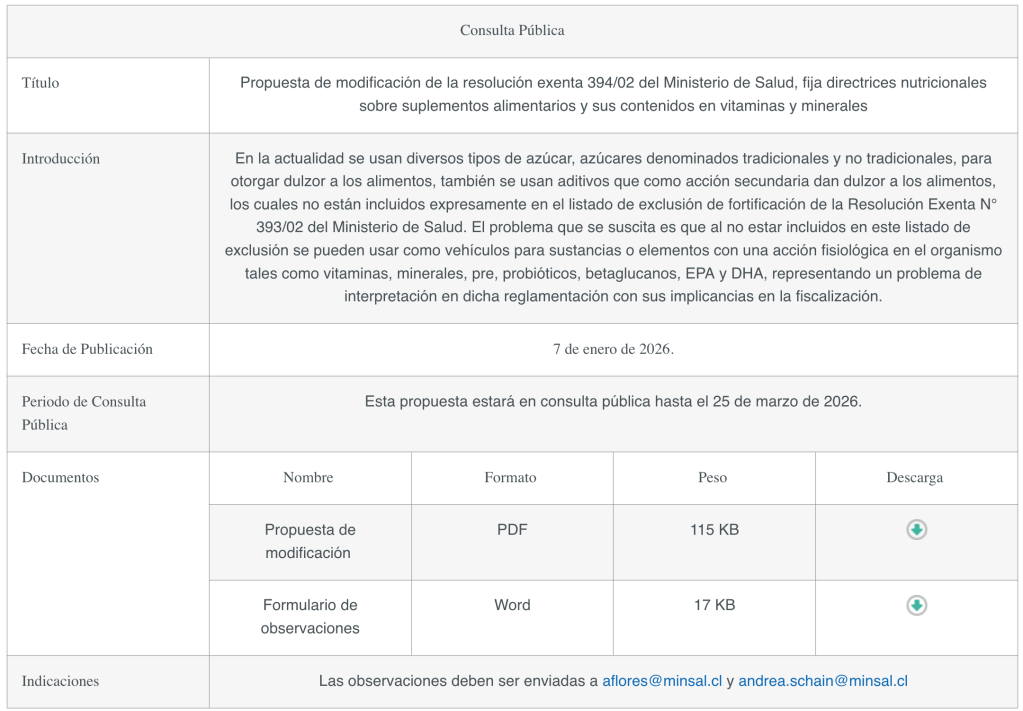
Chile – Proposal to amend Exempt Resolution 394/02 of the Ministry of Health, establishing nutritional guidelines on food supplements and their vitamin and mineral content
The Ministry of Health has published a proposed amendment to Exempt Resolution 394/02 of the Ministry of Health, which establishes nutritional guidelines for dietary supplements and their vitamin and mineral content.
Currently, various types of sugar—both traditional and non-traditional—are used to sweeten foods, as are additives that, as a secondary effect, impart sweetness, none of which are expressly included in the fortification exclusion list of Exempt Resolution No. 393/02 issued by the Ministry of Health. The problem that arises is that, since they are not included in this exclusion list, they can be used as vehicles for substances or elements with a physiological effect on the body, such as vitamins, minerals, prebiotics, probiotics, beta-glucans, EPA, and DHA, posing an interpretive challenge to the regulation and its enforcement.
Brazil – ANVISA updates regulations on ingredients and labeling for food supplements
The National Health Surveillance Agency (ANVISA in Portuguese) has published an amendment to Normative Instruction No. 28/2018, which establishes the lists of components, usage limits, claims, and supplementary labeling for food supplements.
Ecuador – Deadline extended for submitting comments on the draft Partial Reform of the Food Supplements Regulations
The Ministry of Production, Foreign Trade, Investments and Fisheries (MPCEIP) has announced that it is extending the deadline (60 days) for submitting comments and contributions on the draft Partial Reform of the Sanitary Technical Regulations for Obtaining Sanitary Notification and Control of Food Supplements at Establishments Where They Are Manufactured, Stored, Distributed, Imported, and Marketed, Resolution ARCSA-DE-028-2016-YMIH, published in Official Registry Supplement No. 937 of February 3, 2017. The purpose of the regulatory project in question is to establish the Good Manufacturing Practices (GMP) conditions for food processing plants, as well as the requirements that must be met by the manufacturing, production, processing, preparation, packaging, contract manufacturing, transportation, storage, import, distribution, and marketing of processed foods for human consumption.
Peru – The category of food supplements needs to be regulated
Without a specific regulatory category that clearly defines what a dietary supplement is, based on its nature, confusion arises in Peru about whether it should be treated as food or medicine (despite being distinct products). This impacts the regulatory treatment given to it, which constitutes a barrier to the development of this industry in the country.
Therefore, it is imperative that Peruvian legislation clearly differentiate dietary supplements from pharmaceutical products and from the food category. Having an autonomous classification would allow for the establishment of technical and health criteria appropriate to their nature, guarantee oversight of their characteristics, and provide greater legal certainty for all involved. This regulatory differentiation would not only strengthen the protection of public health but would also promote the development of a more dynamic, safe, and competitive supplement market. Currently, the General Directorate of Medicines, Supplies, and Drugs (DIGEMID in Spanish) has the authority to regulate and establish the procedures applicable to dietary supplements, pursuant to Law 29459, the Law on Pharmaceutical Products, Medical Devices, and Health Products. This law defines pharmaceutical products as preparations intended to prevent, diagnose, treat, or cure diseases, a classification that includes the category of dietary products, even though the latter do not have a therapeutic purpose.
However, Article 17 of Decision No. 9 of the Free Trade Commission of the Additional Protocol to the Pacific Alliance Framework Agreement (the decision applicable to Peru) establishes that the competent authority to regulate the category of dietary supplements should be the General Directorate of Environmental Health and Food Safety (DIGESA in Spanish).
 infoAlimentario