June 27, 2025 marks nine years since the entry into force of Law 20.606 On Nutritional Composition of Food and its Advertising (known as the Labeling Law) in Chile, a pioneering policy worldwide that has been recognized for its comprehensive approach to improving food environments. Its implementation was developed in three phases (2016, 2018 and 2019), establishing progressively stricter limits for critical nutrients such as sugars, sodium, saturated fats and calories.
The Institute of Nutrition and Food Technology (INTA) of the University of Chile advised as an expert scientific body to legislators and the Ministry of Health in the drafting of the bill, its implementation and evaluation, through the Center for Research on Food Environments and Prevention of Chronic Diseases Associated with Nutrition (CIAPEC INTA). CIAPEC research shows a reduction in the purchase of ‘High in’ products, food reformulation and industry compliance.
This law has been recognized internationally as a pioneering and model policy in the promotion of healthy food environments. The Pan American Health Organization (PAHO) and the World Health Organization (WHO) have highlighted its comprehensive approach, which includes frontal warning labeling, restrictions on advertising aimed at children and limitations on the sale of unhealthy foods in schools. It has also inspired similar legislation in countries such as Mexico, Peru, Uruguay and Argentina.
The following are some of the impacts of the law, according to CIAPEC INTA studies.
“Decreases in purchases of energy, sodium, sugar, and saturated fat 3 years after implementation of the Chilean food labeling and marketing law: An interrupted time series análisis”, publicado en PLoS Med:
- Following the implementation of the law in its first stage, Chilean households decreased the consumption of ‘High in’ products for all categories, being 36.8% for sugars and 23% for energy/calories.
- Compared to 36 months prior to policy implementation, the Labeling Law led to decreases in critical nutrients during Phase 2 implementation, especially in foods and beverages high in these nutrients. These reductions were maintained or even intensified throughout the various phases of policy implementation.
“Changes in the critical nutrient content of packaged foods and beverages after the full implementation of the Chilean Food Labelling and Advertising Law: a repeated cross-sectional study”, publicado en BMC Med:
The proportion of foods requiring warning labeling was reduced: in 2016 71% of products ‘High in’ sodium, sugars or saturated fats, while in 2020, after implementation of the 2nd phase of the law, it dropped to 53%.
“Food Industry Compliance With the Display of Front-of-Package Warning Labels at the Final Phase (2020) of Chile’s Labeling and Advertising Law”, publicado en American Journal of Public Health
Following full implementation of the law, the food industry complied with front-of-package labeling, with the main message from the paper being that compliance with the use of front-of-package warning labels was high (93.6% for any ‘High In’ designation. About 62.5% of packaged foods and beverages displayed some FOPL (Front-of-Package Warning Label).

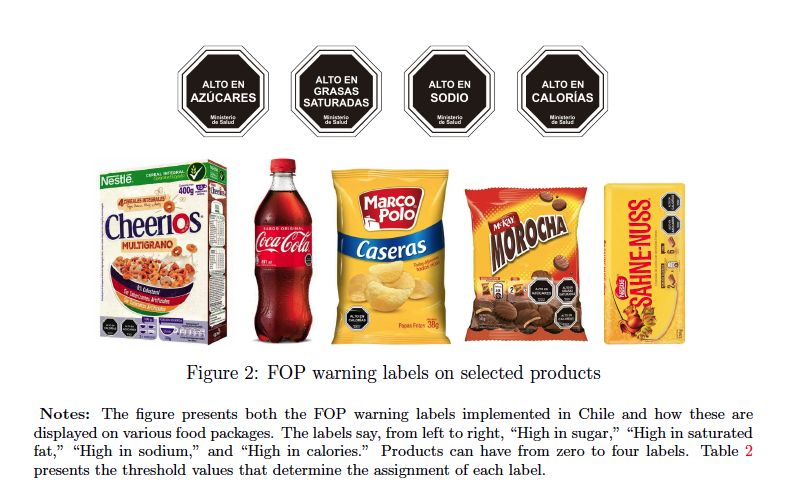
 Chile mandated symbols for food products with high levels of sugar, saturated fat, sodium and calories. The symbols are hexagonal, like stop signs, and the warnings read “Alto en [nutrient]”; the Spanish word alto means both “high” and “stop.”
 infoAlimentario