Brazil – Bill to prohibit the addition of any amount of sugar and sweeteners to foods for infants moves forward

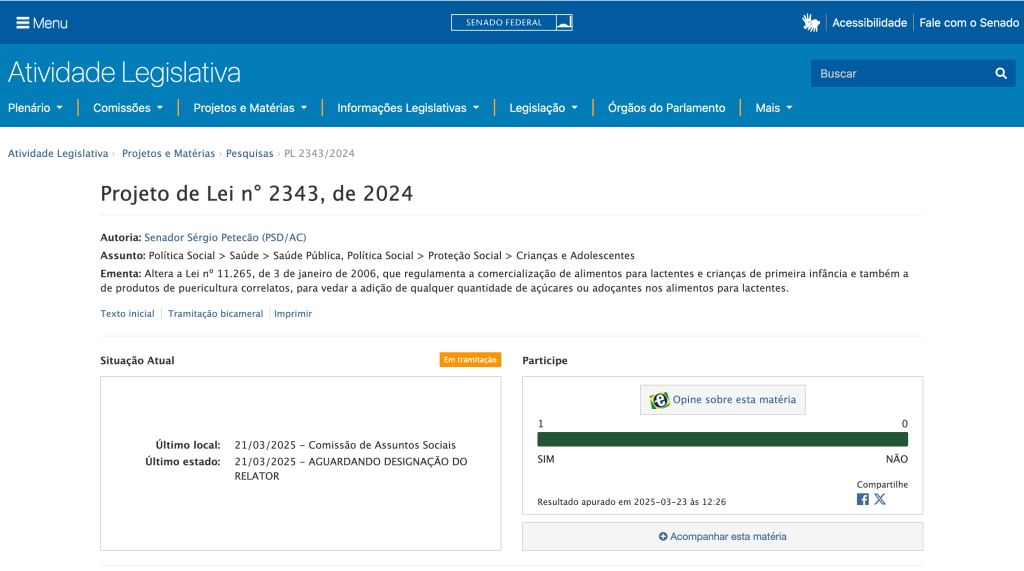
The Senate Committee on Human Rights and Participative Legislation (CDH in Portuguese) approved Bill 2.343/2024, which amends Law 11.265, which regulates the commercialization of food for infants and young children, prohibiting the addition of any amount of sugar and sweeteners to food intended for infants.
The bill by Senator Sérgio Petecão (PSD-AC) received the favorable vote of the rapporteur, Senator Laércio Oliveira (PP-SE), and now passes to the Social Affairs Committee (CAS) for analysis.
Mexico – Government bans transgenic corn by Decree

The reform promoted by President Claudia Sheinbaum, which prohibits the cultivation of transgenic corn and protects native varieties of the grain native to Mexico, was published in the Official Gazette of the Federation (DOF in Spanish).
The document that makes official the reforms to articles 4° and 27 of the Constitution, regarding the conservation and protection of native corn, will enter into force on Tuesday, March 17.
The addition to article 4° specifies that the cultivation of corn “in the national territory must be free of genetic modifications produced with techniques that overcome the natural barriers of reproduction or recombination, such as transgenics. Any other use of genetically modified corn must be evaluated under the terms of the legal provisions to be free from threats to biosafety, health and the biocultural heritage of Mexico and its population.
Article 27 specifies that the State “will promote the conditions for rural, cultural, economic and health development, with the purpose of generating employment and guaranteeing the wellbeing of the peasant population and their participation and incorporation in national development, will promote agricultural and forestry activities, traditional crops with native seeds, especially the milpa system, for the optimal use of land free of genetically modified corn crops”.

Brazil – ANVISA publishes revision and consolidation of the regulation on infant formulas, enteral nutrition formulas and dietary formulas for metabolic errors

The National Health Surveillance Agency (ANVISA in Portuguese) has published the presentation the revision and consolidation of the regulation on infant and young child formulae, transitional and cereal-based foods for infants and young children, enteral nutrition formulae and dietary formulae for metabolic errors.

Mexico – The Consumer Power Organization has presented the study “What Do We Eat? The Double Standard of Colorings in Ultra-Processed Products”

The Consumer Power Organization has presented the study “What Do We Eat? The Double Standard of Colorings in Ultra-Processed Products.”
The study shows that 52% of the products analyzed in Mexico contain synthetic colorings, while in Switzerland and the United Kingdom, those same products, from the same global corporations, either do not use colorings or use natural alternatives.
The document analyzes the presence of synthetic and natural colorings in processed and ultra-processed products aimed at children and adolescents, such as cereals, salty snacks, sugary drinks, and dairy products. It compares products from brands such as Kellogg’s, Nestlé, Sabritas/Fritos Lay, and Walkers and Barcel sold in Mexico, the European Union, and Switzerland.
For the study, a sample of these products was collected, and the colorings reported in the ingredient lists of products available in the Mexican, Swiss, and United Kingdom markets between November 2024 and February 2025 were recorded.

Argentina – Modification of the duties of the establishment manager in matters of management of hygienic and sanitary conditions published

Through Joint Resolution 6/2025, the Secretariat of Health Management and the Secretariat of Agriculture, Livestock and Fisheries have published an amendment on the responsibilities of the holder of the establishment’s authorization related to the management of the safety of the establishment and the products from a hazard-risk approach, in a clear and concrete manner, to facilitate understanding, application and compliance with the regulations by health authorities, establishment owners and the Technical Directors themselves.

ARTICLE 1.- Article 16 of the Argentine Food Code is hereby replaced, which shall read as follows: “Article 16: The holder of the establishment’s authorization must guarantee:

  1. That the hygienic, sanitary, and legal conditions determined by current regulations and established in the corresponding health authorization are maintained in the establishment.
  2. That the products produced or put into circulation comply with the hygienic, sanitary, and legal conditions determined by current regulations and established in the corresponding health authorization.
  3. The resources to implement the necessary measures in the establishment to obtain products that comply with the corresponding health authorization.
  4. That the establishment has the corresponding documentation supporting the traceability of authorized products, from the receipt of raw materials to the marketing of the final product.
  5. That, when required by current regulations, the establishment has the Technical Directorate provided for in Article 17 of the Code and provides it with the resources to fulfill its functions.