The competent health authority, in coordination with the Foreign Trade Committee, has issued a binding regulatory directive to definitively establish the administrative regime applicable to the processing of applications for the inclusion or registration of importers and distributors in health notification certificates, health records, and mandatory health notifications. This legal measure is directly framed within the official implementation phase of the strategic guidelines set forth in Resolution 017-2025, a commercial control instrument originally issued in December of the previous year and formally published in the Official Register 188 for national observance. In strict application of the Second Transitional Provision of the aforementioned regulation, the mandate establishes an exceptional and temporary regime with an exact duration of one hundred and twenty calendar days, counted rigorously from the date the legal document comes into effect. During this transitional period of administrative adaptation, all procedures aimed at the inclusion or updating of import and distribution entities in the current health records will be processed under the technical figure of record modification. To facilitate the operational regularization of commercial agents in the regulated sector, the governmental body stipulates that, for the purpose of collecting official fees, a financial amount equivalent to ten percent of the originally set tariff value for obtaining the respective primary certificate will be applied. Under this temporary scheme, the regulation expressly authorizes product holders to simultaneously incorporate one or more associated importers and distributors thru the submission of a single application, significantly reducing the bureaucratic and economic burdens for companies. However, the legal text explicitly warns that, once this peremptory transition period of one hundred and twenty days has expired, the technical incorporation of new actors in the marketing chain will be irrevocably subject to the permanent provisions stipulated in Article 4 of Ministerial Agreement 112. Consequently, under this definitive and post-transitional framework, the regulatory entity will require the individualized payment of the fee corresponding to ten percent of the base amount of the sanitary registration for each additional importer or distributor intended to be added to the file, consolidating a strict monitoring scheme that requires companies to strategically plan their distribution logistics before the conclusion of the tariff flexibility period.
Argentina – ANMAT updates the Argentine Food Code, incorporating new substances for food packaging coatings
The National Administration of Food, Medicines, and Medical Technology and the Ministry of Agriculture, Livestock, and Fisheries have published Joint Resolution No. 01/2026, which incorporates into the national legal framework the Common Market Group (GMC) Resolution No. 28/24 “AMENDMENT OF GMC RESOLUTION No. 02/12 ‘MERCOSUR TECHNICAL REGULATION ON POSITIVE LIST OF MONOMERS, OTHER STARTING SUBSTANCES, AND POLYMERS AUTHORIZED FOR THE MANUFACTURE OF FOOD CONTACT PLASTICS AND EQUIPMENT'”
Incorporate into Article 207 of the Argentine Food Code (CAA), at the end of the table of Part I “List of authorized monomers and other starting substances” of the Annex of GMC Resolution No. 02/12 the following substance, according to its CAS number:
Reference Number:
CAS Number: 113693-69-9
Substance: Diglycidyl ether of tetramethyl bisphenol F (TMBPF-DGE) = reaction product of tetramethyl bis(4-hydroxyphenyl) methane and epichlorohydrin.
RESTRICTIONS AND/OR SPECIFICATIONS: LME (T) = 0.2 mg/kg (sum of TMBPF, TMBPF-DGE, TMBPF-DGE.H₂O, and TMBPF-DGE.2H₂O).
LME (T) = 0.05 mg/kg (sum of TMBPF-DGE.HCl, TMBPF-DGE.2HCl, and TMBPF-DGE.HCl.H₂O).
Incorporate into Article 207 of the Argentine Food Code, at the end of the table in Part V “List of authorized polymers” of the Annex to GMC Resolution No. 02/12 the following substance:
CAS NUMBER:
SUBSTANCE: Polyamide-imide 2 (PAI-2) = poly-N-(4,4′-diphenylmethane trimellitamide imide), produced by the reaction of 4,4′-diaminodiphenylmethane with benzoyl chloride-3,4-dicarboxylic anhydride.
Guatemala – Congress of the Republic promotes a roadmap aimed at strengthening regulatory frameworks and public policies related to the right to food
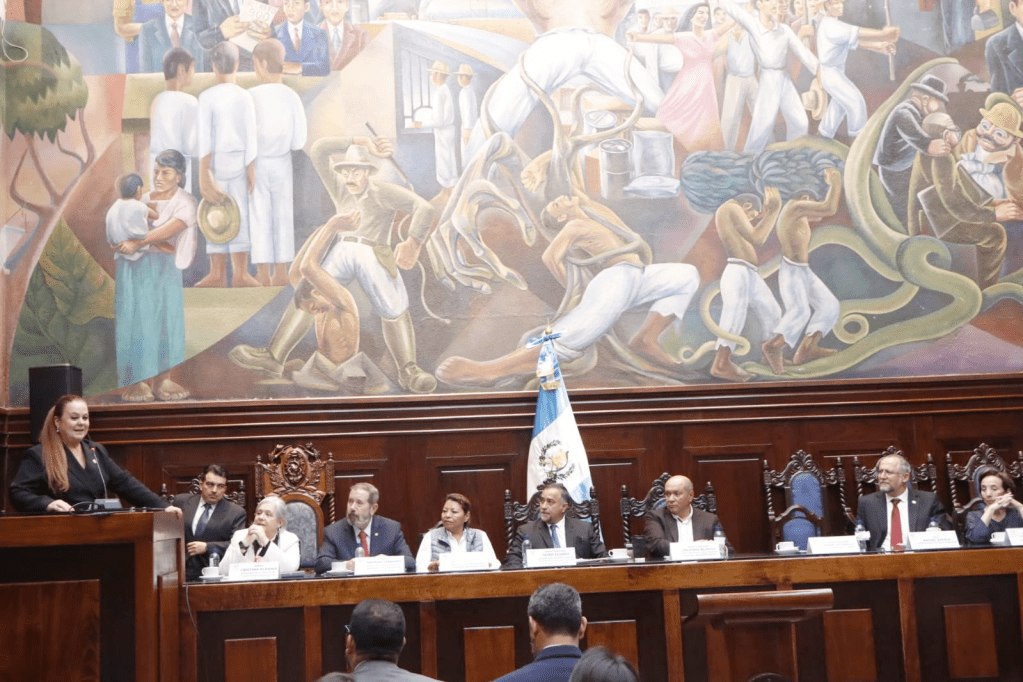
In the Congress of the Republic, the I National Dialog #FoodFirst was held, a space that brought together parliamentarians, ministers and deputy ministers, public institutions, academia, and international cooperation to position food as a priority on the country’s political and social agenda.
The initiative, driven by the Parliamentary Front Against Hunger in Guatemala, continues the commitments made after the signing of the #FoodFirst 2025 Pact, promoting a roadmap aimed at strengthening regulatory frameworks and public policies related to the right to food.
One of the main highlights of the meeting was the presentation of a bill for the construction of kitchens in public educational centers. The proposal seeks to improve the conditions in which food is prepared, contributing to the strengthening of school feeding programs from a perspective of safety, dignity, and sustainability.
Peru – INACAL updates 4 technical standards related to sensory analysis, cocoa and chocolate, fish species identification, and milk acidity
The National Institute of Quality (INACAL in Spanish) thru Directoral Resolution No. 000006-2026-INACAL/DN has approved 4 Peruvian Technical Standards related to food:
- NTP-ISO 13299:2026 Sensory Analysis. Methodology. General guide for establishing a sensory profile. 2nd Edition. Replaces NTP-ISO 13299:2015.
- NTP 208.040:2026 COCOA AND CHOCOLATE. Good practices for harvesting and processing. 3rd Edition.
Replaces NTP 208.040:2017.
- NTP-ISO 17174:2026 Analysis of molecular biomarkers. DNA barcoding of fish and fishery products using defined fragments of the mitochondrial genes cytochrome b and cytochrome c oxidase I. 1st Edition.
- NTP 202.116:2026 MILK AND DAIRY PRODUCTS. Milk. Determination of milk acidity by the
volumetric method. 4th Edition. Replaces NTP 202.116:2008 (revised in 2018).
Brazil – Senate approves the minimum percentage of cocoa in chocolate
The federal Senate approved Bill (PL) 1769/2019, which establishes the criteria for the production of cocoa derivatives and clarifies the labeling standards for these products. Presented by Senator Zequinha Marinho (PSC-PA), the text establishes that labels, packaging, and advertising materials must inform the percentage of cocoa solids present in each product. This measure increases transparency and facilitates consumer choice.
One of the main points of the proposal is to facilitate the visualization of the cocoa percentage on the packaging. The text states that dark or semisweet chocolate can simply be called chocolate, as long as it contains at least 35% total cocoa solids.
Currently, the minimum required is 25%, according to the regulations of the National Health Surveillance Agency (Anvisa). The text establishes the minimum requirements for the different types of chocolate:
- Milk chocolate must contain 25% cocoa solids and 14% total milk solids.
- White chocolate must contain at least 20% cocoa butter.
- Sweet chocolate must contain at least 25% cocoa.
- The cocoa powder must contain at least 32% cocoa.
If the product does not meet the minimum percentages, the packaging must clearly indicate names such as chocolate drink mix, fantasy chocolate, or chocolate-flavored compound and coating. In these cases, the project prohibits the use of elements that may mislead the consumer about the nature of the product. Industries will have 360 days to adapt to the new regulations.

 infoAlimentario