This document contains information provided by CODEX at the TBT Committee meeting of
9-11 March 2022 under Agenda Item 5 (Update by Observers).
Codex: The safety standards set by CCCF at the core of the Codex mandate
Over 400 delegates gathered online for the opening of the Codex Committee on Contaminants in Food (CCCF) which is taking place from 9 to 24 May 2022, hosted by The Netherlands from Utrecht. The committee regulates substances that have not been intentionally added to food by setting maximum levels to avoid levels of contamination that would make the food unsafe or affect its quality.
Codex Secretary Tom Heilandt said: “The safety standards set by CCCF, such as maximum levels and codes of practice to prevent or minimize contamination, are at the core of the Codex mandate to protect consumer health and ensure fair practices in the food trade. You need to balance risks and benefits, enabling trade while ensuring safety. Often that is tricky, and one needs to compromise.”

Articles – Mexico: Effect of stakeholders’ perspectives on the Front-of-Pack Labeling regulation in Mexico
In Mexico, the inclusion of a Front-of-Pack Label in the Official Mexican Standard-051 (NOM-051 for its Spanish acronym) has been widely discussed for years by different stakeholder groups. In 2019, the NOM-051 modification project was proposed, which included front-of-pack warning labels. To be modified, it went through a public consultation period where stakeholders sent their comments to be reviewed and considered. The purpose of this study was to analyze the perspectives of key stakeholders during the public consultation of the NOM-051 modification project in order to understand their positions and their effect on the final public policy.

Articles – EU: Nutrient profiles: A ‘farm to fork’ strategy initiative takes shape
The European Commission is planning to establish ‘nutrient profiles’, that is, maximum amounts for nutrients such as fat, sugar and/or salt in foods, above which the use of nutrition or health claims would be restricted or forbidden. For example, breakfast cereals exceeding a sugar limit could no longer advertise their fibre or vitamin content. The Commission was already tasked with setting nutrient profiles to restrict the promotion of food high in fat, sugar and/or salt under the Nutrition and Health Claims Regulation (‘Claims Regulation’) adopted in 2006. Now, in accordance with the action plan accompanying the EU’s ‘farm to fork’ strategy, the Commission will submit a proposal on nutrient profiles by the end of 2022. The proposal will form part of a wider package revising EU legislation on food information supplied to consumers, together with proposals on front-of-pack nutrition labelling, origin labelling, date marking, and labelling of alcoholic beverages. In the same package, the Commission also intends to solve a problem that has long been puzzling manufacturers and consumers in the herbal and plant products market, namely, that the same product can be classified both as a herbal medicine and as a food, depending on the Member State in which it is sold. While most consumer organisations and health advocates strongly support the idea of introducing nutrient profiles, opponents caution against overly simplistic labels that punish certain food groups and lead health-conscious individuals to avoid them. The European Parliament has stressed that food information is a potent tool for empowering consumers.

The Americas – Mexico: Opposition to NOM 051 on food and beverage labeling
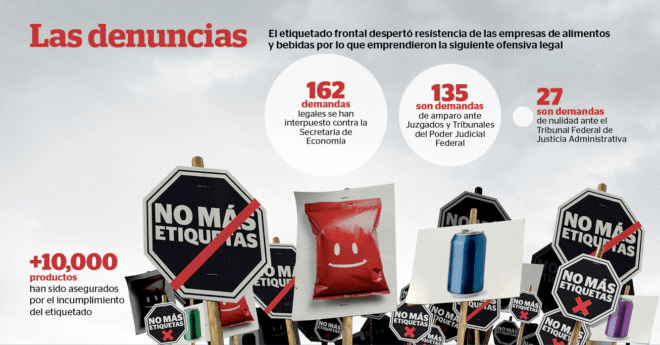
The Ministry of Economy is facing 162 lawsuits seeking to overturn the regulatory changes underpinning the new front-end labeling of prepackaged food and non-alcoholic beverages that went into effect in 2020, however, it reserved the identity of the plaintiffs and the companies or groups they represent.
Of the 162 lawsuits mentioned above, 135 are amparo lawsuits, which are filed in different administrative courts and tribunals of the Federal Judicial Branch, and 27 are nullity lawsuits, filed before the Federal Court of Administrative Justice”.
 infoAlimentario