To present the results of the effectiveness of 4 front-end nutrition labeling systems on prepackaged foods and non-alcoholic beverages in Costa Rica to government decision makers, legislators and civil society.
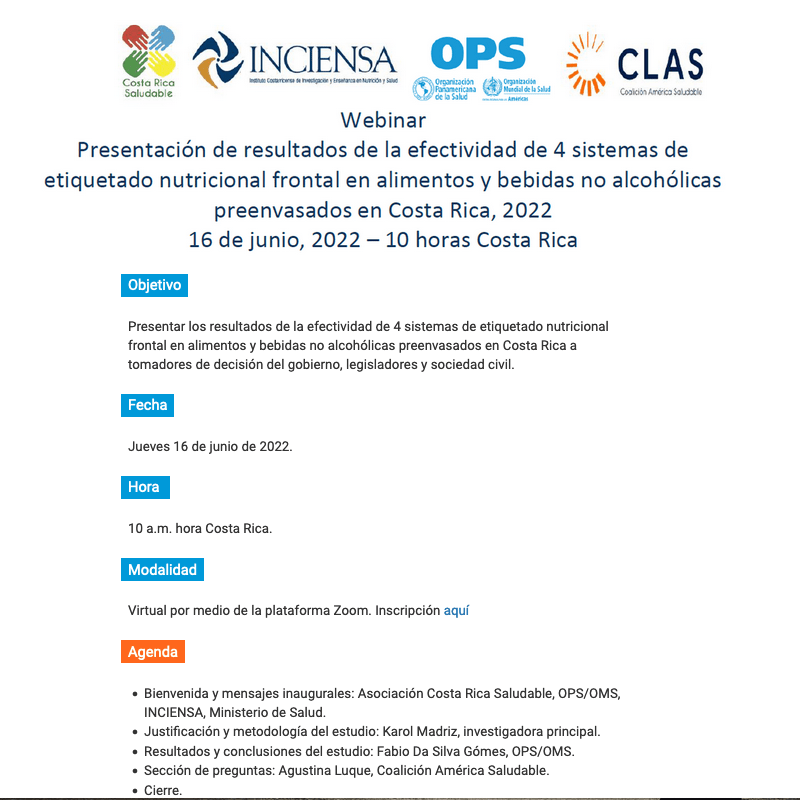
To present the results of the effectiveness of 4 front-end nutrition labeling systems on prepackaged foods and non-alcoholic beverages in Costa Rica to government decision makers, legislators and civil society.
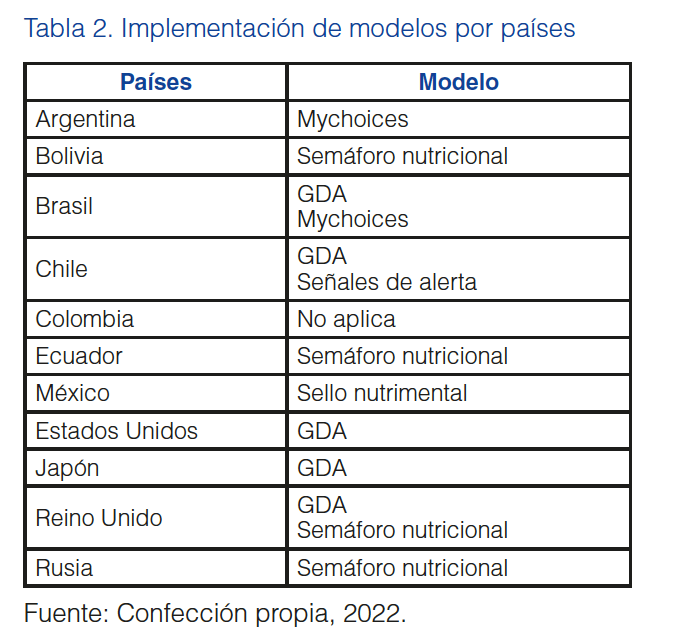
In the communication between producers and consumers, food labeling is fundamental since it allows to know the conformation and nutritional facts of food products. This work is carried out to develop a comparative study on the laws of front labeling as a guarantee of legal protection to consumers, it is a study of doctrinal and jurisprudential review on the protection of the right to health of consumers. It can be evidenced that the main models of front labeling are interpretative, non-interpretative, semi-interpretative and hybrid, of which the most used are the food guides and nutritional traffic lights. The guide system is used in Brazil, Chile, the United States, Japan and Great Britain, while the traffic light system is more widely used in Bolivia, Ecuador, Mexico and Russia.
The members of the Congressional Health Committee approved in general, the bill that provides for the obligation to fortify certain foods with vitamin D. The proposal will now be studied in particular by the same body after the Chamber authorized to continue with its review.
Specifically, the project establishes that:
“Producers of milk and its derivatives of dairy origin, as well as those of wheat flour, cereals and vegetable oils, shall fortify or add, in the amounts defined by the competent authority, the vitamins and minerals required for most human cellular functions, especially vitamin D”.
At the end of last week, the Ministry of Health announced the contracting of the University of Antioquia through its Department of Nutrition and Dietetics to study “the best scientific evidence available and free of conflict of interest” and, according to the conclusions, to move forward with the regulation of Law 2120, particularly in what has to do with labeling.

The objective of this research is to examine, collate and organize the main Brazilian regulations and food safety literature, highlighting key challenges for the Brazilian food industry. This is a qualitative study, using a specific procedure and an intentional sampling for data collection and analysis of open textual information. The results of this research show that there is some important challenges for the food industry, especially with regard to the general requirements that are applicable to any organization in the food chain, such as good manufacturing practices (GMP) standards and programs operational hygiene (SSOP), identification and analysis of risks of contamination and system hazard analysis and critical control points (HACCP).

 infoAlimentario