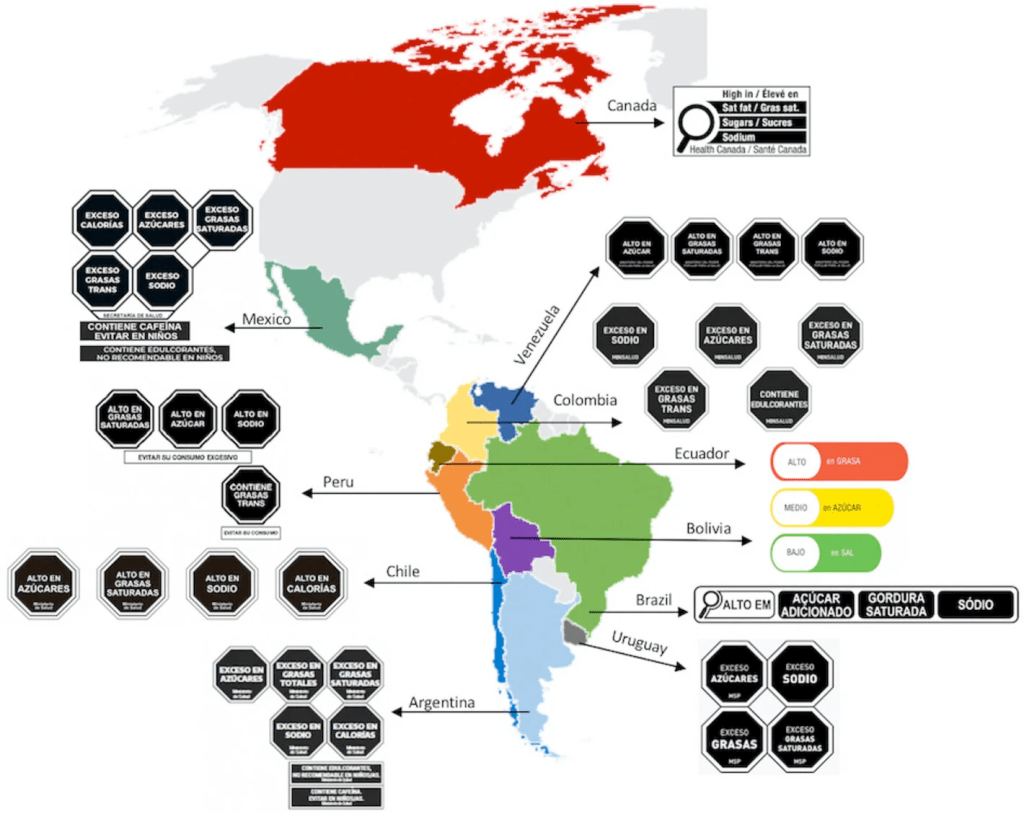
Poor nutrition is one of the leading causes of non-communicable diseases (NCDs), especially in the WHO Region of the Americas (AMRO). In response, international organisations recommend front-of-pack nutrition labelling (FOPNL) systems that present nutrition information clearly to help consumers make healthier choices. In AMRO, all 35 countries have discussed FOPNL, 30 countries have formally introduced FOPNL, eleven have adopted FOPNL, and seven countries (Argentina, Chile, Ecuador, Mexico, Peru, Uruguay and Venezuela) have implemented FOPNL. FOPNL has gradually spread and evolved to better protect health by increasingly adopting larger warning labels, contrasting background devices for better salience, using “excess” instead of “high in” to improve efficacy, and adopting the Pan American Health Organization’s (PAHO) Nutrient Profile Model to better define nutrient thresholds. Early evidence illustrates successful compliance, decreased purchases and product reformulation. Governments still discussing and waiting to implement FOPNL should follow these best practices to help reduce poor nutrition related NCDs.
PAHO – Adoption of front-of-pack nutrition warnings can help decrease obesity, cardiovascular disease, type-2 diabetes and some cancers in the Americas
The adoption of best practice front-of-pack nutrition labeling in more countries of Americas can help reduce poor-nutrition related non-communicable diseases (NCDs) such as cardiovascular disease, type-2 diabetes, high blood pressure and some cancers in the region, a recent study led by researchers at the University of Nevada, Reno and the Pan American Health Organization (PAHO) suggests.
The study, published today in the Lancet Regional Health Americas, examined the evolution of these policies within the PAHO/World Health Organization Region of the Americas (AMRO).
Improvements to front-of-pack nutrition labeling (FOPNL) included larger warning labels, contrasted background for better noticeability, use of “excess” instead of “high in” to improve understanding, and adoption of PAHO’s nutrient profile model to better define nutrient thresholds. FOPNL systems aim to aid a population’s understanding of nutritional content in a product, reduce consumption of ultra-processed and processed food products high in fats, sugars and/or salt, and ultimately help consumers make healthier choices.
Opinion – CARICOM’s front-of-package labelling conundrum
It has been four years since the Caribbean Community (CARICOM) began discussions on the adoption of a front-of-package labelling system to protect population health in the region. As a public- and global-health lawyer, I can confidently characterise this process as one that has only legitimised and prioritised the interests of private actors to the detriment of society.
For starters, the private sector has recently secured a privileged seat and further strengthened its power with the designation of the Caribbean Private Sector Organisation (CPSO) as an Associate Institution of CARICOM. This has, of course, facilitated corporate capture by giving them high-level policymaker access to lobby and delay the process of the adoption of a front-of-package nutrition labelling system. This additional avenue of participation, which is not available to other interested parties, such as regional civil society organisations, has fostered an unequal power imbalance that challenges the foundations of democracy and is at odds with public health policymaking best practices.

Article/Bazil – Learning about food labels about food and nutrients: the use of labeling in research education
The function of labels is to guide consumers to understand food ingredients and promote healthy food choices. However, this does not mean that consumers use labels as a tool to choose which foods should be part of their diet. This investigative activity will address cellular biochemistry content – water and minerals, vitamins, carbohydrates, lipids, proteins, vitamins, and nucleic acids. The proposal will have a duration of 4 classes, and students will be divided into food groups, where after the exposure of images of unprocessed, processed and ultra-processed foods made by the teacher, the groups will create a label of the type of food designated for each group. Next, the teacher will challenge the students with a guiding question, and from this question they will develop hypotheses. The students will use real labels of foods that make up their diet to answer a questionnaire and compare the information on the real labels with the label they produced. A text will be produced reporting if after the research and activities done by the students, their hypotheses were right or not. Finally, there will be a round of conversation in which students can orally explain the difference between the label created by them and the real label. It is hoped that this proposal, based on the reading and analysis of food/beverage labels present in their diet, will alert and make students aware of the importance of having good eating habits, giving priority to unprocessed or minimally processed foods that contain nutrients necessary for the proper functioning of their bodies.
Article – Carbohydrate content and ingredient profile of supposedly “low-carb” food products in Brazil
Purpose
This study aims to evaluate the carbohydrate content, ingredient profile and degree of processing of supposedly “low-carb” foods in the Brazilian market.
Design/methodology/approach
Information was collected from physical supermarkets in Divinópolis, Minas Gerais and on websites throughout Brazil between July and September/2020. The carbohydrate content was assessed in g/100 g, and ingredient lists were investigated for the presence of carbohydrate-rich ingredients. The degree of processing of the products was evaluated by NOVA classification to determine whether the term “low carb” had been translated into Portuguese.
Findings
This study evaluated a total number of 164 products, the most frequent were bakery products (34.7%), granola and cereal bars (19.5%) and candies and desserts (14.0%). This claim was also found in low-carb foods such as cheese and chicken. Most food products evaluated (56.0%) were classified as ultra-processed, with the group having the highest carbohydrate content (20.0; 3.0–47.5g/100g), compared to products classified as processed foods (p < 0.01). The ingredient lists showed items rich in carbohydrates, such as cassava and corn derivatives. In 162 products, a low-carb claim was displayed without translation into Portuguese. These data demonstrate that most of these products are ultra-processed and have a high glycidic content.
 infoAlimentario