Ecuador – Draft revisions and amendments to alcoholic beverage standards

The Ecuadorian Standardization Service (INEN) has published several draft standards on alcoholic beverages such as Whisky, Liquors, Fruit wine, Rum and Cocktails or mixed alcoholic beverages and aperitifs.

  • NTE INEN 365 (Amendment 1).  Alcoholic beverages. Whisky. Requirements.  This standard establishes the requirements for whiskey to be considered fit for human consumption.   

  • NTE INEN 1837 (3rd revision). Alcoholic beverages. Liquors. Requirements. This standard establishes the requirements for liquors considered fit for human consumption. 

  • NTE INEN 374 (amendment 1). Alcoholic beverages. Fruit wine. Requirements. This standard establishes the requirements for fruit wine.

  • NTE INEN 363 (amendment 1). Alcoholic beverages. Rum. Requirements. This standard establishes the requirements for rum considered fit for human consumption.

  • NTE INEN 2802 (amendment 1). Alcoholic beverages. Cocktails or mixed alcoholic beverages and aperitifs. Requirements. This standard establishes the requirements for alcoholic beverages known as cocktails or mixed alcoholic beverages and aperitifs, both domestically produced and imported, that are marketed in the country.
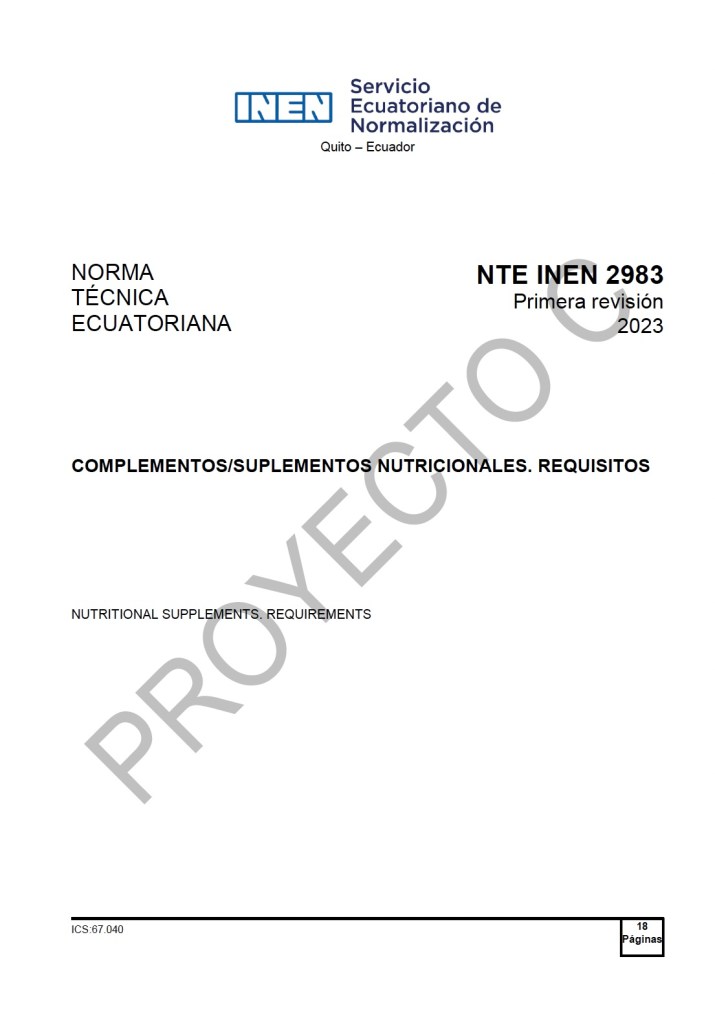
Ecuador – Draft revised standard on dietary supplements

The Ecuadorian Standardization Service (INEN in Spanish) has published a draft revision of NTE INEN 2983 (1st Revision) Complementos/ suplementos nutricionales. Requirements. This standard establishes the requirements for nutritional complements/supplements. This standard does not apply to foods for special diets.

Screenshot

Mexico – New decree prohibits the use of transgenic corn for human consumption

Through the Official Journal of the Federation, President Andrés Manuel López Obrador issued an order to revoke and no longer grant authorizations for the use of genetically modified corn intended for human consumption, as well as the use of glyphosate, a herbicide widely used in the field.

This decree replaces one from December 2020 and its objective, the Ministry of Economy (SE) subsequently detailed in a press release, is to specify the objective and scope of public policies, as well as to “eliminate any possible imprecision of the predecessor text, which lent itself to diverse interpretations”.

The decree, he explained, is strictly limited to corn, so that canola, soybean, cotton and the rest of the raw materials are not subject to this regulation. In addition, to avoid confusion, the decree establishes a categorization of corn according to its use: human food (dough and tortillas), fodder and industrialized corn for human food.

Article – Socioeconomic and Demographic Factors Associated with the Influence of the Food Traffic Light Labeling on the Decision of the Adult Population of Ecuador to Purchase Processed Foods, 2018

Abstract

To determine the socioeconomic and demographic factors associated with the influence of the nutritional traffic light (NTL) on the decision to purchase processed foods using information from the National Health and Nutrition Survey (ENSANUT) 2018 of Ecuador, a cross-sectional and analytical study based on a secondary analysis of the information from the ENSANUT 2018 was performed. We collected data from 25,932 participants 18 years of age or older who knew or had seen the NTL, and for whom complete information on the variables of interest for the study was available. The “Influence of the NTL on the purchase decision of processed foods” was the outcome variable of the study. Generalized linear models of the Poisson family, with log link, were used to assess the association between socioeconomic factors and outcome, using crude (PR) and adjusted (aPR) prevalence ratios, with 95% confidence intervals (CI) and a p-value < 0.05. Participants who understood the NTL (aPR: 2.49; 95% CI: 2.19–2.83), with a higher educational level (aPR: 1.33; 95% CI: 1.09–1.61), women (aPR 1.06; 95% CI: 1.01–1.10), and who had a partner (aPR 1.09; 95% CI: 1.04–1.14) were more likely to be influenced by the NTL when deciding to purchase processed foods, compared to people who did not understand the NTL, who had no educational level or who only attended a literacy center, were men, and those without a partner. The inhabitants of the coastal region (aPR: 0.92; 95% CI: 0.88–0.97), the Amazon (aPR 0.93; 95% CI: 0.88–0.98), and the insular region (aPR 0.76; 95% CI: 0.68–0.84) had few probabilities of being influenced by the NTL in the decision to purchase processed foods, in comparison with the residents of the highlands. Similarly, compared to non-poor people, poor people had a lower probability of being influenced by the NTL (aPR 0.89; 95% CI: 0.82–0.97). Factors associated with the influence of NTL on the decision to purchase processed foods were identified. It is recommended to reformulate and focus awareness strategies for using the NTL to purchase processed foods by taking into account the associated factors.

Article – Food Sovereignty: Rights as instruments in Argentina’s Constitution

Abstract: This article analyzes how certain rights enshrined in Argentina’s Constitution may play a role in supporting the implementation of Food Sovereignty in a national space. First, the article describes the main elements of Food Sovereignty and the ambiguous situation of law in the movement. After describing Argentina’s constitutional system, with special reference to social rights, the article links every main element of Food Sovereignty with one or more constitutional rights that could serve as a defense against policies detrimental to Food Sovereignty or as an instrument to promote or protect the implementation of this new food system.