USA – FDA Issues Second Procedural Notice on Consumer Research on Front-of-Package Labeling

The U.S. Food and Drug Administration has issued a 30-day procedural notice on its plans to conduct a study entitled “Quantitative Research on Front of Package Labeling on Packaged Foods.” The study is a follow up to focus groups conducted in 2022 to further explore consumer responses to various front-of-package labeling schemes. As part of the Paperwork Reduction Act, federal agencies are required to publish a notice in the Federal Register on each proposed information collection to give the public the opportunity to comment.

The FDA is conducting this consumer research to help explore the development of a front-of-package labeling scheme, which is part of the National Strategy on Hunger, Nutrition, and Health, issued as part of the White House Conference held in September 2022 focused on ending hunger and reducing diet-related disease. Front-of-package labeling is intended to complement the Nutrition Facts label on packaged foods by giving consumers additional context to help them identify healthier food selections. A standardized, science-based scheme could help consumers, particularly those with less nutrition knowledge, quickly and easily identify foods that can help them build a healthy eating pattern. The experiences of countries worldwide that have adopted front-of-package labeling suggest that such labeling may help nutrition comprehension and the ability to make healthier choices.

USA – FDA Issues Draft Guidance on Dietary Guidance Statements on Food Labels

The U.S. Food and Drug Administration (FDA) is extending the comment period for the Draft Guidance for Industry entitled “Questions and Answers About Dietary Guidance Statements in Food Labeling” that appeared in the Federal Register on March 27, 2023. The new deadline for comments is September 25, 2023. The FDA is extending the comment period by 90 days in response to multiple requests from stakeholders to allow additional time for interested persons to develop and submit comments. Comments should be submitted to Regulations.gov and identified with the docket number FDA-2023-D-1027.

Peru – Congress sends to the Executive Power the Law that regulates the elaboration and commercialization of foodstuffs of special regimes for vulnerable populations

Law 1941 was sent to the Executive Power for its enactment. Next Tuesday, May 30 is the deadline for the Executive Branch to observe or publish the Law that allows baby formulas and dairy supplements not to carry the warning octagons that allow consumers to know if they are high in sugar, sodium, carbohydrates or other components harmful to health.
According to the glossary of terms contained in the initiative, special diet foods “are foods or beverages specially made or prepared to satisfy particular dietary needs determined by particular physical or physiological conditions and/or specific diseases or disorders and presented as such”.
This decision was made despite the fact that the current Healthy Food Law states that if foods meet or exceed the levels of sugar, sodium and saturated fats, they must bear the warning octagons.

Article – Front-of-package Label in Brazil: Comparison of Guideline Daily Amounts, Traffic-light and Warning Systems

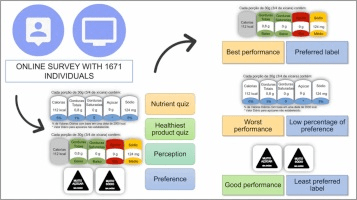
Chronic non-communicable diseases (NCDs) are considered a global public health problem related to dietary factors. In this sense, front-of-package (FOP) labeling is a valuable tool to help consumers assess food products’ composition and make healthier choices. The mandatory FOP labeling adoption process in Brazil was initiated in 2014 and ended in 2020. This work aims to evaluate consumer’s perception and preference towards three different FOP label systems (Guideline Daily Amounts (GDA), Traffic-Light (TL), and Triangular Warnings (TW)) and identify which one is more effective in improving consumer’s understanding. An online survey with 1671 participants was conducted with a nutrient quiz, a healthiest product quiz, and questions about perception and preference. Data were analyzed using chi-square tests, analysis of variance, and logistic regression. TL performed better on the nutrient quiz than GDA. On the healthiest product quiz, TL and TW had a higher rate of correct answers. GDA was considered helpful in deciding which product to buy. TL was considered easy and quick to understand. TW was considered incomplete but helpful in deciding which product to buy. TL was the preferred label, followed by GDA and TW. The evidence from the present study highlights TL and TW’s potential to help consumers understand the products’ nutritional profile. However, any FOP label implementation must be accompanied by educational campaigns to ensure the population can understand and use it effectively.

Uruguay – PAHO/WHO delegation made recommendations on draft laws on healthy eating habits

A delegation from the Pan American Health Organization (PAHO/WHO) appeared before the Public Health and Social Assistance Commission of the Uruguayan House of Representatives to give its opinion on bills related to food and obesity, particularly on “Healthy eating habits”.
They also congratulated the proposal to prohibit the marketing of foods with sweeteners, caffeine and with excess of critical nutrients in educational centers. For the representatives, the ban should also apply to beverages and they suggested replicating it in other environments, such as state agencies that provide collective food services or make food purchases.