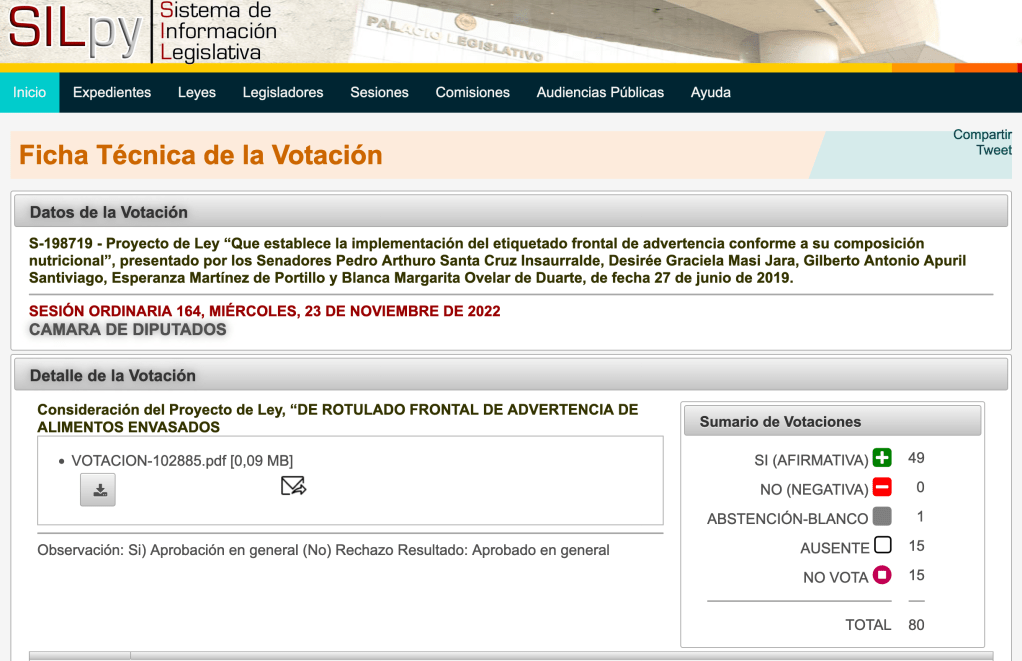
Paraguay – The Senate approved the bill on front labeling of packaged foods

The Senate approved the law on front labeling of packaged foods, with the amendments introduced in the House of Representatives. With this version, products will no longer carry the inscription “high in calories”, since they will have the exact amount of calories.

The head of the Public Health Commission, Jorge Querey, insisted on the need to establish mandatory labeling, according to the nutritional composition of sugars, saturated fats and sodium, incorporating the information of the “high calorie” content, in a visible, quick and easily understandable way for the consumer’s decision making.
Codex – Codex labeling standard: changes in allergen labeling

Together with scientific advice from FAO/WHO, the Codex Committee has for some time been thoroughly analyzing different aspects of the current regulations on mandatory labeling of prepackaged foods, mainly in terms of allergen declaration.

Codex – REPORT OF THE 15th SESSION OF THE CODEX COMMITTEE ON CONTAMINANTS IN FOODS

The Codex Committee on Contaminants in Foods (CCCF) held its 15 th Session virtually, from 9 to 13 and 24 May 2022,
at the kind invitation of the Government of The Netherlands. The session was chaired by Dr. Sally Hoffer, Manager, Food
Safety and Sustainable Food, Directorate Plant Agro Food Chains, Ministry of Agriculture, Nature and Food Quality, The
Netherlands. The session was attended by 85 Member Countries, 1 Member Organization and 17 observer organizations
and Palestine. The list of participants is contained in Appendix I.

USA – Filing of Color Additive Petition From Environmental Defense Fund, et al.; Request To Revoke Color Additive Listing for Use of Titanium Dioxide in Food

The Food and Drug Administration (FDA or we) is announcing that we have filed a color additive petition, submitted by Environmental Defense Fund, et al., proposing that FDA repeal the color additive regulation providing for the use of titanium dioxide in foods.

Under section 721(d)(1) of the Federal Food, Drug, and Cosmetic Act (FD&C Act) (21 U.S.C. 379e(d)(1)), we are giving notice that we have filed a color additive petition (CAP 3C0325), submitted by Environmental Defense Fund, Center for Environmental Health, Center for Food Safety, Center for Science in the Public Interest, and Environmental Working Group, c/o Tom Neltner, 1875 Connecticut Ave. NW, Washington, DC 20009. The petition proposes that we repeal the color additive regulation for titanium dioxide in § 73.575 (21 CFR 73.575), which permits the use of titanium dioxide in foods.

Brazil – Draft on safety and authorization for the use of novel foods and new ingredients

Brazilian Health Regulatory Agency (ANVISA) published Draft resolution N°1158 on safety and authorization for the use of novel foods and novel ingredients.

The text submitted for public consultation brings a series of regulatory novelties, among which the following stand out:

  • The improvement of the definition of novel foods and ingredients, reinforcing that they are those that do not have a history of safe consumption in Brazil and including a list of the different sources of procurement and situations in which they can be classified;
  • The inclusion of other conceptual bases relevant to the application of the legal concept of novel foods and novel ingredients, with emphasis on the history of safe food consumption, food purpose, therapeutic purpose, selective extraction or concentration, significant modification and nanomaterial;
  • Creation of an administrative procedure that allows companies to consult the classification of a certain food or ingredient as novel, with confirmed answers published on the Anvisa portal;
  • Detailing safety assessment requirements, according to the nature and complexity of novel foods and novel ingredients;
  • Incorporation into the regulation of optimized analysis procedures, with flexibility of regulatory requirements for novel foods and novel ingredients that combine characteristics that increase the certainty of safe use or reduce existing uncertainties;