The Ministry of the Interior and Public Safety has published Decree No. 98/2023 approving the Regulations of Articles 40 bis and 40 ter of Law No. 19,925 on the sale and consumption of alcoholic beverages.
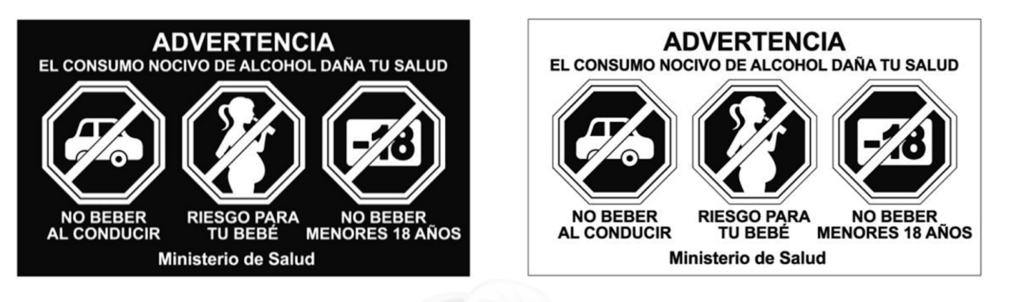
As in the case of food containers, alcoholic beverages -equal or higher than 0.5° alcohol content- shall have octagonal black and white seals, which in this case shall read as follows:
“Do not drink while driving” (accompanied by the crossed-out drawing of a car) will be written on these stamps,
“Risk for your baby” (accompanied by the crossed-out drawing of a pregnant woman drinking).
The Ministry of Development, Industry and Commerce (MIFIC) published in public consultation the Central American Technical Regulation: NTON/RTCA 67.04.79:23 Dairy Products. Yogurt (Yogurt, Yogurth, Yoghurt, Yogourt). Specifications for adoption in national regulations. This RTCA establishes the technical specifications to be met by yoghurt, based on the definition in numeral 4.1 of the based on the definition contained in numeral 4.1 of the technical regulation. technical regulation. The regulation provides elements for the classification and composition of yogurt. It applies to y ogurt destined for direct human consumption or further processing in the territory of the territory of the States Parties.
The National Health Surveillance Agency (in Portuguese) promoted a virtual sectoral dialogue on added sugars. The event was attended by around 550 representatives from different segments of society, including the productive sector, civil society, universities and federal public administration agencies.
Doubts were clarified on the nutritional labeling of added sugars, as well as other points on the declaration of added sugars that require treatment in Mercosur. The purpose of the meeting was also to gather contributions from the different agents interested or affected by the issue, in order to improve the implementation of nutrition labeling standards and also to assist in the negotiation of the issue with the other Mercosur Member States.
The recording of the sectorial dialogue promoted by the National Health Surveillance Agency (ANVISA in Portuguese) on June 28 is now available, to clarify doubts about the Public Consultation (CP) 1.158/2023. The consultation deals with the proposed standard that modernizes the rules, flows and procedures for accrediting the safety and authorization of use of novel foods and novel ingredients.
During the sectorial dialogue, the main doubts already received during the PC were presented, with technical clarifications on the subject. The purpose of the virtual event was to make the most of the remaining quotation period. There was also space for answers to questions raised by participants during the meeting.
Public consultation
The deadline for PC contributions is July 31 of this year. To contribute, simply access the form available on the Public Consultation 1.158/2023 page.
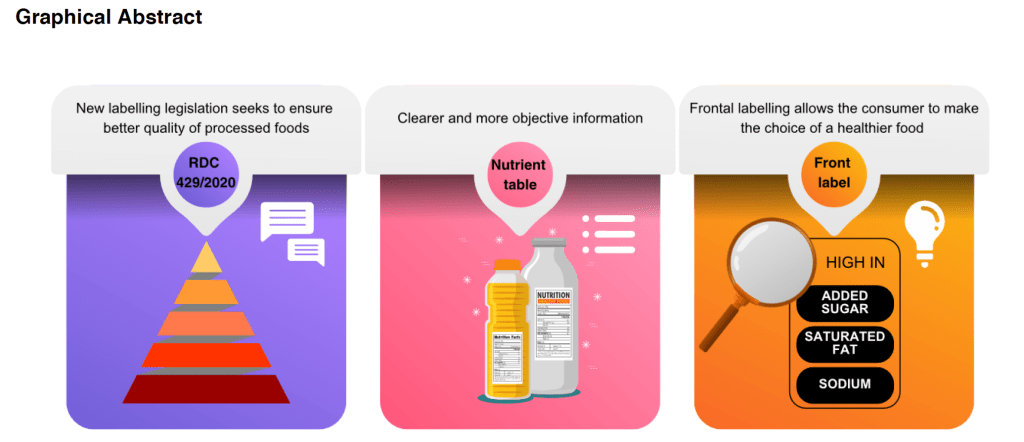
Food product labels, widely used in advertising and marketing actions, play an important role in ensuring the population’s health. The industry communicates with the consumer through it by highlighting the main characteristics of the food, in addition to information regarding the chemical and nutritional composition of the product. Thus, this study aimed to discuss the impact of the new Brazilian legislation for food labeling provided by ANVISA’s RDC 429/2020 on access to nutritional information based on a literature review in digital collections of scientific publications, such as SciELO (Scientific Electronic Library Online), LILACS (Latin American and Caribbean Literature on Health Sciences), and BVS (Virtual Health Library). A time frame of 10 years (2013-2023) was used. It was possible to see that food labeling has evolved over the past decades, always with the aim of providing consumers with a better understanding of what they are eating. Furthermore, RDC 429/2020 brought new mandatory information to the nutrition table, especially with front labeling for foods with high added sugars, saturated fats, and/or sodium content. A positive impact is expected with its fulfillment, which may enable easy access to information for consumers, who will make a more conscious choice about the food products they intend to consume. Therefore, considering avoiding frontal labeling, the food industry will be obliged to reduce the percentage of these compounds, improving the nutritional quality of commercialized products.
 infoAlimentario