The Ministry of Development, Industry and Commerce (MIFIC in Spanish) published the draft standard NTON 03003 Meat and Meat Products. Meat of Poultry (Gallus gallus domesticus), slaughtered whole, its cuts and giblets for Human Consumption. Sanitary and Safety Requirements.
The purpose of the standard is “to establish the safety requirements to be met by poultry (Gallus gallus domesticus) prepared whole or cut, and their offal, intended for human consumption, as well as the sanitary requirements to be met by processing establishments”.
Article – Communication and challenges of ngo in Brazil, Colombia,United States and Mexico: the case of misleading advertising in ultra-processed foods
This article analyzes the actions that the Non-Governmental Organization (NGO) that pro-tect Consumer Rights in Brazil, Colombia, the United States and Mexico perform against misleading advertising in ultra-processed foods. This type of food promotes unhealthy eat-ing habits for children; causes excess weight to be a determining risk factor for chronic noncommunicable diseases (NCDs); and affects the health and quality of life of the popu-lation. Ultraprocessed foods, are considered to be the main factor in the epidemic called globesity, which is why ngo that protect Consumer Rights have made efforts to counteract the misleading communication and advertising strategies followed by the ultraprocessed food industry. The methodology of the study is of qualitative nature through in-depth in-terviews with the directors of six ngo from the aforementioned countries. The study includes the main actions thatngocarry out to demonstrate, inform, persuade and exert pressure on the food processing industry underlining the importance of communication and education in the work of defending consumer rights and the need for incorporate digi-tal media in its activity of information, feedback, manifestation and linking of parents, aca-demic communities, public opinion, legislative groups, government authorities and society in general.
Article/Brazil – (In) safety of labeling of cereal-based infant foods in relation to current brazilian legislation
Introduction: Cereals are widely used in children’s nutrition. Objective: to evaluate the nutritional composition and labeling of cereal-based infant foods, in relation to current legislation. Material and Methods: cross-sectional, analytical and descriptive study that evaluated cereal-based foods, as well as labeling compliance with current Brazilian legislation. Results: 72 food samples were evaluated: cereal for baby food; mixture for the preparation of porridge and cereal flour. One hundred percent of the samples showed some non-compliance with the legislation, including the presence of a false concept of advantage and safety, illustrations not allowed, absence of mandatory warnings and, absence of the minimum age for consumption of the product. In bromatological and labeling analyses, the carbohydrate content of all categories exceeded 80% of the total energy value of the product. The protein, lipid, carbohydrate and energy contents of the cereal category for infant feeding showed significant differences, being, respectively, p=0.015, p<0.001, p=0.013 and p<0.001. The mix category for porridge preparation also showed significant differences for proteins, lipids, carbohydrates and energy (p<0.001). In the category of cereal flours, only the protein content showed a difference (p=0.05).
Conclusion: considering the sample universe of the study, it is possible to conclude that even in the presence of specific legislation, we still find legal non-conformities in the labeling of cereal-based foods intended for infant feeding, and these foods have a nutritional composition different from the information presented on their labels, negatively impacting children’s food safety.
Canada – Guidance document: Supplemented Foods Regulations
This guidance document is intended for stakeholders, including manufacturers and distributors of foods for sale in Canada, to facilitate the understanding of the Supplemented Foods Regulations, which came into force on July 21, 2022.
The Supplemented Foods Regulations should be read in conjunction with other provisions of the FDR applicable to pre-packaged products as well as the FDA and the documents incorporated by reference into the FDR (List of Permitted Supplemental Ingredients, List of Permitted Supplemented Food Categories, Directory of Supplemented Food Facts Table Formats, and Directory of Supplemented Food Caution Identifier Specifications), listed in Appendix 1. To account for new requirements specific to SFs in the FDR, certain consequential amendments had to be made to existing provisions in the FDR (for example, expanding labelling provisions in Part B, Division 1 applicable to the Nutrition Facts table to include the Supplemented Food Facts table). This document does not elaborate on these consequential amendments. Health Canada’s webpage on Supplemented Foods provides information and resources related to the requirements for SFs.
It is the responsibility of manufacturers and distributors to comply with all applicable legislative and regulatory requirements. In case of a discrepancy between this guidance and the provisions of the FDR or documents incorporated by reference, the regulations and the documents incorporated by reference take precedence.
In this guidance document, “must” is used to express a requirement, that is, a provision of the FDR that the manufacturer or distributor is obliged to satisfy; “should” is used to express a recommendation or that which is advised but not required; and “may” is used to express an option or that which is permissible within the limits of this document.

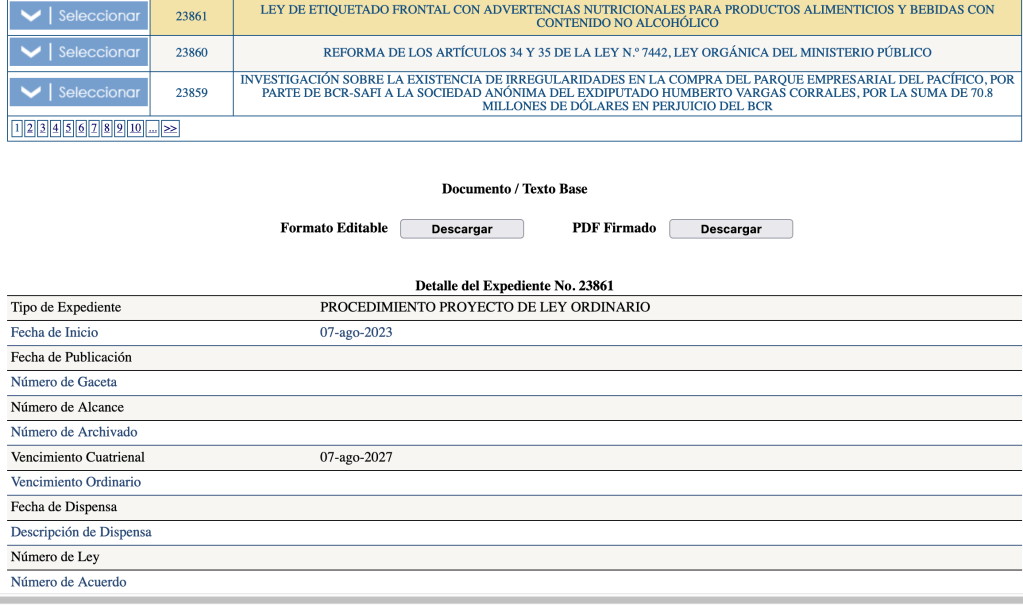
Costa Rica – Food labeling bill introduced in the legislature
Representative Andrea Álvarez of the National Liberation Party, presented bill No. 23861, for front labeling with nutritional warnings on food products and non-alcoholic beverages. According to the legislator, the project will label with octagons the products high in fats, sugars, calories, sodium or others. Products that do not exceed the levels already established worldwide based on scientific studies, would not have these seals that alert the consumer about the contents of critical nutrients.
 infoAlimentario